 Add to Chrome
 Add to Firefox
 Add to Edge
Context-Enriched Natural Language Descriptions of Vessel Trajectories
Mar 08, 2026
We address the problem of transforming raw vessel trajectory data collected from AIS into structured and semantically enriched representations interpretable by humans and directly usable by machine reasoning systems. We propose a context-aware trajectory abstraction framework that segments noisy AIS sequences into distinct trips each consisting of clean, mobility-annotated episodes. Each episode is further enriched with multi-source contextual information, such as nearby geographic entities, offshore navigation features, and weather conditions. Crucially, such representations can support generation of controlled natural language descriptions using LLMs. We empirically examine the quality of such descriptions generated using several LLMs over AIS data along with open contextual features. By increasing semantic density and reducing spatiotemporal complexity, this abstraction can facilitate downstream analytics and enable integration with LLMs for higher-level maritime reasoning tasks.

Data-Driven Trajectory Imputation for Vessel Mobility Analysis
Feb 12, 2026Modeling vessel activity at sea is critical for a wide range of applications, including route planning, transportation logistics, maritime safety, and environmental monitoring. Over the past two decades, the Automatic Identification System (AIS) has enabled real-time monitoring of hundreds of thousands of vessels, generating huge amounts of data daily. One major challenge in using AIS data is the presence of large gaps in vessel trajectories, often caused by coverage limitations or intentional transmission interruptions. These gaps can significantly degrade data quality, resulting in inaccurate or incomplete analysis. State-of-the-art imputation approaches have mainly been devised to tackle gaps in vehicle trajectories, even when the underlying road network is not considered. But the motion patterns of sailing vessels differ substantially, e.g., smooth turns, maneuvering near ports, or navigating in adverse weather conditions. In this application paper, we propose HABIT, a lightweight, configurable H3 Aggregation-Based Imputation framework for vessel Trajectories. This data-driven framework provides a valuable means to impute missing trajectory segments by extracting, analyzing, and indexing motion patterns from historical AIS data. Our empirical study over AIS data across various timeframes, densities, and vessel types reveals that HABIT produces maritime trajectory imputations performing comparably to baseline methods in terms of accuracy, while performing better in terms of latency while accounting for vessel characteristics and their motion patterns.
On Vessel Location Forecasting and the Effect of Federated Learning
May 30, 2024The wide spread of Automatic Identification System (AIS) has motivated several maritime analytics operations. Vessel Location Forecasting (VLF) is one of the most critical operations for maritime awareness. However, accurate VLF is a challenging problem due to the complexity and dynamic nature of maritime traffic conditions. Furthermore, as privacy concerns and restrictions have grown, training data has become increasingly fragmented, resulting in dispersed databases of several isolated data silos among different organizations, which in turn decreases the quality of learning models. In this paper, we propose an efficient VLF solution based on LSTM neural networks, in two variants, namely Nautilus and FedNautilus for the centralized and the federated learning approach, respectively. We also demonstrate the superiority of the centralized approach with respect to current state of the art and discuss the advantages and disadvantages of the federated against the centralized approach.
Monitoring of Underwater Critical Infrastructures: the Nord Stream and Other Recent Case Studies
Feb 03, 2023

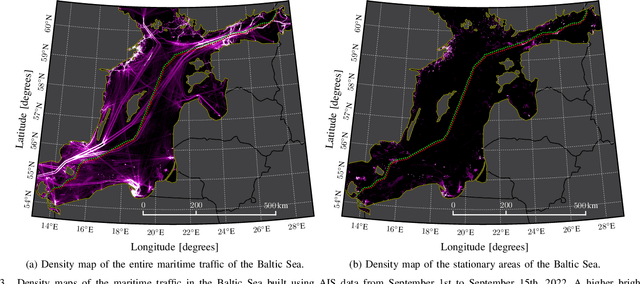

The explosions on September 26th, 2022, which damaged the gas pipelines of Nord Stream 1 and Nord Stream 2, have highlighted the need and urgency of improving the resilience of Underwater Critical Infrastructures (UCIs). Comprising gas pipelines and power and communication cables, these connect countries worldwide and are critical for the global economy and stability. An attack targeting multiple of such infrastructures simultaneously could potentially cause significant damage and greatly affect various aspects of daily life. Due to the increasing number and continuous deployment of UCIs, existing underwater surveillance solutions, such as Autonomous Underwater Vehicles (AUVs) or Remotely Operated Vehicles (ROVs), are not adequate enough to ensure thorough monitoring. We show that the combination of information from both underwater and above-water surveillance sensors enables achieving Seabed-to-Space Situational Awareness (S3A), mainly thanks to Artificial Intelligence (AI) and Information Fusion (IF) methodologies. These are designed to process immense volumes of information, fused from a variety of sources and generated from monitoring a very large number of assets on a daily basis. The learned knowledge can be used to anticipate future behaviors, identify threats, and determine critical situations concerning UCIs. To illustrate the capabilities and importance of S3A, we consider three events that occurred in the second half of 2022: the aforementioned Nord Stream explosions, the cutoff of the underwater communication cable SHEFA-2 connecting the Shetland Islands and the UK mainland, and the suspicious activity of a large vessel in the Adriatic Sea. Specifically, we provide analyses of the available data, from Automatic Identification System (AIS) and satellite data, integrated with possible contextual information, e.g., bathymetry, weather conditions, and human intelligence.