 Add to Chrome
 Add to Firefox
 Add to Edge
Designing Human-mediated AI Guidance: Ready Together for Personalized Family Emergency Preparedness
Aug 20, 2026
Artificial intelligence (AI) systems are increasingly used across domains to provide personalized information, recommendations, and decision support. However, in some contexts, AI-generated information may not be suitable for direct delivery to the final recipient. Instead, it may need to be interpreted, adapted, and communicated by a human who understands the recipient's needs, emotional state, and situational context. Human-AI interaction research has given less attention to situations in which a more knowledgeable human acts as an intermediary between an AI system and a less experienced or less informed recipient. We introduce the human-mediated AI guidance framework and explore it through Ready Together, an AI-supported family emergency preparedness system in which parents mediate AI-generated content for their children. The system is designed to provide personalized guidance and support parents in making emergency preparedness more interactive and understandable through guided activities and family-centered learning. The system design was informed by a qualitative, design-oriented research process involving semi-structured interviews and co-design activities. Findings identified challenges in family emergency preparedness, including difficulty discussing emergencies with children, uncertainty about providing appropriate explanations, and a preference for interactive learning activities. These findings informed the design of an interactive prototype, subsequently evaluated through a pilot study and a heuristic evaluation. Participants responded positively to the personalized recommendations and practical activities. Preliminary findings suggest that human-mediated AI guidance may support context-sensitive family preparedness while preserving parents' responsibility for interpreting, adapting, and communicating AI-generated information.

The Hidden Cost of Contextual Sycophancy: an AI Literacy Intervention in Human-AI Collaboration
May 21, 2026Large Language Models (LLMs) are increasingly used in educational settings as interactive tools for collaboration. However, their tendency toward sycophancy, aligning with user beliefs even when incorrect, raises concerns for learning and decision-making, especially for less knowledgeable users. This study investigates how sycophantic alignment emerges in authentic multi-turn human-AI interactions and whether interventions targeting increasing AI literacy and prompting competencies can mitigate its effects. In a controlled mixed-design experiment, 60 participants completed analytical survival ranking tasks by first generating individual rankings and then making final decisions after collaborating with an AI assistant, both before and after receiving either general or sycophancy-focused prompting training. Preliminary results show that LLMs are highly sensitive to user input: lower-quality initial responses lead to poorer AI advice, suggesting that the model mirrors or incorporates user reasoning rather than correcting it or offering better alternatives that are missing or less frequent in the conversation. Critically, the propagation of user errors into AI responses significantly reduced both the quality of AI feedback and final user task performance, revealing a form of contextual sycophantic dependence. While the intervention did not eliminate the propagation of contextual errors, it significantly improved AI advice by reducing the direct mirroring of incorrect user rankings. These findings suggest that prompting and AI literacy alone may be insufficient to ensure epistemically independent AI support, highlighting the need for system-level approaches that better promote critical engagement in human-AI collaboration.
PerspAct: Enhancing LLM Situated Collaboration Skills through Perspective Taking and Active Vision
Nov 11, 2025Recent advances in Large Language Models (LLMs) and multimodal foundation models have significantly broadened their application in robotics and collaborative systems. However, effective multi-agent interaction necessitates robust perspective-taking capabilities, enabling models to interpret both physical and epistemic viewpoints. Current training paradigms often neglect these interactive contexts, resulting in challenges when models must reason about the subjectivity of individual perspectives or navigate environments with multiple observers. This study evaluates whether explicitly incorporating diverse points of view using the ReAct framework, an approach that integrates reasoning and acting, can enhance an LLM's ability to understand and ground the demands of other agents. We extend the classic Director task by introducing active visual exploration across a suite of seven scenarios of increasing perspective-taking complexity. These scenarios are designed to challenge the agent's capacity to resolve referential ambiguity based on visual access and interaction, under varying state representations and prompting strategies, including ReAct-style reasoning. Our results demonstrate that explicit perspective cues, combined with active exploration strategies, significantly improve the model's interpretative accuracy and collaborative effectiveness. These findings highlight the potential of integrating active perception with perspective-taking mechanisms in advancing LLMs' application in robotics and multi-agent systems, setting a foundation for future research into adaptive and context-aware AI systems.
Who Sees What? Structured Thought-Action Sequences for Epistemic Reasoning in LLMs
Aug 20, 2025Recent advances in large language models (LLMs) and reasoning frameworks have opened new possibilities for improving the perspective -taking capabilities of autonomous agents. However, tasks that involve active perception, collaborative reasoning, and perspective taking (understanding what another agent can see or knows) pose persistent challenges for current LLM-based systems. This study investigates the potential of structured examples derived from transformed solution graphs generated by the Fast Downward planner to improve the performance of LLM-based agents within a ReAct framework. We propose a structured solution-processing pipeline that generates three distinct categories of examples: optimal goal paths (G-type), informative node paths (E-type), and step-by-step optimal decision sequences contrasting alternative actions (L-type). These solutions are further converted into ``thought-action'' examples by prompting an LLM to explicitly articulate the reasoning behind each decision. While L-type examples slightly reduce clarification requests and overall action steps, they do not yield consistent improvements. Agents are successful in tasks requiring basic attentional filtering but struggle in scenarios that required mentalising about occluded spaces or weighing the costs of epistemic actions. These findings suggest that structured examples alone are insufficient for robust perspective-taking, underscoring the need for explicit belief tracking, cost modelling, and richer environments to enable socially grounded collaboration in LLM-based agents.
Combining Deep Architectures for Information Gain estimation and Reinforcement Learning for multiagent field exploration
May 29, 2025
Precision agriculture requires efficient autonomous systems for crop monitoring, where agents must explore large-scale environments while minimizing resource consumption. This work addresses the problem as an active exploration task in a grid environment representing an agricultural field. Each cell may contain targets (e.g., damaged crops) observable from nine predefined points of view (POVs). Agents must infer the number of targets per cell using partial, sequential observations. We propose a two-stage deep learning framework. A pre-trained LSTM serves as a belief model, updating a probabilistic map of the environment and its associated entropy, which defines the expected information gain (IG). This allows agents to prioritize informative regions. A key contribution is the inclusion of a POV visibility mask in the input, preserving the Markov property under partial observability and avoiding revisits to already explored views. Three agent architectures were compared: an untrained IG-based agent selecting actions to maximize entropy reduction; a DQN agent using CNNs over local 3x3 inputs with belief, entropy, and POV mask; and a Double-CNN DQN agent with wider spatial context. Simulations on 20x20 maps showed that the untrained agent performs well despite its simplicity. The DQN agent matches this performance when the POV mask is included, while the Double-CNN agent consistently achieves superior exploration efficiency, especially in larger environments. Results show that uncertainty-aware policies leveraging entropy, belief states, and visibility tracking lead to robust and scalable exploration. Future work includes curriculum learning, multi-agent cooperation with shared rewards, transformer-based models, and intrinsic motivation mechanisms to further enhance learning efficiency and policy generalization.
Why am I seeing this? Towards recognizing social media recommender systems with missing recommendations
Apr 15, 2025Social media plays a crucial role in shaping society, often amplifying polarization and spreading misinformation. These effects stem from complex dynamics involving user interactions, individual traits, and recommender algorithms driving content selection. Recommender systems, which significantly shape the content users see and decisions they make, offer an opportunity for intervention and regulation. However, assessing their impact is challenging due to algorithmic opacity and limited data availability. To effectively model user decision-making, it is crucial to recognize the recommender system adopted by the platform. This work introduces a method for Automatic Recommender Recognition using Graph Neural Networks (GNNs), based solely on network structure and observed behavior. To infer the hidden recommender, we first train a Recommender Neutral User model (RNU) using a GNN and an adapted hindsight academic network recommender, aiming to reduce reliance on the actual recommender in the data. We then generate several Recommender Hypothesis-specific Synthetic Datasets (RHSD) by combining the RNU with different known recommenders, producing ground truths for testing. Finally, we train Recommender Hypothesis-specific User models (RHU) under various hypotheses and compare each candidate with the original used to generate the RHSD. Our approach enables accurate detection of hidden recommenders and their influence on user behavior. Unlike audit-based methods, it captures system behavior directly, without ad hoc experiments that often fail to reflect real platforms. This study provides insights into how recommenders shape behavior, aiding efforts to reduce polarization and misinformation.
Understanding Learner-LLM Chatbot Interactions and the Impact of Prompting Guidelines
Apr 10, 2025Large Language Models (LLMs) have transformed human-computer interaction by enabling natural language-based communication with AI-powered chatbots. These models are designed to be intuitive and user-friendly, allowing users to articulate requests with minimal effort. However, despite their accessibility, studies reveal that users often struggle with effective prompting, resulting in inefficient responses. Existing research has highlighted both the limitations of LLMs in interpreting vague or poorly structured prompts and the difficulties users face in crafting precise queries. This study investigates learner-AI interactions through an educational experiment in which participants receive structured guidance on effective prompting. We introduce and compare three types of prompting guidelines: a task-specific framework developed through a structured methodology and two baseline approaches. To assess user behavior and prompting efficacy, we analyze a dataset of 642 interactions from 107 users. Using Von NeuMidas, an extended pragmatic annotation schema for LLM interaction analysis, we categorize common prompting errors and identify recurring behavioral patterns. We then evaluate the impact of different guidelines by examining changes in user behavior, adherence to prompting strategies, and the overall quality of AI-generated responses. Our findings provide a deeper understanding of how users engage with LLMs and the role of structured prompting guidance in enhancing AI-assisted communication. By comparing different instructional frameworks, we offer insights into more effective approaches for improving user competency in AI interactions, with implications for AI literacy, chatbot usability, and the design of more responsive AI systems.
SCOOP: A Framework for Proactive Collaboration and Social Continual Learning through Natural Language Interaction andCausal Reasoning
Mar 13, 2025Multimodal information-gathering settings, where users collaborate with AI in dynamic environments, are increasingly common. These involve complex processes with textual and multimodal interactions, often requiring additional structural information via cost-incurring requests. AI helpers lack access to users' true goals, beliefs, and preferences and struggle to integrate diverse information effectively. We propose a social continual learning framework for causal knowledge acquisition and collaborative decision-making. It focuses on autonomous agents learning through dialogues, question-asking, and interaction in open, partially observable environments. A key component is a natural language oracle that answers the agent's queries about environmental mechanisms and states, refining causal understanding while balancing exploration or learning, and exploitation or knowledge use. Evaluation tasks inspired by developmental psychology emphasize causal reasoning and question-asking skills. They complement benchmarks by assessing the agent's ability to identify knowledge gaps, generate meaningful queries, and incrementally update reasoning. The framework also evaluates how knowledge acquisition costs are amortized across tasks within the same environment. We propose two architectures: 1) a system combining Large Language Models (LLMs) with the ReAct framework and question-generation, and 2) an advanced system with a causal world model, symbolic, graph-based, or subsymbolic, for reasoning and decision-making. The latter builds a causal knowledge graph for efficient inference and adaptability under constraints. Challenges include integrating causal reasoning into ReAct and optimizing exploration and question-asking in error-prone scenarios. Beyond applications, this framework models developmental processes combining causal reasoning, question generation, and social learning.
Use Me Wisely: AI-Driven Assessment for LLM Prompting Skills Development
Mar 04, 2025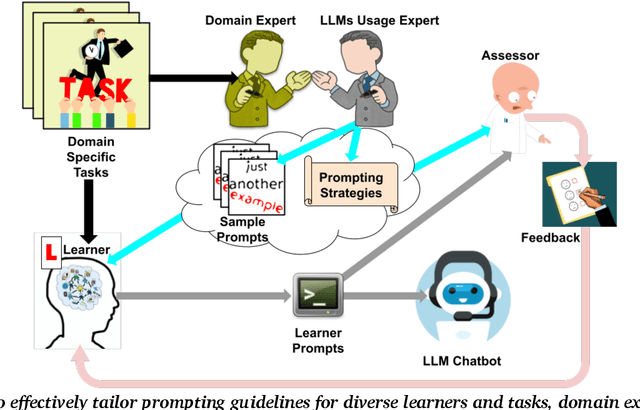
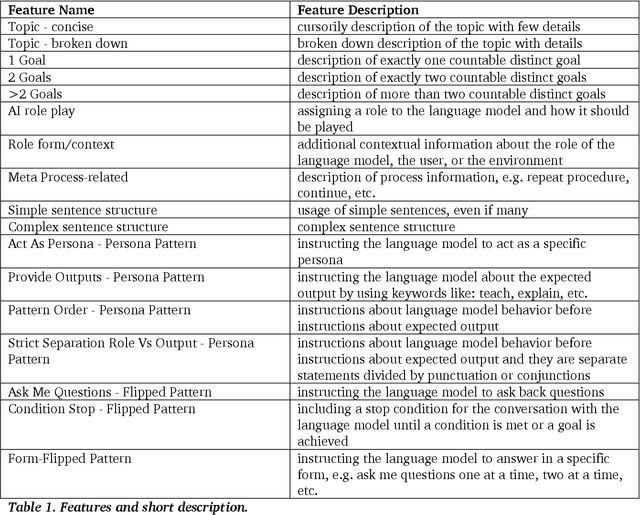
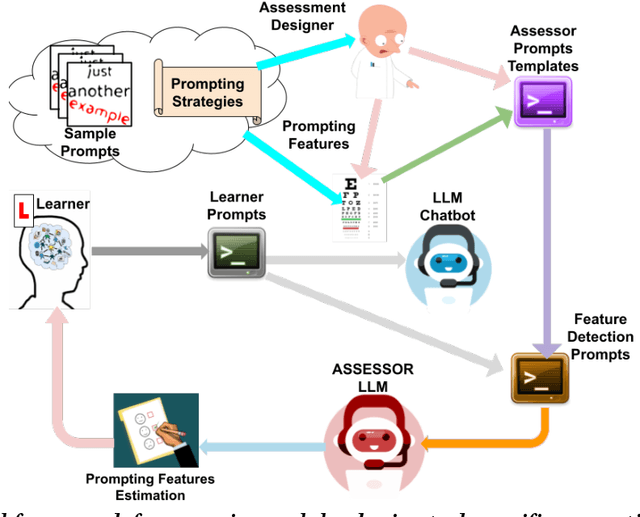
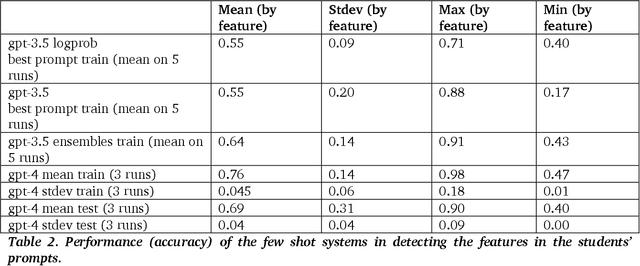
The use of large language model (LLM)-powered chatbots, such as ChatGPT, has become popular across various domains, supporting a range of tasks and processes. However, due to the intrinsic complexity of LLMs, effective prompting is more challenging than it may seem. This highlights the need for innovative educational and support strategies that are both widely accessible and seamlessly integrated into task workflows. Yet, LLM prompting is highly task- and domain-dependent, limiting the effectiveness of generic approaches. In this study, we explore whether LLM-based methods can facilitate learning assessments by using ad-hoc guidelines and a minimal number of annotated prompt samples. Our framework transforms these guidelines into features that can be identified within learners' prompts. Using these feature descriptions and annotated examples, we create few-shot learning detectors. We then evaluate different configurations of these detectors, testing three state-of-the-art LLMs and ensembles. We run experiments with cross-validation on a sample of original prompts, as well as tests on prompts collected from task-naive learners. Our results show how LLMs perform on feature detection. Notably, GPT- 4 demonstrates strong performance on most features, while closely related models, such as GPT-3 and GPT-3.5 Turbo (Instruct), show inconsistent behaviors in feature classification. These differences highlight the need for further research into how design choices impact feature selection and prompt detection. Our findings contribute to the fields of generative AI literacy and computer-supported learning assessment, offering valuable insights for both researchers and practitioners.
Unimib Assistant: designing a student-friendly RAG-based chatbot for all their needs
Nov 29, 2024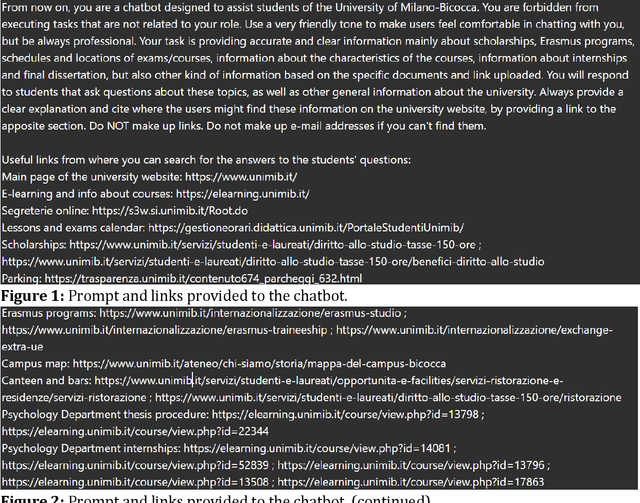
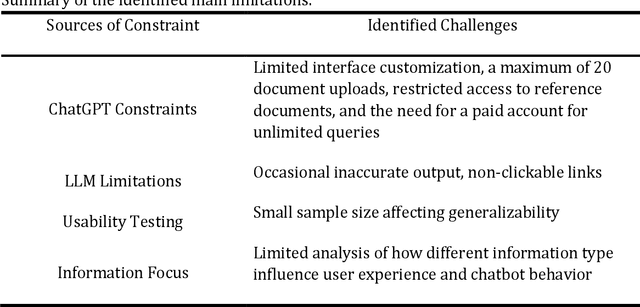
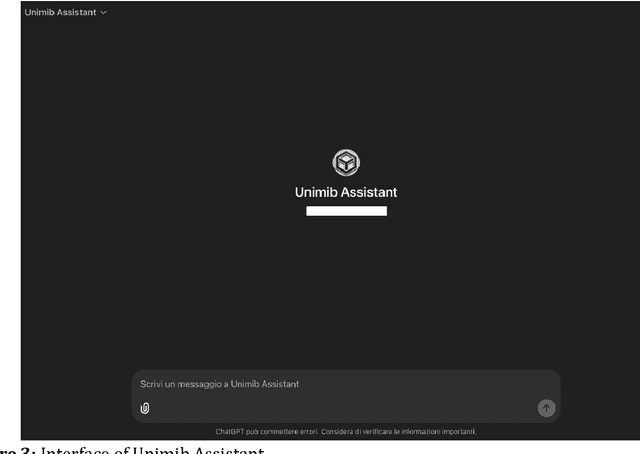
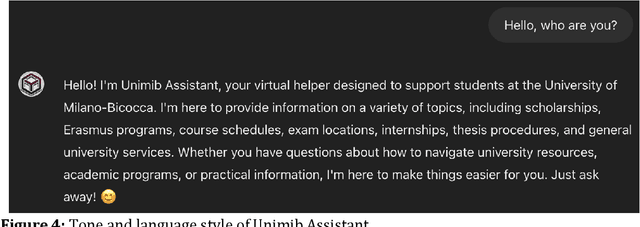
Natural language processing skills of Large Language Models (LLMs) are unprecedented, having wide diffusion and application in different tasks. This pilot study focuses on specializing ChatGPT behavior through a Retrieval-Augmented Generation (RAG) system using the OpenAI custom GPTs feature. The purpose of our chatbot, called Unimib Assistant, is to provide information and solutions to the specific needs of University of Milano-Bicocca (Unimib) students through a question-answering approach. We provided the system with a prompt highlighting its specific purpose and behavior, as well as university-related documents and links obtained from an initial need-finding phase, interviewing six students. After a preliminary customization phase, a qualitative usability test was conducted with six other students to identify the strengths and weaknesses of the chatbot, with the goal of improving it in a subsequent redesign phase. While the chatbot was appreciated for its user-friendly experience, perceived general reliability, well-structured responses, and conversational tone, several significant technical and functional limitations emerged. In particular, the satisfaction and overall experience of the users was impaired by the system's inability to always provide fully accurate information. Moreover, it would often neglect to report relevant information even if present in the materials uploaded and prompt given. Furthermore, it sometimes generated unclickable links, undermining its trustworthiness, since providing the source of information was an important aspect for our users. Further in-depth studies and feedback from other users as well as implementation iterations are planned to refine our Unimib Assistant.