 Add to Chrome
 Add to Firefox
 Add to Edge
Towards Visually Grounded Multimodal Summarization via Cross-Modal Transformer and Gated Attention
May 12, 2026
Multimodal summarization requires models to jointly understand textual and visual inputs to generate concise, semantically coherent summaries. Existing methods often inject shallow visual features into deep language models, leading to representational mismatches and weak cross-modal grounding. We propose a unified framework that jointly performs text summarization and representative image selection. Our system, SPeCTrA-Sum (Sampler Perceiver with Cross-modal Transformer and gated Attention for Summarization), introduces two key innovations. First, a Deep Visual Processor (DVP) aligns the visual encoder with the language model at corresponding depths, enabling hierarchical, layer-wise fusion that preserves semantic consistency. Second, a lightweight Visual Relevance Predictor (VRP) selects salient and diverse images by distilling soft labels from a Determinantal Point Processes (DPP) teacher. SPeCTrA-Sum is trained using a multi-objective loss that combines autoregressive summarization, cross-modal alignment, and DPP-based distillation. Experiments show that our system produces more accurate, visually grounded summaries and selects more representative images, demonstrating the benefits of depth-aware fusion and principled image selection for multimodal summarization.

Measuring What Matters Beyond Text: Evaluating Multimodal Summaries by Quality, Alignment, and Diversity
May 12, 2026Multimodal Large Language Models (MLLMs) have facilitated Multimodal Summarization with Multimodal Output (MSMO), wherein systems generate concise textual summaries accompanied by salient visuals from multimodal sources. However, current MSMO evaluation remains fragmented: text quality, image-text alignment, and visual diversity are typically assessed in isolation using unimodal metrics, making it difficult to capture whether the modalities jointly support a faithful and useful summary. To address this gap, we introduce MM-Eval, a unified evaluation framework that integrates assessments of textual quality, cross-modal alignment, and visual diversity. MM-Eval comprises three components: (1) text quality, measured using OpenFActScore for factual consistency and G-Eval for coherence, fluency, and relevance; (2) image-text relevance, evaluated via an MLLM-as-a-judge approach; and (3) image-set diversity, quantified using Truncated CLIP Entropy. We calibrate MM-Eval through a learned aggregation model trained on the mLLM-EVAL news benchmark, aligning component contributions with human preferences. Our analysis reveals a text-dominant hierarchy in this setting, where factual consistency acts as a critical determinant of perceived overall quality, while visual relevance and diversity provide complementary signals. MM-Eval improves over heuristic aggregation baselines and provides an interpretable, reference-weak framework for comparative evaluation of multimodal summaries.
LLM Ensemble for RAG: Role of Context Length in Zero-Shot Question Answering for BioASQ Challenge
Sep 10, 2025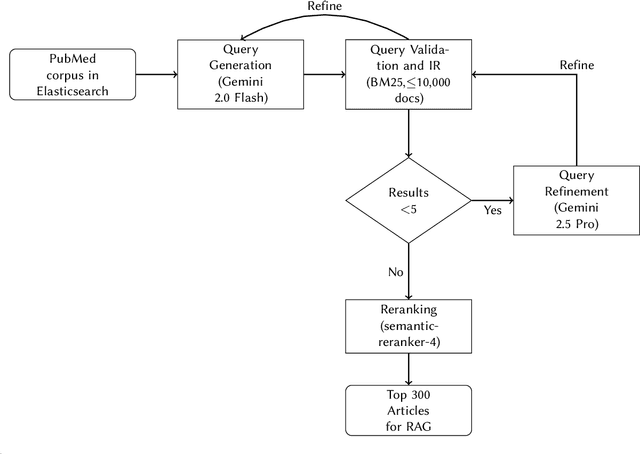
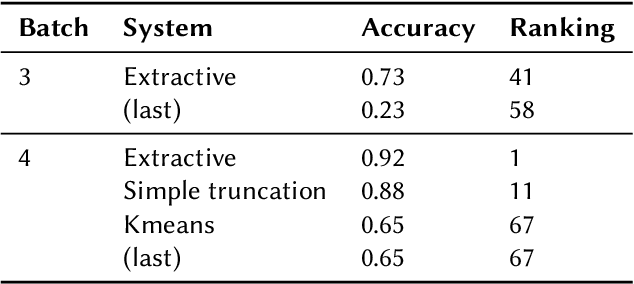
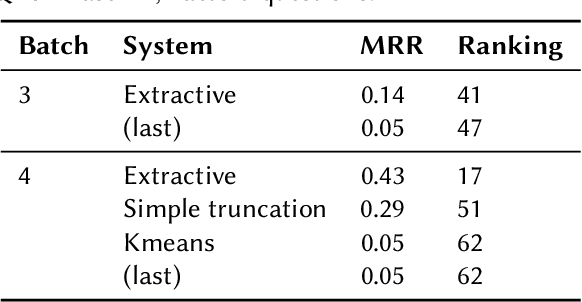
Biomedical question answering (QA) poses significant challenges due to the need for precise interpretation of specialized knowledge drawn from a vast, complex, and rapidly evolving corpus. In this work, we explore how large language models (LLMs) can be used for information retrieval (IR), and an ensemble of zero-shot models can accomplish state-of-the-art performance on a domain-specific Yes/No QA task. Evaluating our approach on the BioASQ challenge tasks, we show that ensembles can outperform individual LLMs and in some cases rival or surpass domain-tuned systems - all while preserving generalizability and avoiding the need for costly fine-tuning or labeled data. Our method aggregates outputs from multiple LLM variants, including models from Anthropic and Google, to synthesize more accurate and robust answers. Moreover, our investigation highlights a relationship between context length and performance: while expanded contexts are meant to provide valuable evidence, they simultaneously risk information dilution and model disorientation. These findings emphasize IR as a critical foundation in Retrieval-Augmented Generation (RAG) approaches for biomedical QA systems. Precise, focused retrieval remains essential for ensuring LLMs operate within relevant information boundaries when generating answers from retrieved documents. Our results establish that ensemble-based zero-shot approaches, when paired with effective RAG pipelines, constitute a practical and scalable alternative to domain-tuned systems for biomedical question answering.
Synthetic Dialogue Dataset Generation using LLM Agents
Jan 30, 2024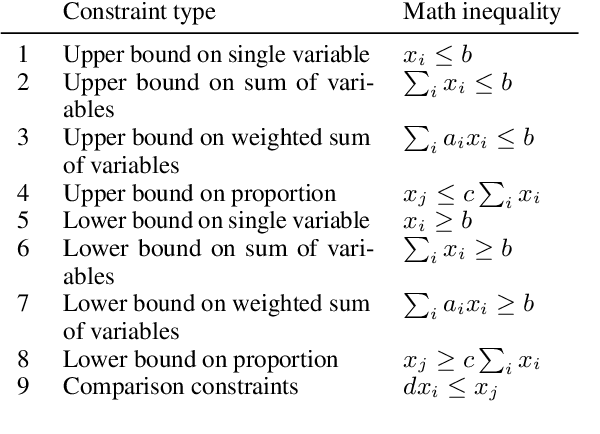


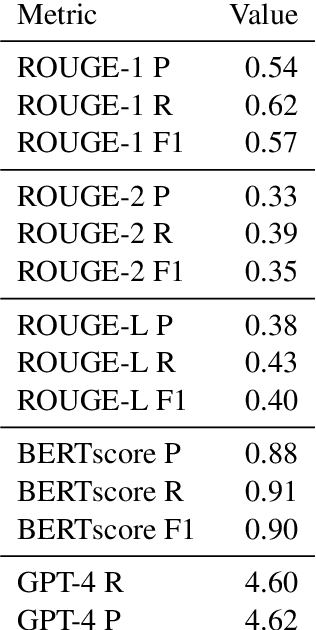
Linear programming (LP) problems are pervasive in real-life applications. However, despite their apparent simplicity, an untrained user may find it difficult to determine the linear model of their specific problem. We envisage the creation of a goal-oriented conversational agent that will engage in conversation with the user to elicit all information required so that a subsequent agent can generate the linear model. In this paper, we present an approach for the generation of sample dialogues that can be used to develop and train such a conversational agent. Using prompt engineering, we develop two agents that "talk" to each other, one acting as the conversational agent, and the other acting as the user. Using a set of text descriptions of linear problems from NL4Opt available to the user only, the agent and the user engage in conversation until the agent has retrieved all key information from the original problem description. We also propose an extrinsic evaluation of the dialogues by assessing how well the summaries generated by the dialogues match the original problem descriptions. We conduct human and automatic evaluations, including an evaluation approach that uses GPT-4 to mimic the human evaluation metrics. The evaluation results show an overall good quality of the dialogues, though research is still needed to improve the quality of the GPT-4 evaluation metrics. The resulting dialogues, including the human annotations of a subset, are available to the research community. The conversational agent used for the generation of the dialogues can be used as a baseline.
On Extending Neural Networks with Loss Ensembles for Text Classification
Nov 14, 2017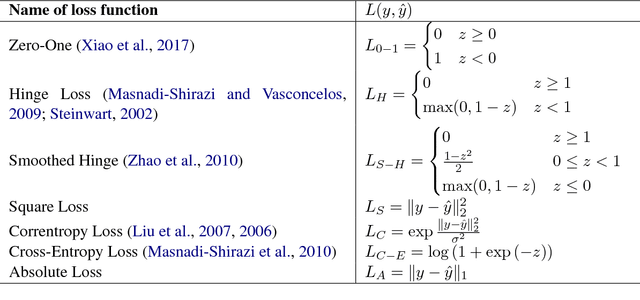
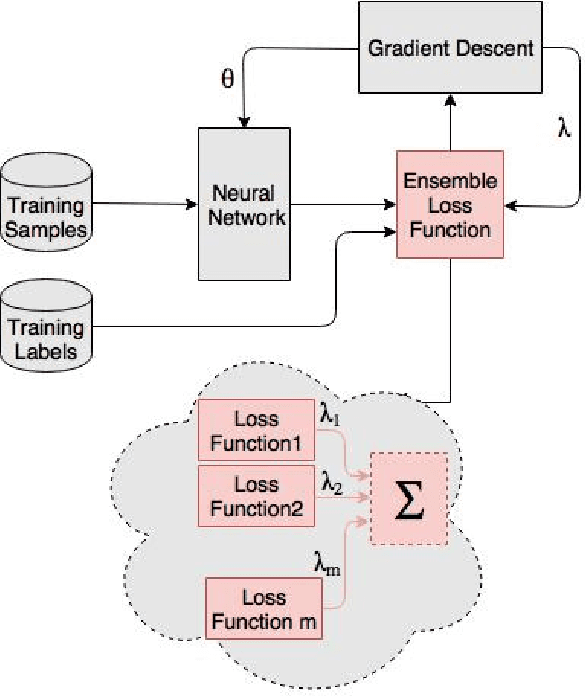
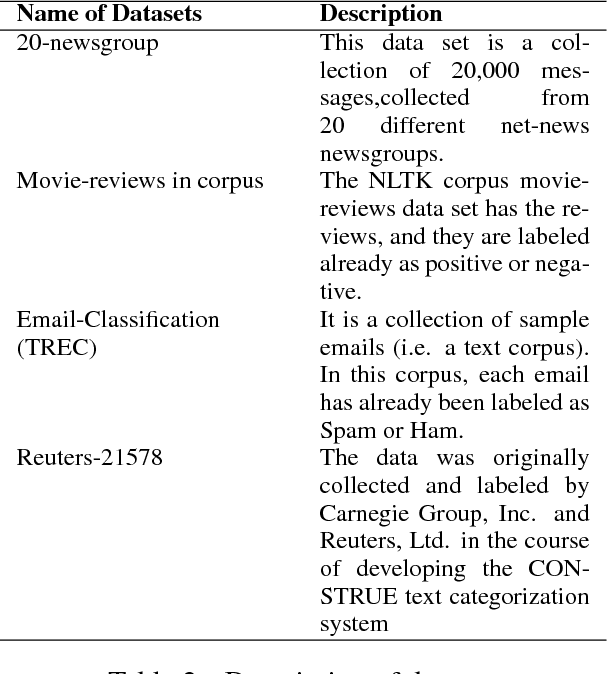
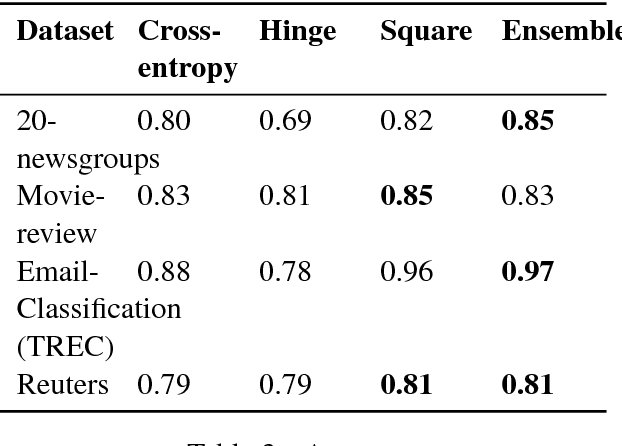
Ensemble techniques are powerful approaches that combine several weak learners to build a stronger one. As a meta learning framework, ensemble techniques can easily be applied to many machine learning techniques. In this paper we propose a neural network extended with an ensemble loss function for text classification. The weight of each weak loss function is tuned within the training phase through the gradient propagation optimization method of the neural network. The approach is evaluated on several text classification datasets. We also evaluate its performance in various environments with several degrees of label noise. Experimental results indicate an improvement of the results and strong resilience against label noise in comparison with other methods.
Macquarie University at BioASQ 5b -- Query-based Summarisation Techniques for Selecting the Ideal Answers
Aug 11, 2017
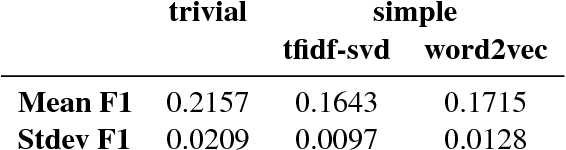
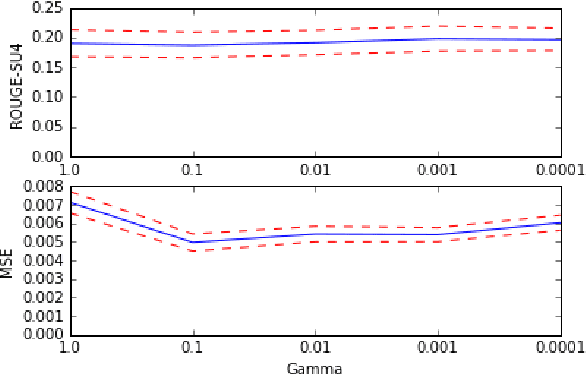
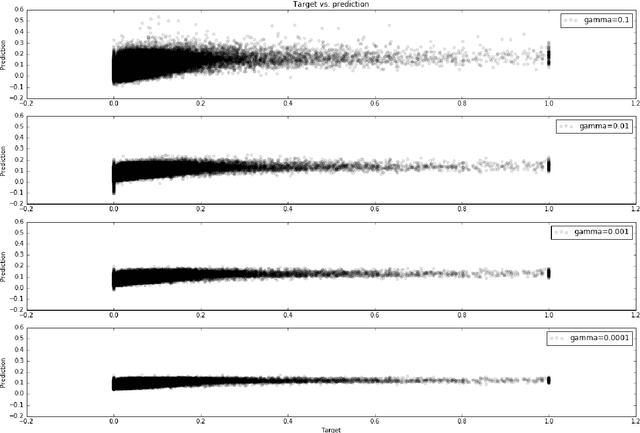
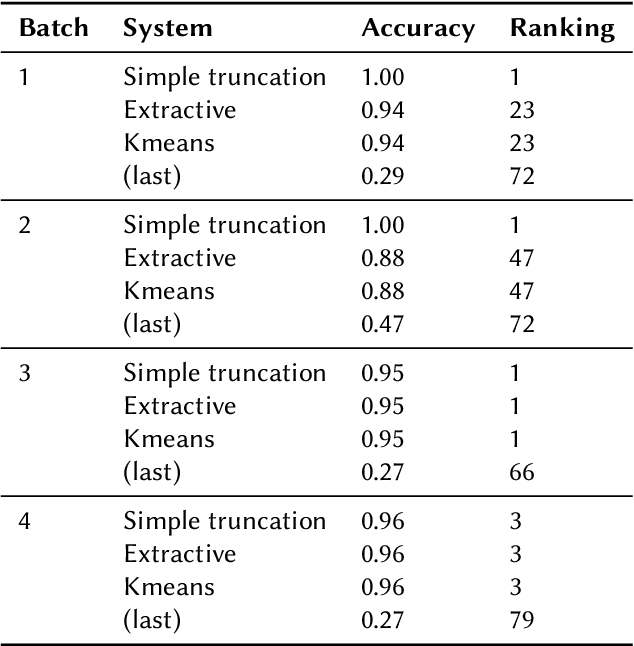
Macquarie University's contribution to the BioASQ challenge (Task 5b Phase B) focused on the use of query-based extractive summarisation techniques for the generation of the ideal answers. Four runs were submitted, with approaches ranging from a trivial system that selected the first $n$ snippets, to the use of deep learning approaches under a regression framework. Our experiments and the ROUGE results of the five test batches of BioASQ indicate surprisingly good results for the trivial approach. Overall, most of our runs on the first three test batches achieved the best ROUGE-SU4 results in the challenge.
* As published in BioNLP2017. 9 pages, 5 figures, 4 tables