 Add to Chrome
 Add to Firefox
 Add to Edge
Learning Generalizable Neural Operators for Inverse Problems
Dec 19, 2025
Inverse problems challenge existing neural operator architectures because ill-posed inverse maps violate continuity, uniqueness, and stability assumptions. We introduce B2B${}^{-1}$, an inverse basis-to-basis neural operator framework that addresses this limitation. Our key innovation is to decouple function representation from the inverse map. We learn neural basis functions for the input and output spaces, then train inverse models that operate on the resulting coefficient space. This structure allows us to learn deterministic, invertible, and probabilistic models within a single framework, and to choose models based on the degree of ill-posedness. We evaluate our approach on six inverse PDE benchmarks, including two novel datasets, and compare against existing invertible neural operator baselines. We learn probabilistic models that capture uncertainty and input variability, and remain robust to measurement noise due to implicit denoising in the coefficient calculation. Our results show consistent re-simulation performance across varying levels of ill-posedness. By separating representation from inversion, our framework enables scalable surrogate models for inverse problems that generalize across instances, domains, and degrees of ill-posedness.

Learning Hidden Physics and System Parameters with Deep Operator Networks
Dec 06, 2024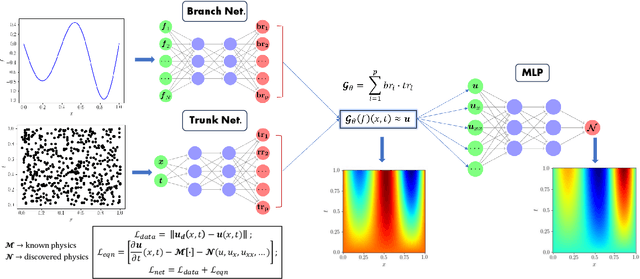
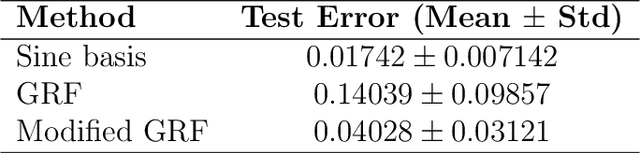
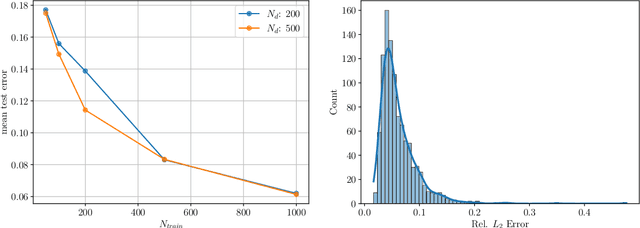
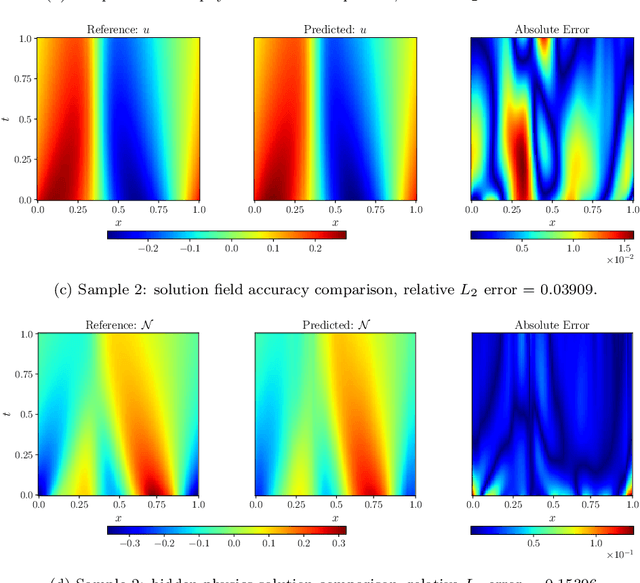
Big data is transforming scientific progress by enabling the discovery of novel models, enhancing existing frameworks, and facilitating precise uncertainty quantification, while advancements in scientific machine learning complement this by providing powerful tools to solve inverse problems to identify the complex systems where traditional methods falter due to sparse or noisy data. We introduce two innovative neural operator frameworks tailored for discovering hidden physics and identifying unknown system parameters from sparse measurements. The first framework integrates a popular neural operator, DeepONet, and a physics-informed neural network to capture the relationship between sparse data and the underlying physics, enabling the accurate discovery of a family of governing equations. The second framework focuses on system parameter identification, leveraging a DeepONet pre-trained on sparse sensor measurements to initialize a physics-constrained inverse model. Both frameworks excel in handling limited data and preserving physical consistency. Benchmarking on the Burgers' equation and reaction-diffusion system demonstrates state-of-the-art performance, achieving average $L_2$ errors of $\mathcal{O}(10^{-2})$ for hidden physics discovery and absolute errors of $\mathcal{O}(10^{-3})$ for parameter identification. These results underscore the frameworks' robustness, efficiency, and potential for solving complex scientific problems with minimal observational data.