 Add to Chrome
 Add to Firefox
 Add to Edge
SwiftChannel: Algorithm-Hardware Co-Design for Deep Learning-Based 5G Channel Estimation
May 03, 2026
Channel estimation is crucial in 5G communication networks for optimizing transmission parameters and ensuring reliable, high-speed communication. However, the use of multiple-input and multiple-output (MIMO) and millimeter-wave (mmWave) in 5G networks presents challenges in achieving accurate estimation under strict latency requirements on resource-limited hardware platforms. To address these challenges, we propose SwiftChannel, an algorithm-hardware co-design framework that integrates a hardware-friendly deep learning-based channel estimator with a dedicated accelerator. Our approach employs a convolutional neural network enhanced with a parameter-free attention mechanism, which effectively reconstructs full-resolution spatial-frequency domain channel matrices from low-resolution least squares (LS) estimates. We further develop a multi-stage model compression pipeline combining knowledge distillation, convolution re-parameterization, and quantization-aware training, resulting in substantial model size reduction with negligible accuracy loss. The hardware accelerator, implementing the compressed model and the LS estimator on FPGA platforms using High-level Synthesis (HLS), features a fine-grained pipeline architecture and optimized dataflow strategies. Tested on a Zynq UltraScale+ RFSoC, the accelerator achieves sub-millisecond latency, providing up to 24x speed-up and over 33x improvement in energy efficiency compared to GPU-based solutions. Extensive evaluations demonstrate that the proposed design generalizes not only across various noise levels and user mobilities, but also to a variety of unseen channel profiles, outperforming state-of-the-art baselines. By unifying algorithmic innovation with hardware-aware design, our work presents a future-proof channel estimation solution for 5G MIMO systems.

EarDA: Towards Accurate and Data-Efficient Earable Activity Sensing
Jun 18, 2024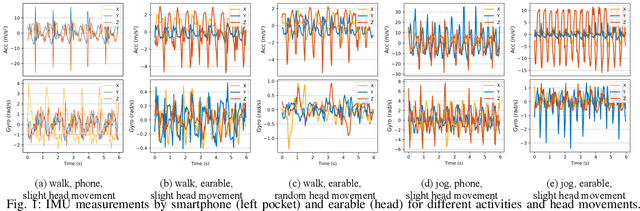
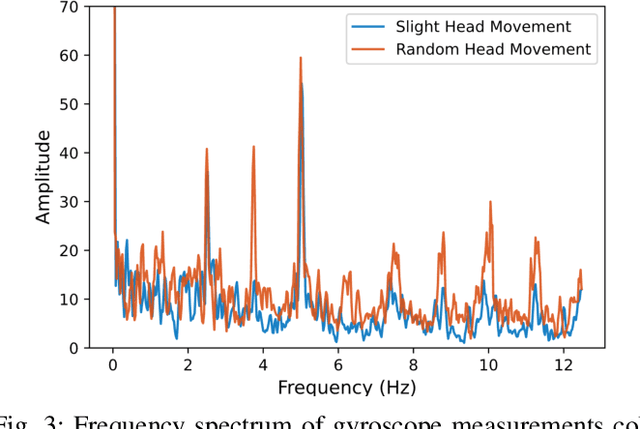
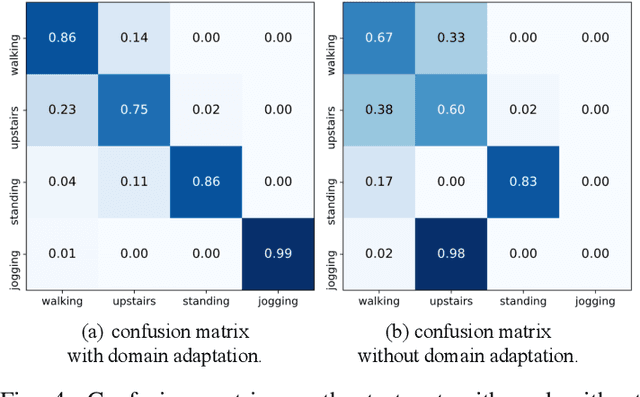
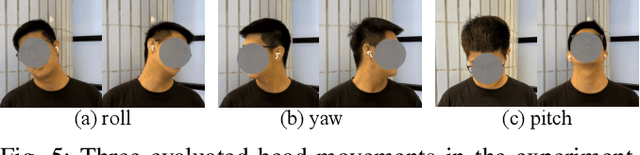
In the realm of smart sensing with the Internet of Things, earable devices are empowered with the capability of multi-modality sensing and intelligence of context-aware computing, leading to its wide usage in Human Activity Recognition (HAR). Nonetheless, unlike the movements captured by Inertial Measurement Unit (IMU) sensors placed on the upper or lower body, those motion signals obtained from earable devices show significant changes in amplitudes and patterns, especially in the presence of dynamic and unpredictable head movements, posing a significant challenge for activity classification. In this work, we present EarDA, an adversarial-based domain adaptation system to extract the domain-independent features across different sensor locations. Moreover, while most deep learning methods commonly rely on training with substantial amounts of labeled data to offer good accuracy, the proposed scheme can release the potential usage of publicly available smartphone-based IMU datasets. Furthermore, we explore the feasibility of applying a filter-based data processing method to mitigate the impact of head movement. EarDA, the proposed system, enables more data-efficient and accurate activity sensing. It achieves an accuracy of 88.8% under HAR task, demonstrating a significant 43% improvement over methods without domain adaptation. This clearly showcases its effectiveness in mitigating domain gaps.