 Add to Chrome
 Add to Firefox
 Add to Edge
TraceBack: Multi-Agent Decomposition for Fine-Grained Table Attribution
Feb 13, 2026
Question answering (QA) over structured tables requires not only accurate answers but also transparency about which cells support them. Existing table QA systems rarely provide fine-grained attribution, so even correct answers often lack verifiable grounding, limiting trust in high-stakes settings. We address this with TraceBack, a modular multi-agent framework for scalable, cell-level attribution in single-table QA. TraceBack prunes tables to relevant rows and columns, decomposes questions into semantically coherent sub-questions, and aligns each answer span with its supporting cells, capturing both explicit and implicit evidence used in intermediate reasoning steps. To enable systematic evaluation, we release CITEBench, a benchmark with phrase-to-cell annotations drawn from ToTTo, FetaQA, and AITQA. We further propose FairScore, a reference-less metric that compares atomic facts derived from predicted cells and answers to estimate attribution precision and recall without human cell labels. Experiments show that TraceBack substantially outperforms strong baselines across datasets and granularities, while FairScore closely tracks human judgments and preserves relative method rankings, supporting interpretable and scalable evaluation of table-based QA.

Weaver: Interweaving SQL and LLM for Table Reasoning
May 25, 2025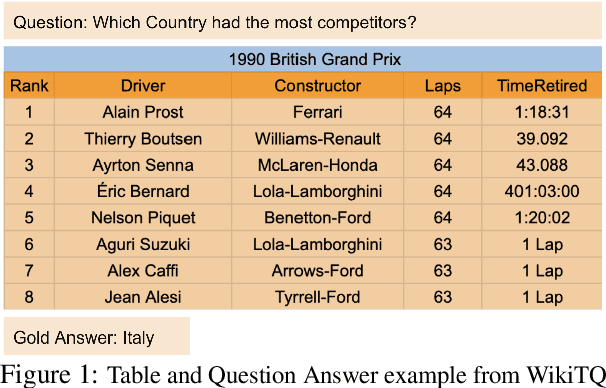
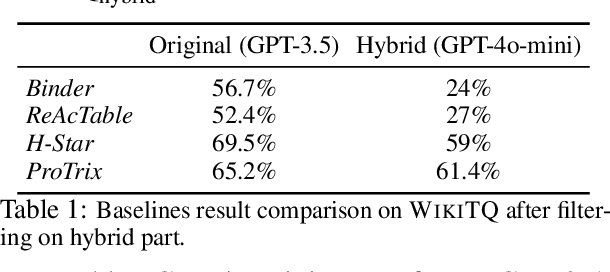
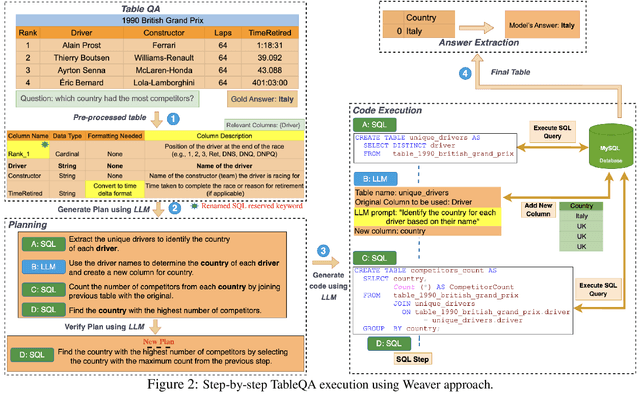
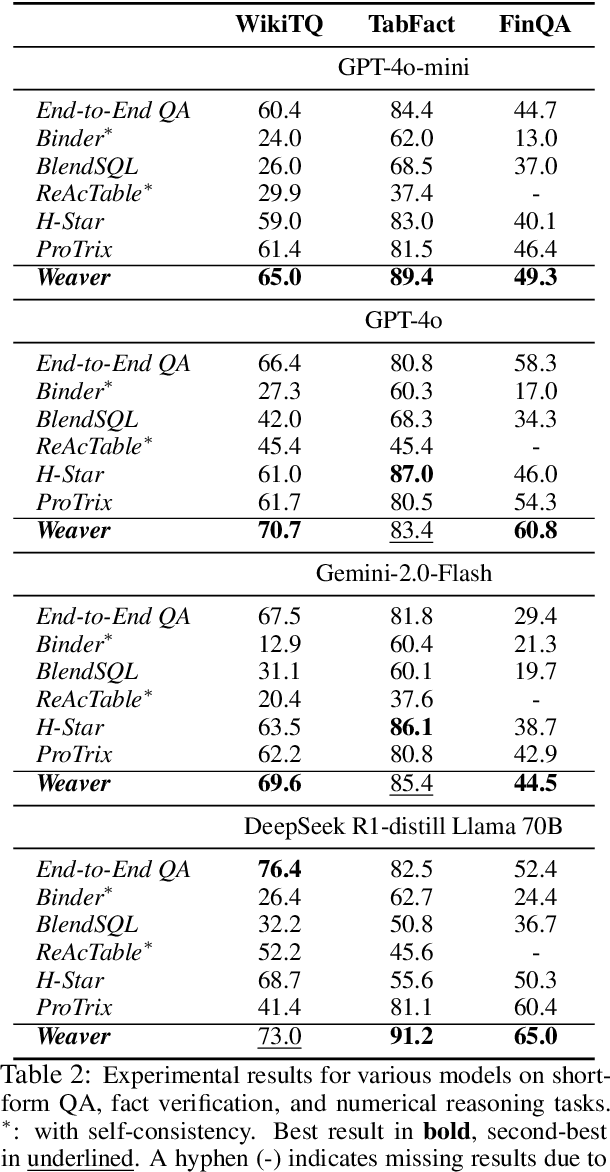
Querying tables with unstructured data is challenging due to the presence of text (or image), either embedded in the table or in external paragraphs, which traditional SQL struggles to process, especially for tasks requiring semantic reasoning. While Large Language Models (LLMs) excel at understanding context, they face limitations with long input sequences. Existing approaches that combine SQL and LLMs typically rely on rigid, predefined work-flows, limiting their adaptability to complex queries. To address these issues, we introduce Weaver , a modular pipeline that dynamically integrates SQL and LLMs for table-based question answering (TableQA). Weaver generates a flexible, step-by-step plan that combines SQL for structured data retrieval with LLMs for semantic processing. By decomposing complex queries into manageable subtasks, Weaver improves accuracy and generalization. Our experiments show that Weaver consistently outperforms state-of-the-art methods across four TableQA datasets, reducing both API calls and error rates.