 Add to Chrome
 Add to Firefox
 Add to Edge
Better Rigs, Not Bigger Networks: A Body Model Ablation for Gaussian Avatars
Apr 01, 2026
Recent 3D Gaussian splatting methods built atop SMPL achieve remarkable visual fidelity while continually increasing the complexity of the overall training architecture. We demonstrate that much of this complexity is unnecessary: by replacing SMPL with the Momentum Human Rig (MHR), estimated via SAM-3D-Body, a minimal pipeline with no learned deformations or pose-dependent corrections achieves the highest reported PSNR and competitive or superior LPIPS and SSIM on PeopleSnapshot and ZJU-MoCap. To disentangle pose estimation quality from body model representational capacity, we perform two controlled ablations: translating SAM-3D-Body meshes to SMPL-X, and translating the original dataset's SMPL poses into MHR both retrained under identical conditions. These ablations confirm that body model expressiveness has been a primary bottleneck in avatar reconstruction, with both mesh representational capacity and pose estimation quality contributing meaningfully to the full pipeline's gains.

GRAD-SUM: Leveraging Gradient Summarization for Optimal Prompt Engineering
Jul 12, 2024
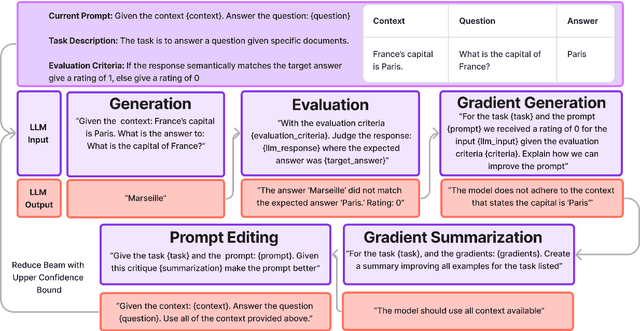

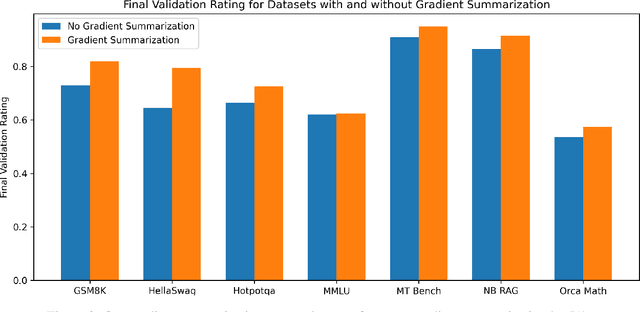
Prompt engineering for large language models (LLMs) is often a manual time-intensive process that involves generating, evaluating, and refining prompts iteratively to ensure high-quality outputs. While there has been work on automating prompt engineering, the solutions generally are either tuned to specific tasks with given answers or are quite costly. We introduce GRAD-SUM, a scalable and flexible method for automatic prompt engineering that builds on gradient-based optimization techniques. Our approach incorporates user-defined task descriptions and evaluation criteria, and features a novel gradient summarization module to generalize feedback effectively. Our results demonstrate that GRAD-SUM consistently outperforms existing methods across various benchmarks, highlighting its versatility and effectiveness in automatic prompt optimization.
A Dataset and Benchmark for Automatically Answering and Generating Machine Learning Final Exams
Jun 11, 2022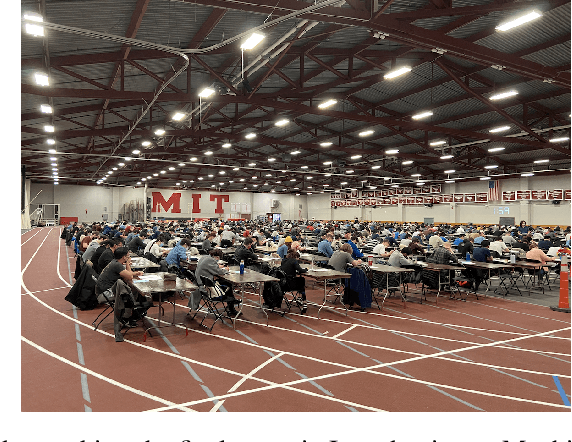


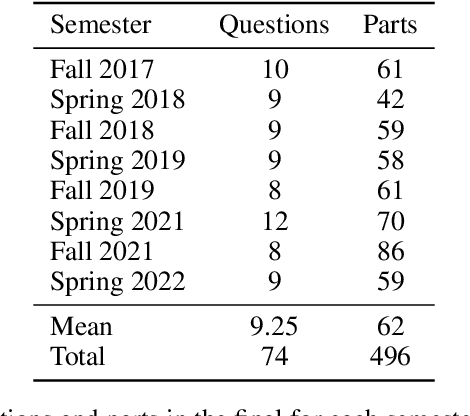
Can a machine learn machine learning? We propose to answer this question using the same criteria we use to answer a similar question: can a human learn machine learning? We automatically answer MIT final exams in Introduction to Machine Learning at a human level. The course is a large undergraduate class with around five hundred students each semester. Recently, program synthesis and few-shot learning solved university-level problem set questions in mathematics and STEM courses at a human level. In this work, we solve questions from final exams that differ from problem sets in several ways: the questions are longer, have multiple parts, are more complicated, and span a broader set of topics. We provide a new dataset and benchmark of questions from eight MIT Introduction to Machine Learning final exams between Fall 2017 and Spring 2022 and provide code for automatically answering these questions and generating new questions. We perform ablation studies comparing zero-shot learning with few-shot learning, chain-of-thought prompting, GPT-3 pre-trained on text and Codex fine-tuned on code on a range of machine learning topics and find that few-shot learning methods perform best. We make our data and code publicly available for the machine learning community.