 Add to Chrome
 Add to Firefox
 Add to Edge
MAVISEG: Manifold Propagation and Visual Prototypes for Zero-Shot Open-Vocabulary Segmentation in Diffusion Transformers
Aug 06, 2026
Text-to-image diffusion transformers learn about objects and scenes by learning to generate them, making them strong candidates for training-free zero-shot open-vocabulary semantic segmentation. State-of-the-art attribution methods score each pixel independently, comparing its features against a fixed text-derived class representation, whether as an output-space similarity or as a cross-attention weight. This discards structured signals the model itself exposes: the temporal structure of the generative trajectory, the visual appearance statistics of each concept, and the image's own pairwise feature geometry. We present MAVISEG, a training-free refinement layer that recovers these signals. Because its operators consume only a pixel-by-concept score field and a pixel feature space, MAVISEG is capture-agnostic rather than tied to one attribution method. Across six benchmarks it achieves the strongest overall results among training-free methods, including the best mIoU on every benchmark. Interestingly, gains are largest where the initial capture is weakest, and individual operators contribute depending on the noise in the field they refine. Our results indicate that diffusion transformers carry more concept-level information than current attribution methods recover, and that much of it is lost on the way to the mask rather than absent from the model.

StraightDP: Geometry-Aware Differential Privacy for Rectified-Flow Transformers
Jul 31, 2026Differentially private (DP) training of text-conditioned generative models suffers a utility cliff at strong privacy. We revisit this problem through the geometry of rectified flows: along the straight interpolation between noise and data, the Bayes-optimal velocity is governed to leading order at the noise end by a few class-conditional moments, and increasingly sample-specific structure matters toward the data end. StraightDP exploits this heterogeneity end to end. A small budget share releases whitened class-conditional moments once, to be distilled into the weights or injected at sampling time. The rest is spent by pre-declared DP-SGD toward the data end, beyond the moments' reach. At $\varepsilon=1$ on MNIST, the released moments alone already attain $0.76$ downstream accuracy with prototype-like samples and an FID of $237$, and uniform DP-SGD attains $0.21$. The pipeline built on the release reaches $0.81$ accuracy at FID $56$ in a public latent space. Constraining per-token stream norms of the multimodal backbone leaves the pretraining loss unchanged yet improves downstream accuracy in the extreme-noise pixel-space regime, and its accuracy effect becomes monotonically more favorable as privacy strengthens. The released moments also port to frozen SD3-medium, where sampling-time injection beats DP-LoRA training at a fraction of the budget.
MARLIN: De Novo Molecular Structure Elucidation from Tandem Mass Spectra without a Ground-Truth Formula
Jul 06, 2026Untargeted tandem mass spectrometry (MS/MS) detects thousands of small molecules per biological sample, yet most go unidentified because they are absent from spectral libraries. These uncharacterized metabolites and natural products are precisely the compounds that matter for drug discovery, biomarker research, and exposomics. Computational de novo structure elucidation could close this gap, but almost all state-of-the-art methods assume the ground-truth molecular formula is known, an oracle that does not exist for genuinely novel compounds and is itself predicted with substantial error. We present MARLIN, a de novo method that elucidates structures directly from a spectrum with no molecular formula at any stage. A self-supervised encoder predicts a molecular fingerprint from the raw peaks, and a block-diffusion language model generates candidate structures conditioned only on the fingerprint and the instrument-measured precursor mass. A provably safe mass-shell constraint keeps every candidate consistent with the measured mass without fixing the atom inventory, and candidates are accepted by exact parts-per-million mass agreement. A symmetric noise objective absorbs encoder error, and a candidate-diversity mechanism keeps the candidates from collapsing to a single structure. On the NPLIB1 benchmark, MARLIN is the strongest method evaluated without a ground-truth formula across exact-match accuracy, structural distance, and fingerprint similarity, and it recovers the correct molecular formula as a byproduct about as often as a dedicated predictor without ever using one. MARLIN enables reliable de novo structure elucidation in the realistic discovery regime where the molecular formula is unavailable.
Comparative Analysis of Formula and Structure Prediction from Tandem Mass Spectra
Jan 02, 2026Liquid chromatography mass spectrometry (LC-MS)-based metabolomics and exposomics aim to measure detectable small molecules in biological samples. The results facilitate hypothesis-generating discovery of metabolic changes and disease mechanisms and provide information about environmental exposures and their effects on human health. Metabolomics and exposomics are made possible by the high resolving power of LC and high mass measurement accuracy of MS. However, a majority of the signals from such studies still cannot be identified or annotated using conventional library searching because existing spectral libraries are far from covering the vast chemical space captured by LC-MS/MS. To address this challenge and unleash the full potential of metabolomics and exposomics, a number of computational approaches have been developed to predict compounds based on tandem mass spectra. Published assessment of these approaches used different datasets and evaluation. To select prediction workflows for practical applications and identify areas for further improvements, we have carried out a systematic evaluation of the state-of-the-art prediction algorithms. Specifically, the accuracy of formula prediction and structure prediction was evaluated for different types of adducts. The resulting findings have established realistic performance baselines, identified critical bottlenecks, and provided guidance to further improve compound predictions based on MS.
BadSAD: Clean-Label Backdoor Attacks against Deep Semi-Supervised Anomaly Detection
Dec 17, 2024Image anomaly detection (IAD) is essential in applications such as industrial inspection, medical imaging, and security. Despite the progress achieved with deep learning models like Deep Semi-Supervised Anomaly Detection (DeepSAD), these models remain susceptible to backdoor attacks, presenting significant security challenges. In this paper, we introduce BadSAD, a novel backdoor attack framework specifically designed to target DeepSAD models. Our approach involves two key phases: trigger injection, where subtle triggers are embedded into normal images, and latent space manipulation, which positions and clusters the poisoned images near normal images to make the triggers appear benign. Extensive experiments on benchmark datasets validate the effectiveness of our attack strategy, highlighting the severe risks that backdoor attacks pose to deep learning-based anomaly detection systems.
Adversary-Guided Motion Retargeting for Skeleton Anonymization
May 08, 2024Skeleton-based motion visualization is a rising field in computer vision, especially in the case of virtual reality (VR). With further advancements in human-pose estimation and skeleton extracting sensors, more and more applications that utilize skeleton data have come about. These skeletons may appear to be anonymous but they contain embedded personally identifiable information (PII). In this paper we present a new anonymization technique that is based on motion retargeting, utilizing adversary classifiers to further remove PII embedded in the skeleton. Motion retargeting is effective in anonymization as it transfers the movement of the user onto the a dummy skeleton. In doing so, any PII linked to the skeleton will be based on the dummy skeleton instead of the user we are protecting. We propose a Privacy-centric Deep Motion Retargeting model (PMR) which aims to further clear the retargeted skeleton of PII through adversarial learning. In our experiments, PMR achieves motion retargeting utility performance on par with state of the art models while also reducing the performance of privacy attacks.
Generating Textual Adversaries with Minimal Perturbation
Nov 12, 2022
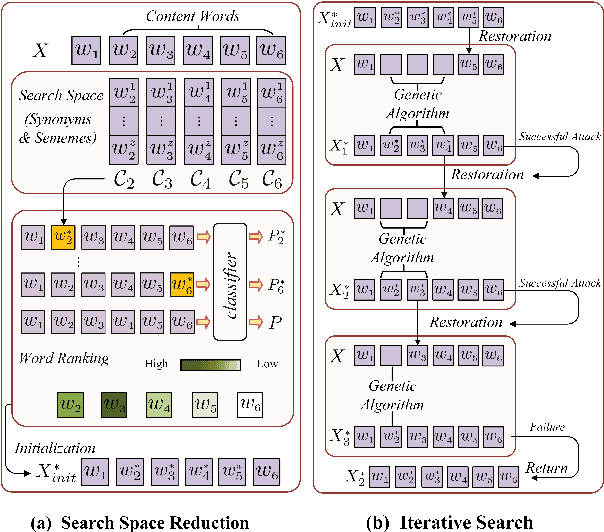


Many word-level adversarial attack approaches for textual data have been proposed in recent studies. However, due to the massive search space consisting of combinations of candidate words, the existing approaches face the problem of preserving the semantics of texts when crafting adversarial counterparts. In this paper, we develop a novel attack strategy to find adversarial texts with high similarity to the original texts while introducing minimal perturbation. The rationale is that we expect the adversarial texts with small perturbation can better preserve the semantic meaning of original texts. Experiments show that, compared with state-of-the-art attack approaches, our approach achieves higher success rates and lower perturbation rates in four benchmark datasets.
Fine-grained Anomaly Detection in Sequential Data via Counterfactual Explanations
Oct 09, 2022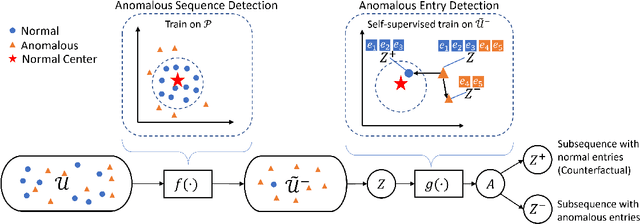
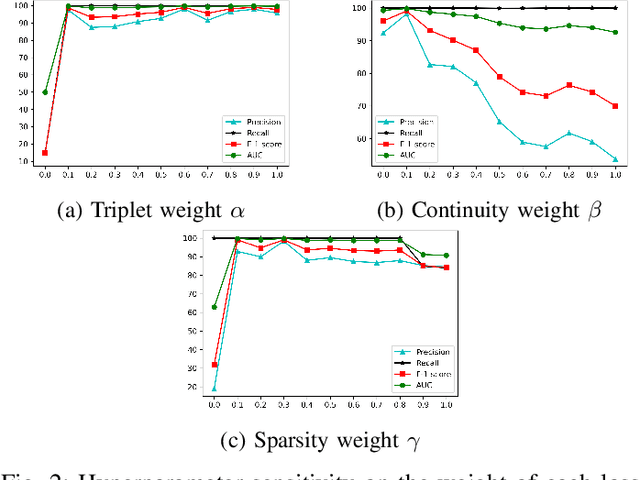
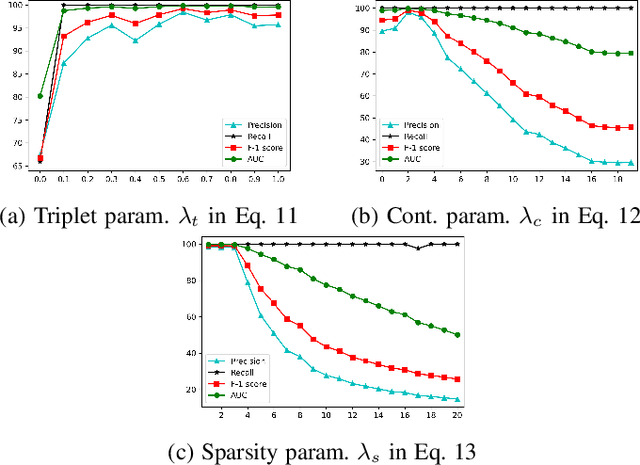
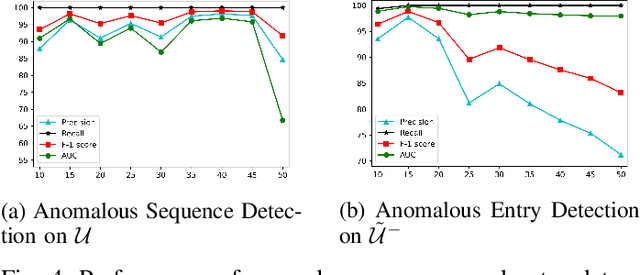
Anomaly detection in sequential data has been studied for a long time because of its potential in various applications, such as detecting abnormal system behaviors from log data. Although many approaches can achieve good performance on anomalous sequence detection, how to identify the anomalous entries in sequences is still challenging due to a lack of information at the entry-level. In this work, we propose a novel framework called CFDet for fine-grained anomalous entry detection. CFDet leverages the idea of interpretable machine learning. Given a sequence that is detected as anomalous, we can consider anomalous entry detection as an interpretable machine learning task because identifying anomalous entries in the sequence is to provide an interpretation to the detection result. We make use of the deep support vector data description (Deep SVDD) approach to detect anomalous sequences and propose a novel counterfactual interpretation-based approach to identify anomalous entries in the sequences. Experimental results on three datasets show that CFDet can correctly detect anomalous entries.
Fairness-aware Agnostic Federated Learning
Oct 10, 2020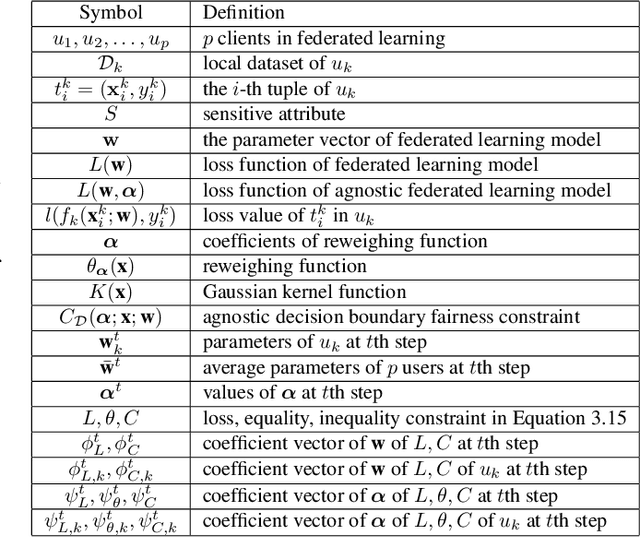
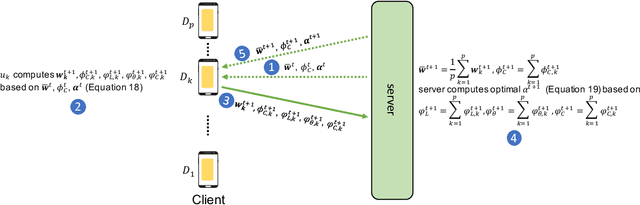
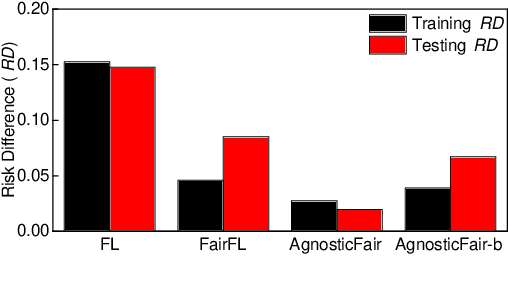
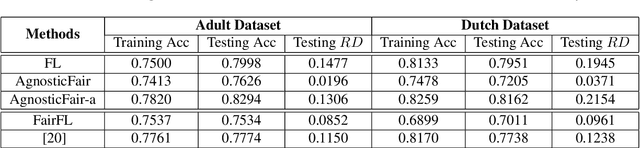
Federated learning is an emerging framework that builds centralized machine learning models with training data distributed across multiple devices. Most of the previous works about federated learning focus on the privacy protection and communication cost reduction. However, how to achieve fairness in federated learning is under-explored and challenging especially when testing data distribution is different from training distribution or even unknown. Introducing simple fairness constraints on the centralized model cannot achieve model fairness on unknown testing data. In this paper, we develop a fairness-aware agnostic federated learning framework (AgnosticFair) to deal with the challenge of unknown testing distribution. We use kernel reweighing functions to assign a reweighing value on each training sample in both loss function and fairness constraint. Therefore, the centralized model built from AgnosticFair can achieve high accuracy and fairness guarantee on unknown testing data. Moreover, the built model can be directly applied to local sites as it guarantees fairness on local data distributions. To our best knowledge, this is the first work to achieve fairness in federated learning. Experimental results on two real datasets demonstrate the effectiveness in terms of both utility and fairness under data shift scenarios.
Removing Disparate Impact of Differentially Private Stochastic Gradient Descent on Model Accuracy
Mar 08, 2020
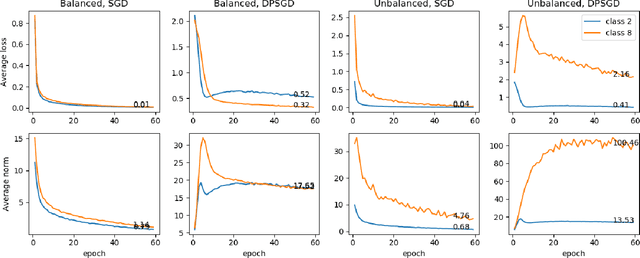
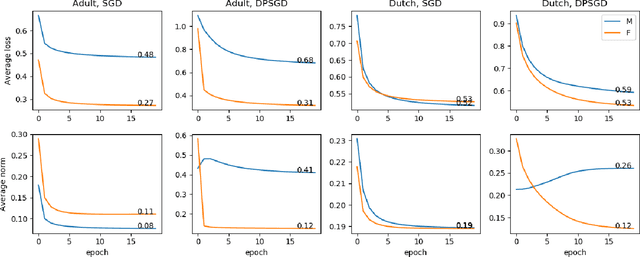
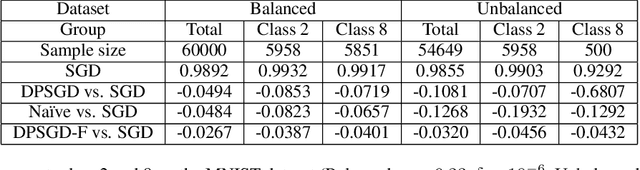
When we enforce differential privacy in machine learning, the utility-privacy trade-off is different w.r.t. each group. Gradient clipping and random noise addition disproportionately affect underrepresented and complex classes and subgroups, which results in inequality in utility loss. In this work, we analyze the inequality in utility loss by differential privacy and propose a modified differentially private stochastic gradient descent (DPSGD), called DPSGD-F, to remove the potential disparate impact of differential privacy on the protected group. DPSGD-F adjusts the contribution of samples in a group depending on the group clipping bias such that differential privacy has no disparate impact on group utility. Our experimental evaluation shows how group sample size and group clipping bias affect the impact of differential privacy in DPSGD, and how adaptive clipping for each group helps to mitigate the disparate impact caused by differential privacy in DPSGD-F.