 Add to Chrome
 Add to Firefox
 Add to Edge
LogosKG: Hardware-Optimized Scalable and Interpretable Knowledge Graph Retrieval
Apr 20, 2026
Knowledge graphs (KGs) are increasingly integrated with large language models (LLMs) to provide structured, verifiable reasoning. A core operation in this integration is multi-hop retrieval, yet existing systems struggle to balance efficiency, scalability, and interpretability. We introduce LogosKG, a novel, hardware-aligned framework that enables scalable and interpretable k-hop retrieval on large KGs by building on symbolic KG formulations and executing traversal as hardware-efficient operations over decomposed subject, object, and relation representations. To scale to billion-edge graphs, LogosKG integrates degree-aware partitioning, cross-graph routing, and on-demand caching. Experiments show substantial efficiency gains over CPU and GPU baselines without loss of retrieval fidelity. With proven performance in KG retrieval, a downstream two-round KG-LLM interaction demonstrates how LogosKG enables large-scale, evidence-grounded analysis of how KG topology, such as hop distribution and connectivity, shapes the alignment between structured biomedical knowledge and LLM diagnostic reasoning, thereby opening the door for next-generation KG-LLM integration. The source code is publicly available at https://github.com/LARK-NLP-Lab/LogosKG, and an online demo is available at https://lark-nlp-lab-logoskg.hf.space/.

BadSAD: Clean-Label Backdoor Attacks against Deep Semi-Supervised Anomaly Detection
Dec 17, 2024Image anomaly detection (IAD) is essential in applications such as industrial inspection, medical imaging, and security. Despite the progress achieved with deep learning models like Deep Semi-Supervised Anomaly Detection (DeepSAD), these models remain susceptible to backdoor attacks, presenting significant security challenges. In this paper, we introduce BadSAD, a novel backdoor attack framework specifically designed to target DeepSAD models. Our approach involves two key phases: trigger injection, where subtle triggers are embedded into normal images, and latent space manipulation, which positions and clusters the poisoned images near normal images to make the triggers appear benign. Extensive experiments on benchmark datasets validate the effectiveness of our attack strategy, highlighting the severe risks that backdoor attacks pose to deep learning-based anomaly detection systems.
Backdoor Attack against One-Class Sequential Anomaly Detection Models
Feb 15, 2024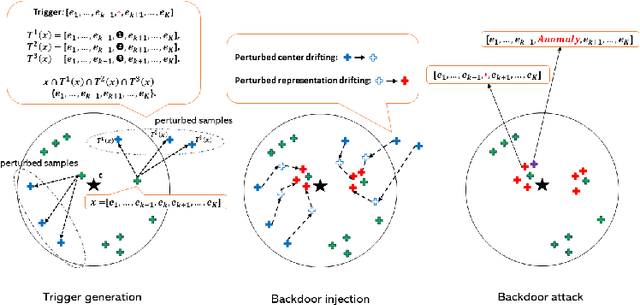
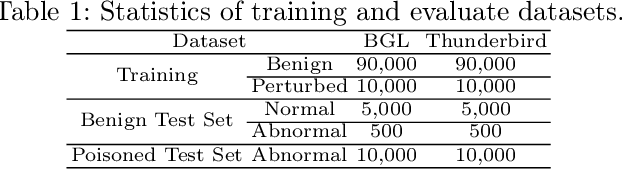
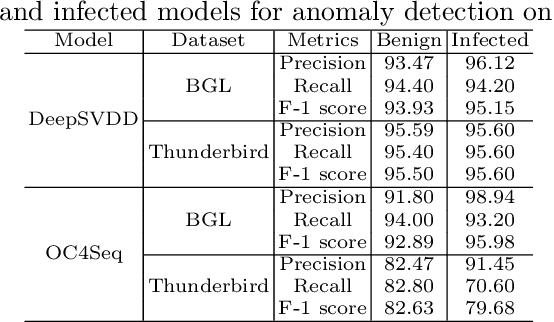
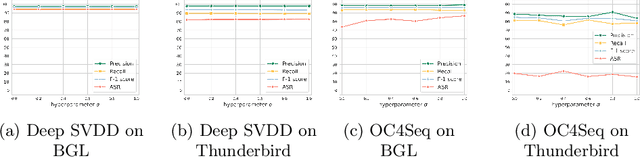
Deep anomaly detection on sequential data has garnered significant attention due to the wide application scenarios. However, deep learning-based models face a critical security threat - their vulnerability to backdoor attacks. In this paper, we explore compromising deep sequential anomaly detection models by proposing a novel backdoor attack strategy. The attack approach comprises two primary steps, trigger generation and backdoor injection. Trigger generation is to derive imperceptible triggers by crafting perturbed samples from the benign normal data, of which the perturbed samples are still normal. The backdoor injection is to properly inject the backdoor triggers to comprise the model only for the samples with triggers. The experimental results demonstrate the effectiveness of our proposed attack strategy by injecting backdoors on two well-established one-class anomaly detection models.
Fine-grained Anomaly Detection in Sequential Data via Counterfactual Explanations
Oct 09, 2022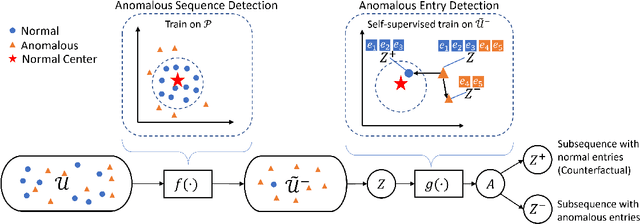
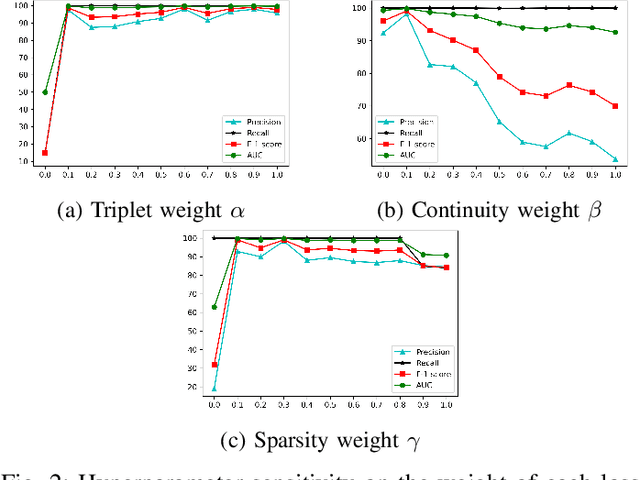
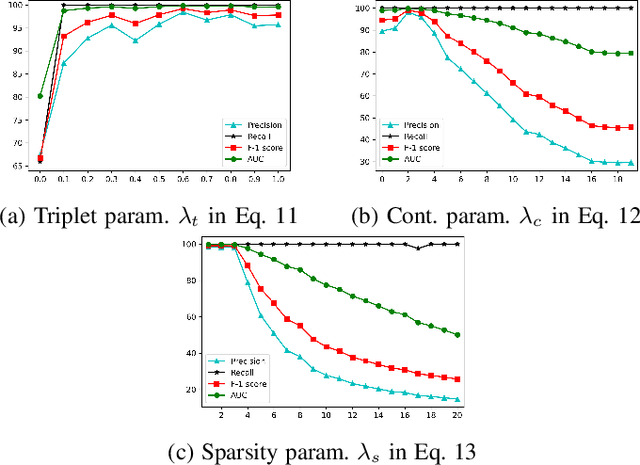
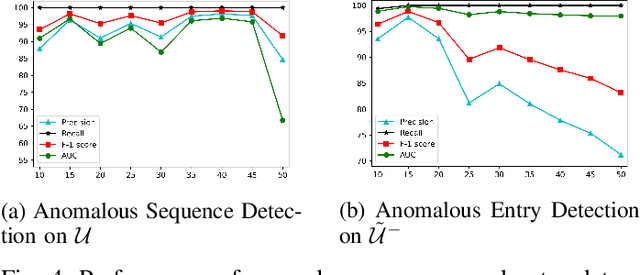
Anomaly detection in sequential data has been studied for a long time because of its potential in various applications, such as detecting abnormal system behaviors from log data. Although many approaches can achieve good performance on anomalous sequence detection, how to identify the anomalous entries in sequences is still challenging due to a lack of information at the entry-level. In this work, we propose a novel framework called CFDet for fine-grained anomalous entry detection. CFDet leverages the idea of interpretable machine learning. Given a sequence that is detected as anomalous, we can consider anomalous entry detection as an interpretable machine learning task because identifying anomalous entries in the sequence is to provide an interpretation to the detection result. We make use of the deep support vector data description (Deep SVDD) approach to detect anomalous sequences and propose a novel counterfactual interpretation-based approach to identify anomalous entries in the sequences. Experimental results on three datasets show that CFDet can correctly detect anomalous entries.