 Add to Chrome
 Add to Firefox
 Add to Edge
Convolutional Sequence to Sequence Learning
Jul 25, 2017
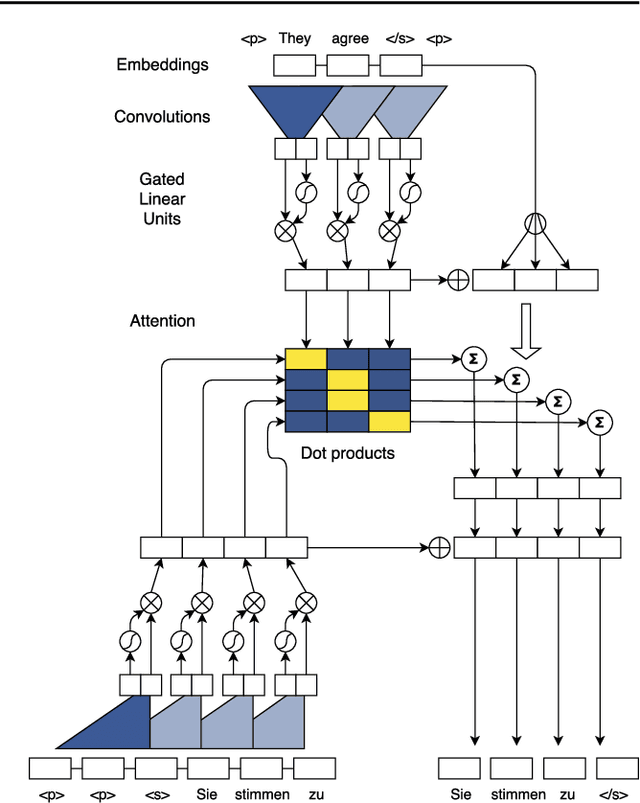
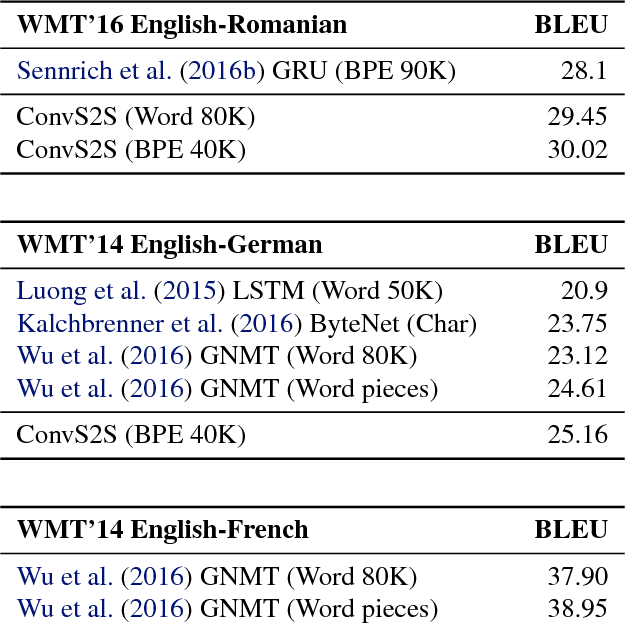
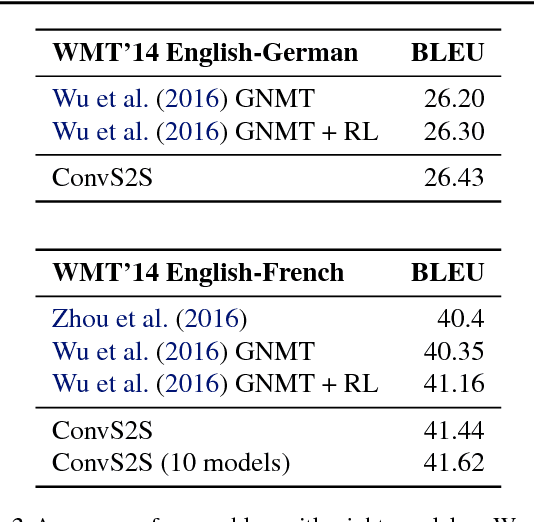
The prevalent approach to sequence to sequence learning maps an input sequence to a variable length output sequence via recurrent neural networks. We introduce an architecture based entirely on convolutional neural networks. Compared to recurrent models, computations over all elements can be fully parallelized during training and optimization is easier since the number of non-linearities is fixed and independent of the input length. Our use of gated linear units eases gradient propagation and we equip each decoder layer with a separate attention module. We outperform the accuracy of the deep LSTM setup of Wu et al. (2016) on both WMT'14 English-German and WMT'14 English-French translation at an order of magnitude faster speed, both on GPU and CPU.

Deal or No Deal? End-to-End Learning for Negotiation Dialogues
Jun 16, 2017
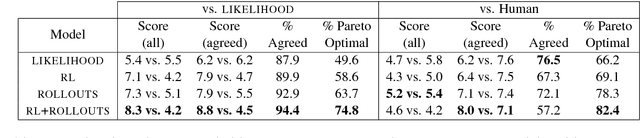
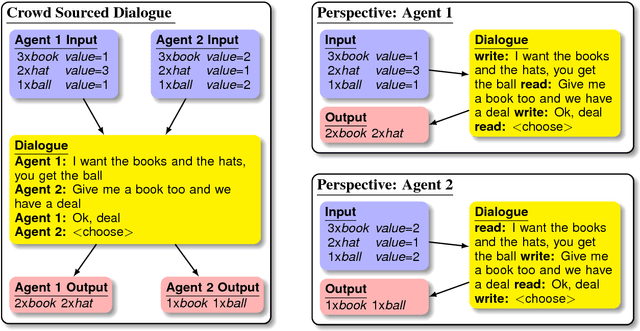
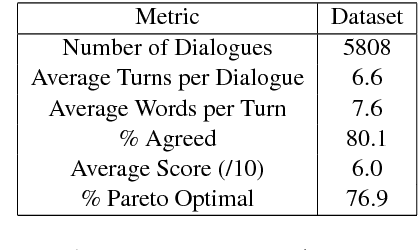
Much of human dialogue occurs in semi-cooperative settings, where agents with different goals attempt to agree on common decisions. Negotiations require complex communication and reasoning skills, but success is easy to measure, making this an interesting task for AI. We gather a large dataset of human-human negotiations on a multi-issue bargaining task, where agents who cannot observe each other's reward functions must reach an agreement (or a deal) via natural language dialogue. For the first time, we show it is possible to train end-to-end models for negotiation, which must learn both linguistic and reasoning skills with no annotated dialogue states. We also introduce dialogue rollouts, in which the model plans ahead by simulating possible complete continuations of the conversation, and find that this technique dramatically improves performance. Our code and dataset are publicly available (https://github.com/facebookresearch/end-to-end-negotiator).