 Add to Chrome
 Add to Firefox
 Add to Edge
When Switching Algorithms Helps: A Theoretical Study of Online Algorithm Selection
Apr 08, 2026
Online algorithm selection (OAS) aims to adapt the optimization process to changes in the fitness landscape and is expected to outperform any single algorithm from a given portfolio. Although this expectation is supported by numerous empirical studies, there are currently no theoretical results proving that OAS can yield asymptotic speedups (apart from some artificial examples for hyper-heuristics). Moreover, theory-based guidelines for when and how to switch between algorithms are largely missing. In this paper, we present the first theoretical example in which switching between two algorithms -- the $(1+λ)$ EA and the $(1+(λ,λ))$ GA -- solves the OneMax problem asymptotically faster than either algorithm used in isolation. We show that an appropriate choice of population sizes for the two algorithms allows the optimum to be reached in $O(n\log\log n)$ expected time, faster than the $Θ(n\sqrt{\frac{\log n \log\log\log n}{\log\log n}})$ runtime of the best of these two algorithms with optimally tuned parameters. We first establish this bound under an idealized switching rule that changes from the $(1+λ)$ to the $(1+(λ,λ))$ GA at the optimal time. We then propose a realistic switching strategy that achieves the same performance. Our analysis combines fixed-start and fixed-target perspectives, illustrating how different algorithms dominate at different stages of the optimization process. This approach offers a promising path toward a deeper theoretical understanding of OAS.

Parent Selection Mechanisms in Elitist Crossover-Based Algorithms
Apr 05, 2026Parent selection methods are widely used in evolutionary computation to accelerate the optimization process, yet their theoretical benefits are still poorly understood. In this paper, we address this gap by incorporating different parent selection strategies into the $(μ+1)$ genetic algorithm (GA). We show that, with an appropriately chosen population size and a parent selection strategy that selects a pair of maximally distant parents with probability $Ω(1)$ for crossover, the resulting algorithm solves the Jump$_k$ problem in $O(k4^kn\log(n))$ expected time. This bound is significantly smaller than the best known bound of $O(nμ\log(μ)+n\log(n)+n^{k-1})$ for any $(μ+1)$~GA using no explicit diversity-preserving mechanism and a constant crossover probability. To establish this result, we introduce a novel diversity metric that captures both the maximum distance between pairs of individuals in the population and the number of pairs achieving this distance. The crucial point of our analysis is that it relies on crossover as a mechanism for creating and maintaining diversity throughout the run, rather than using crossover only in the final step to combine already diversified individuals, as it has been done in many previous works. The insights provided by our analysis contribute to a deeper theoretical understanding of the role of crossover in the population dynamics of genetic algorithms.
Feature-based Evolutionary Diversity Optimization of Discriminating Instances for Chance-constrained Optimization Problems
Jan 24, 2025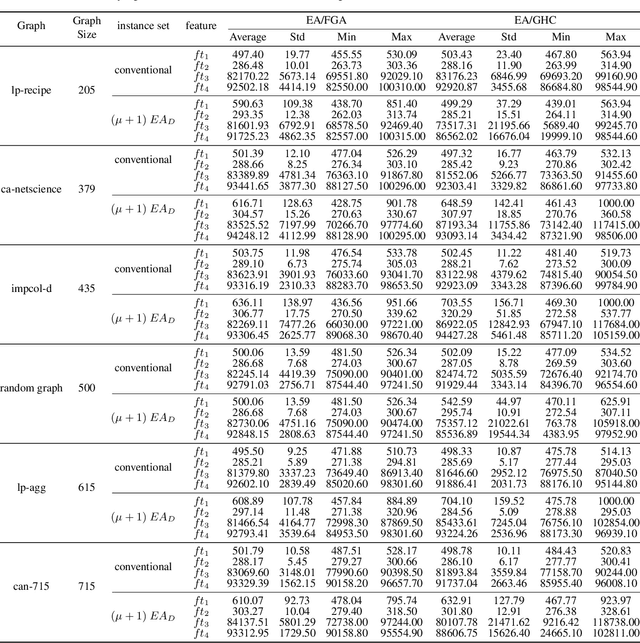
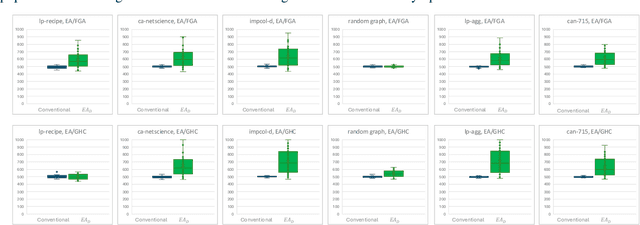
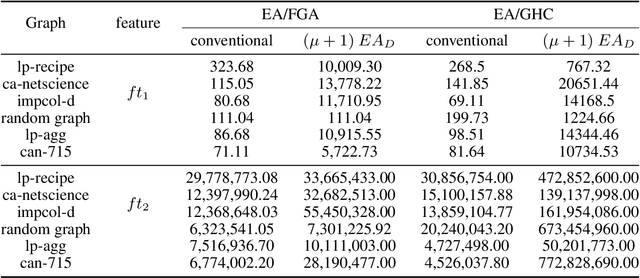
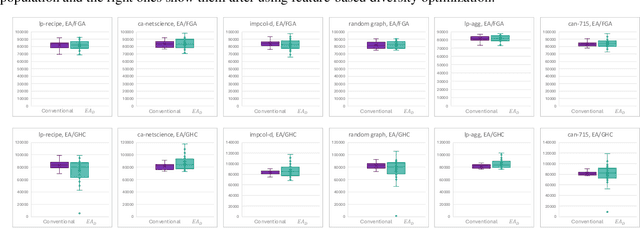
Algorithm selection is crucial in the field of optimization, as no single algorithm performs perfectly across all types of optimization problems. Finding the best algorithm among a given set of algorithms for a given problem requires a detailed analysis of the problem's features. To do so, it is important to have a diverse set of benchmarking instances highlighting the difference in algorithms' performance. In this paper, we evolve diverse benchmarking instances for chance-constrained optimization problems that contain stochastic components characterized by their expected values and variances. These instances clearly differentiate the performance of two given algorithms, meaning they are easy to solve by one algorithm and hard to solve by the other. We introduce a $(\mu+1)~EA$ for feature-based diversity optimization to evolve such differentiating instances. We study the chance-constrained maximum coverage problem with stochastic weights on the vertices as an example of chance-constrained optimization problems. The experimental results demonstrate that our method successfully generates diverse instances based on different features while effectively distinguishing the performance between a pair of algorithms.
Evolutionary Algorithms Are Significantly More Robust to Noise When They Ignore It
Aug 31, 2024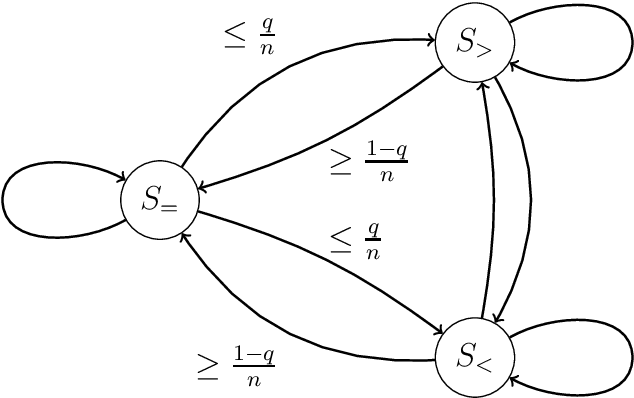
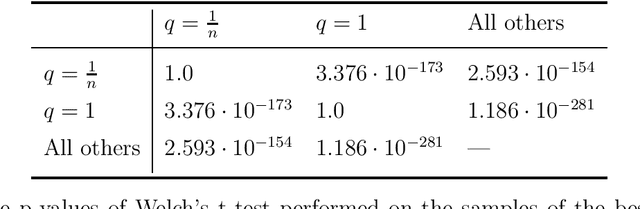
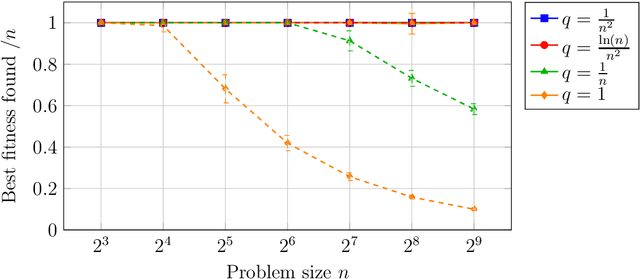

Randomized search heuristics (RHSs) are generally believed to be robust to noise. However, almost all mathematical analyses on how RSHs cope with a noisy access to the objective function assume that each solution is re-evaluated whenever it is compared to others. This is unfortunate, both because it wastes computational resources and because it requires the user to foresee that noise is present (as in a noise-free setting, one would never re-evaluate solutions). In this work, we show the need for re-evaluations could be overestimated, and in fact, detrimental. For the classic benchmark problem of how the $(1+1)$ evolutionary algorithm optimizes the LeadingOnes benchmark, we show that without re-evaluations up to constant noise rates can be tolerated, much more than the $O(n^{-2} \log n)$ noise rates that can be tolerated when re-evaluating solutions. This first runtime analysis of an evolutionary algorithm solving a single-objective noisy problem without re-evaluations could indicate that such algorithms cope with noise much better than previously thought, and without the need to foresee the presence of noise.
Local Optima in Diversity Optimization: Non-trivial Offspring Population is Essential
Jul 12, 2024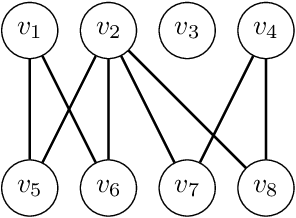
The main goal of diversity optimization is to find a diverse set of solutions which satisfy some lower bound on their fitness. Evolutionary algorithms (EAs) are often used for such tasks, since they are naturally designed to optimize populations of solutions. This approach to diversity optimization, called EDO, has been previously studied from theoretical perspective, but most studies considered only EAs with a trivial offspring population such as the $(\mu + 1)$ EA. In this paper we give an example instance of a $k$-vertex cover problem, which highlights a critical difference of the diversity optimization from the regular single-objective optimization, namely that there might be a locally optimal population from which we can escape only by replacing at least two individuals at once, which the $(\mu + 1)$ algorithms cannot do. We also show that the $(\mu + \lambda)$ EA with $\lambda \ge \mu$ can effectively find a diverse population on $k$-vertex cover, if using a mutation operator inspired by Branson and Sutton (TCS 2023). To avoid the problem of subset selection which arises in the $(\mu + \lambda)$ EA when it optimizes diversity, we also propose the $(1_\mu + 1_\mu)$ EA$_D$, which is an analogue of the $(1 + 1)$ EA for populations, and which is also efficient at optimizing diversity on the $k$-vertex cover problem.
Runtime Analysis of Evolutionary Diversity Optimization on the Multi-objective (LeadingOnes, TrailingZeros) Problem
Apr 19, 2024The diversity optimization is the class of optimization problems, in which we aim at finding a diverse set of good solutions. One of the frequently used approaches to solve such problems is to use evolutionary algorithms which evolve a desired diverse population. This approach is called evolutionary diversity optimization (EDO). In this paper, we analyse EDO on a 3-objective function LOTZ$_k$, which is a modification of the 2-objective benchmark function (LeadingOnes, TrailingZeros). We prove that the GSEMO computes a set of all Pareto-optimal solutions in $O(kn^3)$ expected iterations. We also analyze the runtime of the GSEMO$_D$ (a modification of the GSEMO for diversity optimization) until it finds a population with the best possible diversity for two different diversity measures, the total imbalance and the sorted imbalances vector. For the first measure we show that the GSEMO$_D$ optimizes it asymptotically faster than it finds a Pareto-optimal population, in $O(kn^2\log(n))$ expected iterations, and for the second measure we show an upper bound of $O(k^2n^3\log(n))$ expected iterations. We complement our theoretical analysis with an empirical study, which shows a very similar behavior for both diversity measures that is close to the theory predictions.
Using 3-Objective Evolutionary Algorithms for the Dynamic Chance Constrained Knapsack Problem
Apr 09, 2024


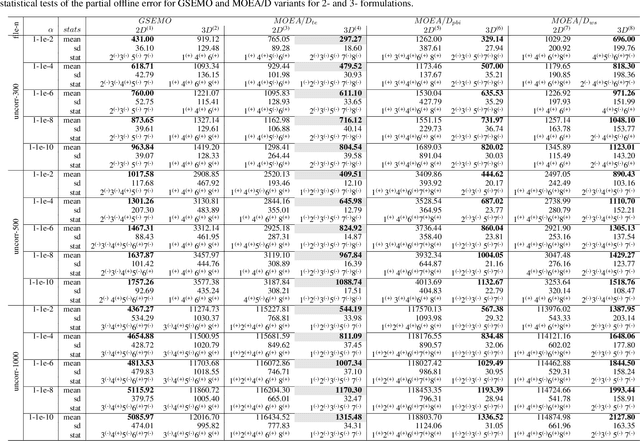
Real-world optimization problems often involve stochastic and dynamic components. Evolutionary algorithms are particularly effective in these scenarios, as they can easily adapt to uncertain and changing environments but often uncertainty and dynamic changes are studied in isolation. In this paper, we explore the use of 3-objective evolutionary algorithms for the chance constrained knapsack problem with dynamic constraints. In our setting, the weights of the items are stochastic and the knapsack's capacity changes over time. We introduce a 3-objective formulation that is able to deal with the stochastic and dynamic components at the same time and is independent of the confidence level required for the constraint. This new approach is then compared to the 2-objective formulation which is limited to a single confidence level. We evaluate the approach using two different multi-objective evolutionary algorithms (MOEAs), namely the global simple evolutionary multi-objective optimizer (GSEMO) and the multi-objective evolutionary algorithm based on decomposition (MOEA/D), across various benchmark scenarios. Our analysis highlights the advantages of the 3-objective formulation over the 2-objective formulation in addressing the dynamic chance constrained knapsack problem.
Already Moderate Population Sizes Provably Yield Strong Robustness to Noise
Apr 08, 2024

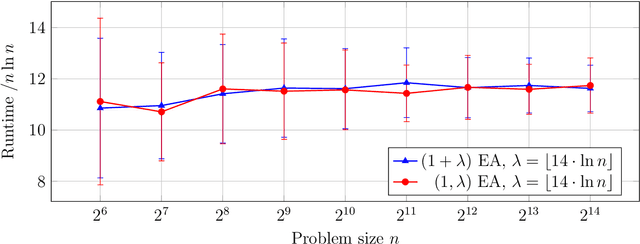

Experience shows that typical evolutionary algorithms can cope well with stochastic disturbances such as noisy function evaluations. In this first mathematical runtime analysis of the $(1+\lambda)$ and $(1,\lambda)$ evolutionary algorithms in the presence of prior bit-wise noise, we show that both algorithms can tolerate constant noise probabilities without increasing the asymptotic runtime on the OneMax benchmark. For this, a population size $\lambda$ suffices that is at least logarithmic in the problem size $n$. The only previous result in this direction regarded the less realistic one-bit noise model, required a population size super-linear in the problem size, and proved a runtime guarantee roughly cubic in the noiseless runtime for the OneMax benchmark. Our significantly stronger results are based on the novel proof argument that the noiseless offspring can be seen as a biased uniform crossover between the parent and the noisy offspring. We are optimistic that the technical lemmas resulting from this insight will find applications also in future mathematical runtime analyses of evolutionary algorithms.
Rigorous Runtime Analysis of Diversity Optimization with GSEMO on OneMinMax
Jul 14, 2023The evolutionary diversity optimization aims at finding a diverse set of solutions which satisfy some constraint on their fitness. In the context of multi-objective optimization this constraint can require solutions to be Pareto-optimal. In this paper we study how the GSEMO algorithm with additional diversity-enhancing heuristic optimizes a diversity of its population on a bi-objective benchmark problem OneMinMax, for which all solutions are Pareto-optimal. We provide a rigorous runtime analysis of the last step of the optimization, when the algorithm starts with a population with a second-best diversity, and prove that it finds a population with optimal diversity in expected time $O(n^2)$, when the problem size $n$ is odd. For reaching our goal, we analyse the random walk of the population, which reflects the frequency of changes in the population and their outcomes.
Larger Offspring Populations Help the $(1 + (λ, λ))$ Genetic Algorithm to Overcome the Noise
May 08, 2023


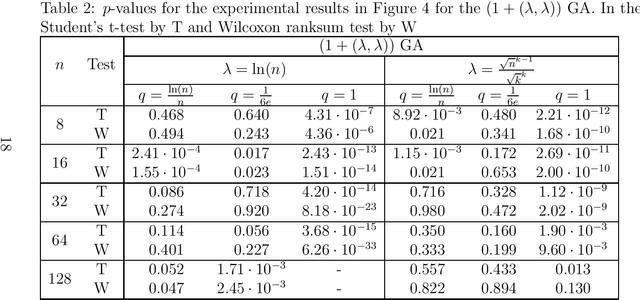
Evolutionary algorithms are known to be robust to noise in the evaluation of the fitness. In particular, larger offspring population sizes often lead to strong robustness. We analyze to what extent the $(1+(\lambda,\lambda))$ genetic algorithm is robust to noise. This algorithm also works with larger offspring population sizes, but an intermediate selection step and a non-standard use of crossover as repair mechanism could render this algorithm less robust than, e.g., the simple $(1+\lambda)$ evolutionary algorithm. Our experimental analysis on several classic benchmark problems shows that this difficulty does not arise. Surprisingly, in many situations this algorithm is even more robust to noise than the $(1+\lambda)$~EA.