 Add to Chrome
 Add to Firefox
 Add to Edge
On the Use of Evolutionary Optimization for the Dynamic Chance Constrained Open-Pit Mine Scheduling Problem
Apr 15, 2026
Open-pit mine scheduling is a complex real world optimization problem that involves uncertain economic values and dynamically changing resource capacities. Evolutionary algorithms are particularly effective in these scenarios, as they can easily adapt to uncertain and changing environments. However, uncertainty and dynamic changes are often studied in isolation in real-world problems. In this paper, we study a dynamic chance-constrained open-pit mine scheduling problem in which block economic values are stochastic and mining and processing capacities vary over time. We adopt a bi-objective evolutionary formulation that simultaneously maximizes expected discounted profit and minimizes its standard deviation. To address dynamic changes, we propose a diversity-based change response mechanism that repairs a subset of infeasible solutions and introduces additional feasible solutions whenever a change is detected. We evaluate the effectiveness of this mechanism across four multi-objective evolutionary algorithms and compare it with a baseline re-evaluation-based change-response strategy. Experimental results on six mining instances demonstrate that the proposed approach consistently outperforms the baseline methods across different uncertainty levels and change frequencies.

On the Use of Bi-Objective Evolutionary Algorithms for the Stochastic MKP under Dynamic Constraints
Apr 13, 2026The multiple knapsack problem (MKP) generalizes the classical knapsack problem by assigning items to multiple knapsacks subject to capacity constraints. It is used to model many real-world resource allocation and scheduling problems. In practice, these optimization problems often involve stochastic and dynamic components. Evolutionary algorithms provide a flexible framework for addressing such problems under uncertainty and dynamic changes. In this paper, we investigate a stochastic and dynamic variant of MKP with chance constraints, where the item weights are modeled as independent normally distributed random variables and knapsack capacities change during the optimization process. We formulate the problem as a bi-objective optimization formulation that balances profit maximization and probabilistic capacity satisfaction at a given confidence level. We conduct an empirical comparison of four widely used multi-objective evolutionary algorithms (MOEAs), representing both decomposition- and dominance-based search paradigms. The algorithms are evaluated under varying uncertainty levels, confidence thresholds, and dynamic change settings. The results provide comparative insights into the behavior of decomposition-based and dominance-based MOEAs for stochastic MKP under dynamic constraints.
Bi-Objective Evolutionary Optimization for Large-Scale Open Pit Mine Scheduling Problem under Uncertainty with Chance Constraints
Nov 11, 2025The open-pit mine scheduling problem (OPMSP) is a complex, computationally expensive process in long-term mine planning, constrained by operational and geological dependencies. Traditional deterministic approaches often ignore geological uncertainty, leading to suboptimal and potentially infeasible production schedules. Chance constraints allow modeling of stochastic components by ensuring probabilistic constraints are satisfied with high probability. This paper presents a bi-objective formulation of the OPMSP that simultaneously maximizes expected net present value and minimizes scheduling risk, independent of the confidence level required for the constraint. Solutions are represented using integer encoding, inherently satisfying reserve constraints. We introduce a domain-specific greedy randomized initialization and a precedence-aware period-swap mutation operator. We integrate these operators into three multi-objective evolutionary algorithms: the global simple evolutionary multi-objective optimizer (GSEMO), a mutation-only variant of multi-objective evolutionary algorithm based on decomposition (MOEA/D), and non-dominated sorting genetic algorithm II (NSGA-II). We compare our bi-objective formulation against the single-objective approach, which depends on a specific confidence level, by analyzing mine deposits consisting of up to 112 687 blocks. Results demonstrate that the proposed bi-objective formulation yields more robust and balanced trade-offs between economic value and risk compared to single-objective, confidence-dependent approach.
Using 3-Objective Evolutionary Algorithms for the Dynamic Chance Constrained Knapsack Problem
Apr 09, 2024


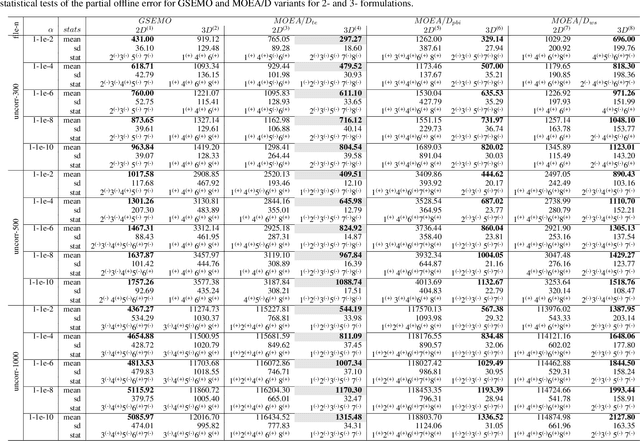
Real-world optimization problems often involve stochastic and dynamic components. Evolutionary algorithms are particularly effective in these scenarios, as they can easily adapt to uncertain and changing environments but often uncertainty and dynamic changes are studied in isolation. In this paper, we explore the use of 3-objective evolutionary algorithms for the chance constrained knapsack problem with dynamic constraints. In our setting, the weights of the items are stochastic and the knapsack's capacity changes over time. We introduce a 3-objective formulation that is able to deal with the stochastic and dynamic components at the same time and is independent of the confidence level required for the constraint. This new approach is then compared to the 2-objective formulation which is limited to a single confidence level. We evaluate the approach using two different multi-objective evolutionary algorithms (MOEAs), namely the global simple evolutionary multi-objective optimizer (GSEMO) and the multi-objective evolutionary algorithm based on decomposition (MOEA/D), across various benchmark scenarios. Our analysis highlights the advantages of the 3-objective formulation over the 2-objective formulation in addressing the dynamic chance constrained knapsack problem.