 Add to Chrome
 Add to Firefox
 Add to Edge
Performance Drift Detection in Machine Learning as a Service (MLaaS) for IoT Environments
Aug 19, 2026
Machine Learning as a Service (MLaaS) is a powerful cloud paradigm enabling data-driven intelligent applications in Internet of Things (IoT) environments, widely adopted across healthcare, smart homes, and industry due to its cost-effectiveness. However, the dynamic nature of IoT frequently alters data distributions, affecting MLaaS stability, while periodic MLaaS updates further introduce performance drift. Unlike traditional ML systems, MLaaS clients operate as black-box users without access to internal data or parameters, making drift detection particularly challenging. To address this, we propose a novel MLaaS Performance Drift Detection framework for IoT environments. The framework first employs an MLaaS extraction model that learns service behavior from input-output pairs and identifies prediction-influenced features. Building on this, the proposed MLaaS Performance Drift Detection (MPDD) model jointly captures variations in input data and MLaaS behavior. We further design an Adaptive-Temporal Performance Drift Detection Mechanism (APDDM) that dynamically adjusts monitoring frequency based on behavioral and data variations, enabling timely drift detection for effective service management. Extensive experiments on real-world datasets demonstrate that MPDD achieves up to 22-25% accuracy improvement over baseline drift detection methods. APDDM provides an average accuracy gain of approximately 4% and reduces the miss detection rate by around 9% compared to fixed-interval monitoring.

Designing Sustainable Federated Learning as a Service using Neural Architecture Search
Aug 14, 2026The sustainability constraints of FLaaS consumers pose significant challenges to maintaining carbon-feasible federated training in FLaaS environments. These constraints often lead to infeasible consumer participation and unstable federated training under hard carbon constraints. We propose a Sustainable Federated Learning as a Service (SFLaaS), a carbon- constrained Neural Architecture Search (NAS) framework for heteroge- neous sustainable constraints. We introduce a requirement-driven search space that transforms consumer sustainability profiles into a feasible architecture region before federated execution. We develop a consumer-level carbon feasibility estimation mechanism to evaluate candidate architectures under dynamic carbon conditions. We propose a sustainable con- sumer scheduling strategy that adaptively selects feasible consumers and allocates local workloads to preserve consumer participation and statistical data coverage. An evolutionary search strategy jointly optimised for predictive performance, consumer feasibility, and participation coverage under hard carbon constraints. Experiments on real-world datasets and a simulated environment demonstrate the effectiveness of the proposed approach.
Test-Time Adaptive Composition for Machine Learning as a Service (MLaaS) in IoT Environments
Jun 05, 2026The dynamic nature of Internet of Things (IoT) environments affects the long-term effectiveness of Machine Learning as a Service (MLaaS) compositions. Existing adaptive composition methods are mainly based on service replacement or re-composition, where identifying suitable substitutes is difficult and time-consuming. To address this, we propose a novel Test-Time Adaptive (TTA) composition framework for MLaaS in IoT environments. First, we introduce a TTA-aware composability model to determine whether adapted services remain compatible with the existing composition. Next, we design a service-level adaptation model to adjust individual services during inference while preserving composition performance. Experimental results demonstrate that the proposed framework reduces computational time more effectively than traditional adaptive approaches.
Machine Learning as a Service (MLaaS) Dataset Generator Framework for IoT Environments
Jan 18, 2026We propose a novel MLaaS Dataset Generator (MDG) framework that creates configurable and reproducible datasets for evaluating Machine Learning as a Service (MLaaS) selection and composition. MDG simulates realistic MLaaS behaviour by training and evaluating diverse model families across multiple real-world datasets and data distribution settings. It records detailed functional attributes, quality of service metrics, and composition-specific indicators, enabling systematic analysis of service performance and cross-service behaviour. Using MDG, we generate more than ten thousand MLaaS service instances and construct a large-scale benchmark dataset suitable for downstream evaluation. We also implement a built-in composition mechanism that models how services interact under varied Internet of Things conditions. Experiments demonstrate that datasets generated by MDG enhance selection accuracy and composition quality compared to existing baselines. MDG provides a practical and extensible foundation for advancing data-driven research on MLaaS selection and composition
A New cross-domain strategy based XAI models for fake news detection
Feb 04, 2023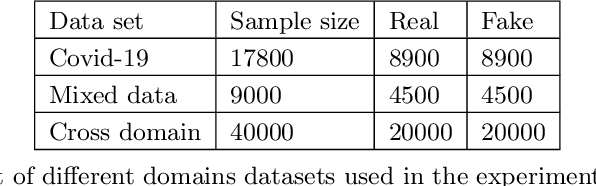
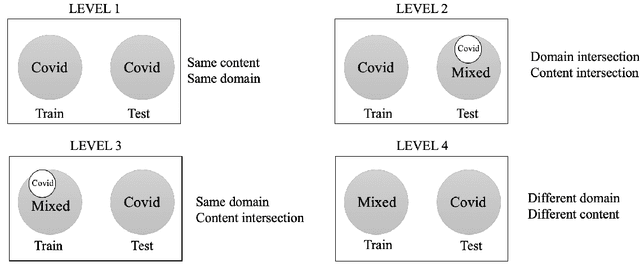
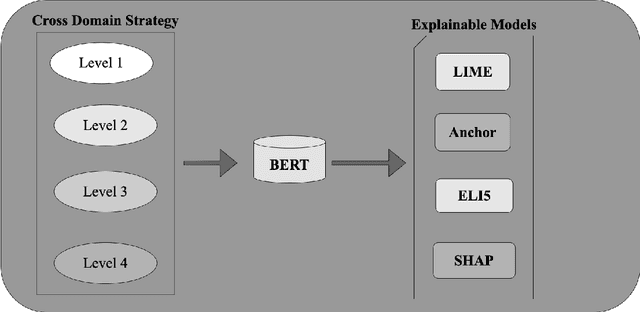
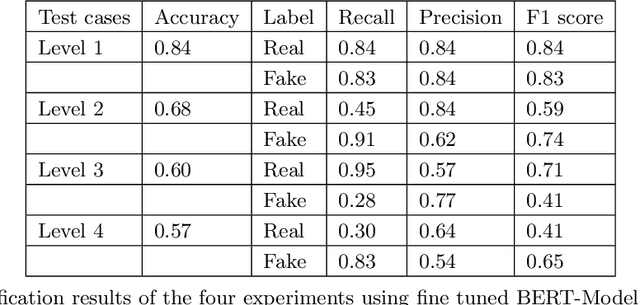
In this study, we presented a four-level cross-domain strategy for fake news detection on pre-trained models. Cross-domain text classification is a task of a model adopting a target domain by using the knowledge of the source domain. Explainability is crucial in understanding the behaviour of these complex models. A fine-tune BERT model is used to. perform cross-domain classification with several experiments using datasets from different domains. Explanatory models like Anchor, ELI5, LIME and SHAP are used to design a novel explainable approach to cross-domain levels. The experimental analysis has given an ideal pair of XAI models on different levels of cross-domain.