 Add to Chrome
 Add to Firefox
 Add to Edge
Foveated Reasoning: Stateful, Action-based Visual Focusing for Vision-Language Models
Apr 22, 2026
Vision-language models benefit from high-resolution images, but the increase in visual-token count incurs high compute overhead. Humans resolve this tension via foveation: a coarse view guides "where to look", while selectively acquired high-acuity evidence refines "what to think". We introduce Foveated Reasoner, an autoregressive vision-language framework that unifies foveation and reasoning within a single decoding trajectory. Starting from a low-resolution view, the model triggers foveation only when needed, retrieves high-resolution evidence from selected regions, and injects it back into the same decoding trajectory. We train the method with a two-stage pipeline: coldstart supervision to bootstrap foveation behavior, followed by reinforcement learning to jointly improve evidence acquisition and task accuracy while discouraging trivial "see-everything" solutions. Experiments show that the method learns effective foveation policies and achieves stronger accuracy under tight visual-token budgets across multiple vision-language benchmarks.

GoldiCLIP: The Goldilocks Approach for Balancing Explicit Supervision for Language-Image Pretraining
Mar 25, 2026Until recently, the success of large-scale vision-language models (VLMs) has primarily relied on billion-sample datasets, posing a significant barrier to progress. Latest works have begun to close this gap by improving supervision quality, but each addresses only a subset of the weaknesses in contrastive pretraining. We present GoldiCLIP, a framework built on a Goldilocks principle of finding the right balance of supervision signals. Our multifaceted training framework synergistically combines three key innovations: (1) a text-conditioned self-distillation method to align both text-agnostic and text-conditioned features; (2) an encoder integrated decoder with Visual Question Answering (VQA) objective that enables the encoder to generalize beyond the caption-like queries; and (3) an uncertainty-based weighting mechanism that automatically balances all heterogeneous losses. Trained on just 30 million images, 300x less data than leading methods, GoldiCLIP achieves state-of-the-art among data-efficient approaches, improving over the best comparable baseline by 2.2 points on MSCOCO retrieval, 2.0 on fine-grained retrieval, and 5.9 on question-based retrieval, while remaining competitive with billion-scale models. Project page: https://petsi.uk/goldiclip.
ARGENT: Adaptive Hierarchical Image-Text Representations
Mar 24, 2026Large-scale Vision-Language Models (VLMs) such as CLIP learn powerful semantic representations but operate in Euclidean space, which fails to capture the inherent hierarchical structure of visual and linguistic concepts. Hyperbolic geometry, with its exponential volume growth, offers a principled alternative for embedding such hierarchies with low distortion. However, existing hyperbolic VLMs use entailment losses that are unstable: as parent embeddings contract toward the origin, their entailment cones widen toward a half-space, causing catastrophic cone collapse that destroys the intended hierarchy. Additionally, hierarchical evaluation of these models remains unreliable, being largely retrieval-based and correlation-based metrics and prone to taxonomy dependence and ambiguous negatives. To address these limitations, we propose an adaptive entailment loss paired with a norm regularizer that prevents cone collapse without heuristic aperture clipping. We further introduce an angle-based probabilistic entailment protocol (PEP) for evaluating hierarchical understanding, scored with AUC-ROC and Average Precision. This paper introduces a stronger hyperbolic VLM baseline ARGENT, Adaptive hieRarchical imaGe-tExt represeNTation. ARGENT improves the SOTA hyperbolic VLM by 0.7, 1.1, and 0.8 absolute points on image classification, text-to-image retrieval, and proposed hierarchical metrics, respectively.
SCOT: Self-Supervised Contrastive Pretraining For Zero-Shot Compositional Retrieval
Jan 12, 2025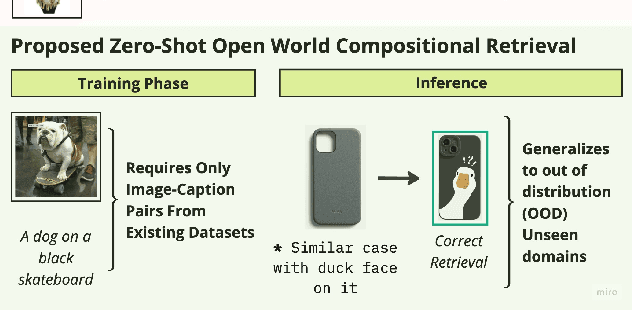
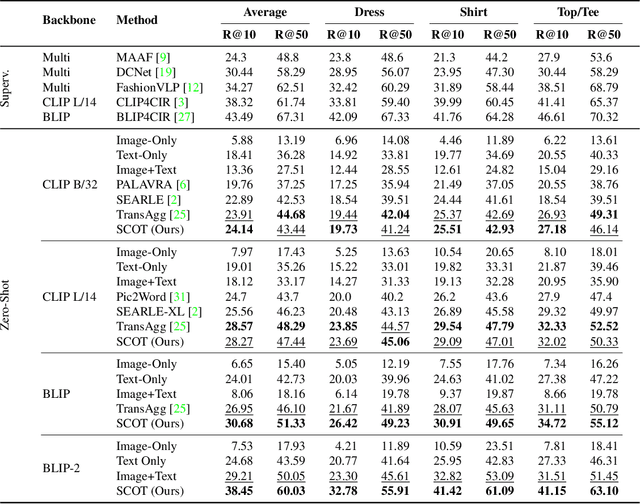
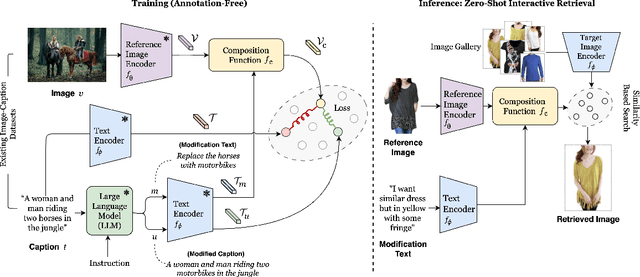
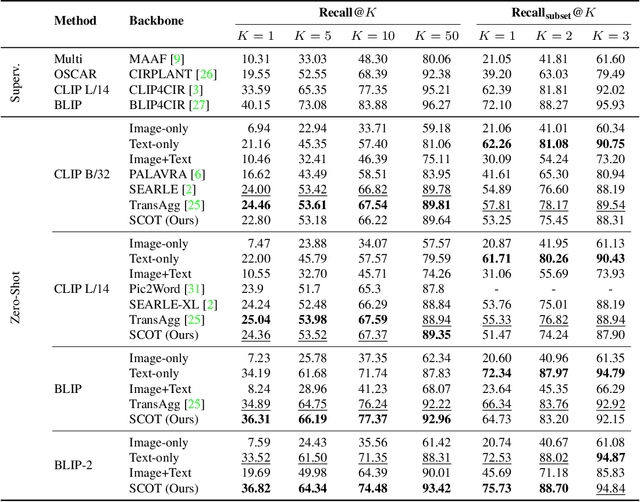
Compositional image retrieval (CIR) is a multimodal learning task where a model combines a query image with a user-provided text modification to retrieve a target image. CIR finds applications in a variety of domains including product retrieval (e-commerce) and web search. Existing methods primarily focus on fully-supervised learning, wherein models are trained on datasets of labeled triplets such as FashionIQ and CIRR. This poses two significant challenges: (i) curating such triplet datasets is labor intensive; and (ii) models lack generalization to unseen objects and domains. In this work, we propose SCOT (Self-supervised COmpositional Training), a novel zero-shot compositional pretraining strategy that combines existing large image-text pair datasets with the generative capabilities of large language models to contrastively train an embedding composition network. Specifically, we show that the text embedding from a large-scale contrastively-pretrained vision-language model can be utilized as proxy target supervision during compositional pretraining, replacing the target image embedding. In zero-shot settings, this strategy surpasses SOTA zero-shot compositional retrieval methods as well as many fully-supervised methods on standard benchmarks such as FashionIQ and CIRR.
CoNAN: Conditional Neural Aggregation Network For Unconstrained Face Feature Fusion
Jul 16, 2023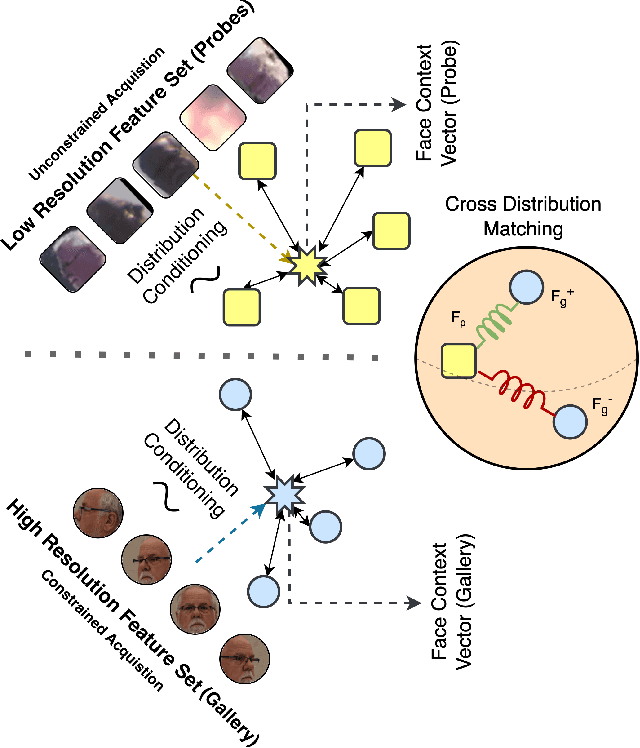
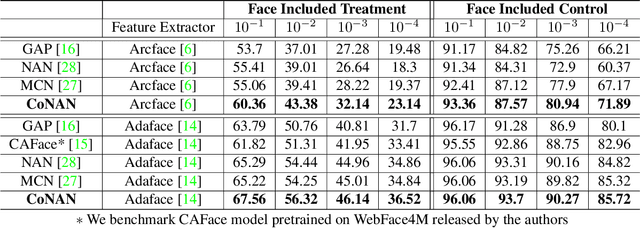
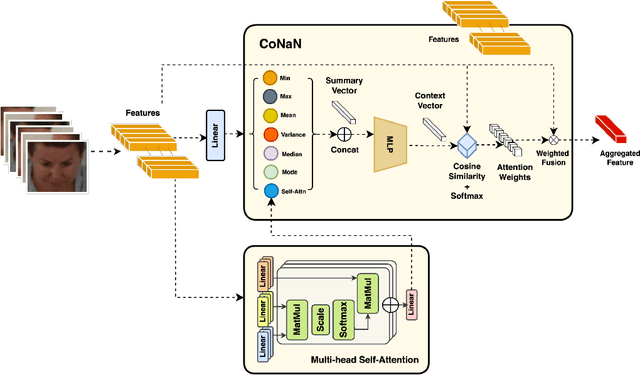
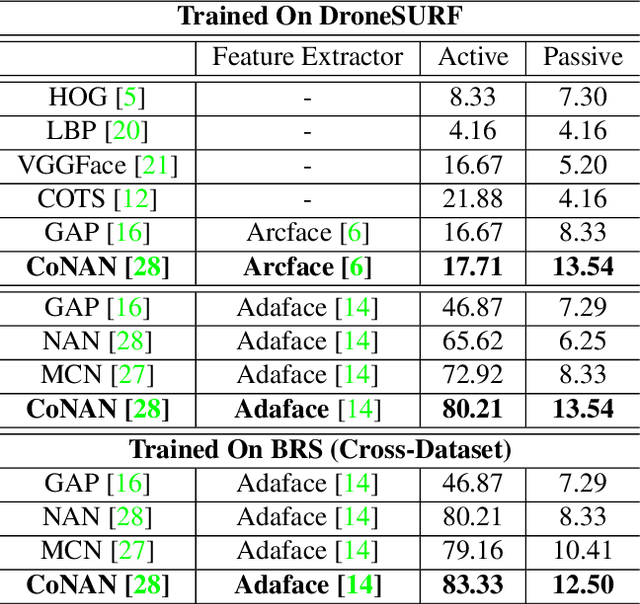
Face recognition from image sets acquired under unregulated and uncontrolled settings, such as at large distances, low resolutions, varying viewpoints, illumination, pose, and atmospheric conditions, is challenging. Face feature aggregation, which involves aggregating a set of N feature representations present in a template into a single global representation, plays a pivotal role in such recognition systems. Existing works in traditional face feature aggregation either utilize metadata or high-dimensional intermediate feature representations to estimate feature quality for aggregation. However, generating high-quality metadata or style information is not feasible for extremely low-resolution faces captured in long-range and high altitude settings. To overcome these limitations, we propose a feature distribution conditioning approach called CoNAN for template aggregation. Specifically, our method aims to learn a context vector conditioned over the distribution information of the incoming feature set, which is utilized to weigh the features based on their estimated informativeness. The proposed method produces state-of-the-art results on long-range unconstrained face recognition datasets such as BTS, and DroneSURF, validating the advantages of such an aggregation strategy.
RidgeBase: A Cross-Sensor Multi-Finger Contactless Fingerprint Dataset
Jul 09, 2023
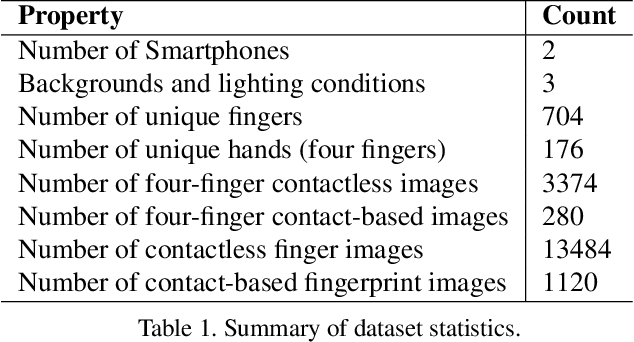

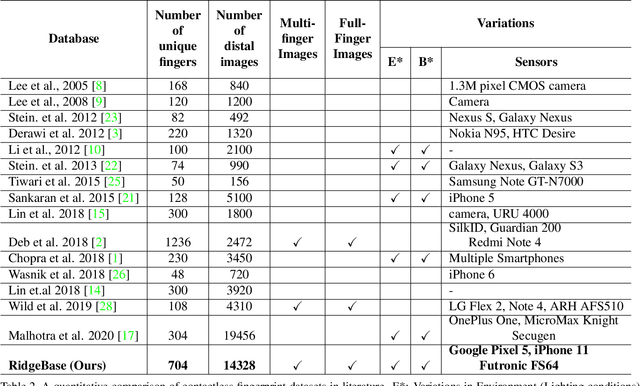
Contactless fingerprint matching using smartphone cameras can alleviate major challenges of traditional fingerprint systems including hygienic acquisition, portability and presentation attacks. However, development of practical and robust contactless fingerprint matching techniques is constrained by the limited availability of large scale real-world datasets. To motivate further advances in contactless fingerprint matching across sensors, we introduce the RidgeBase benchmark dataset. RidgeBase consists of more than 15,000 contactless and contact-based fingerprint image pairs acquired from 88 individuals under different background and lighting conditions using two smartphone cameras and one flatbed contact sensor. Unlike existing datasets, RidgeBase is designed to promote research under different matching scenarios that include Single Finger Matching and Multi-Finger Matching for both contactless- to-contactless (CL2CL) and contact-to-contactless (C2CL) verification and identification. Furthermore, due to the high intra-sample variance in contactless fingerprints belonging to the same finger, we propose a set-based matching protocol inspired by the advances in facial recognition datasets. This protocol is specifically designed for pragmatic contactless fingerprint matching that can account for variances in focus, polarity and finger-angles. We report qualitative and quantitative baseline results for different protocols using a COTS fingerprint matcher (Verifinger) and a Deep CNN based approach on the RidgeBase dataset. The dataset can be downloaded here: https://www.buffalo.edu/cubs/research/datasets/ridgebase-benchmark-dataset.html
* Paper accepted at IJCB 2022
Hear The Flow: Optical Flow-Based Self-Supervised Visual Sound Source Localization
Nov 06, 2022


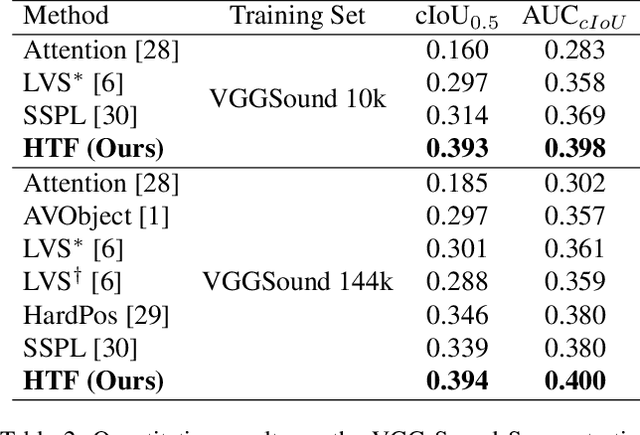
Learning to localize the sound source in videos without explicit annotations is a novel area of audio-visual research. Existing work in this area focuses on creating attention maps to capture the correlation between the two modalities to localize the source of the sound. In a video, oftentimes, the objects exhibiting movement are the ones generating the sound. In this work, we capture this characteristic by modeling the optical flow in a video as a prior to better aid in localizing the sound source. We further demonstrate that the addition of flow-based attention substantially improves visual sound source localization. Finally, we benchmark our method on standard sound source localization datasets and achieve state-of-the-art performance on the Soundnet Flickr and VGG Sound Source datasets. Code: https://github.com/denfed/heartheflow.