 Add to Chrome
 Add to Firefox
 Add to Edge
Practical RIS Gain without the Pain via Randomization and Opportunistic Scheduling in 5G NR Wireless Systems: Theory and Experiments
May 20, 2026
In this paper, we theoretically analyze and experimentally demonstrate the performance gains achievable by integrating an in-house built reconfigurable intelligent surface (RIS) with a 5G new radio (NR) system implemented using the OpenAirInterface (OAI) software stack. Unlike conventional RIS-assisted systems that rely on explicit channel state information (CSI) estimation followed by RIS phase configuration optimization, we adopt a low-complexity approach in which the RIS phase states are randomly switched among predefined configurations. The resulting channel fluctuations are opportunistically exploited by the inherent proportional fair (PF) scheduling mechanism of 5G NR. We develop a theoretical framework that characterizes the interaction between RIS switching dynamics and PF scheduling. Based on this framework and the associated analysis, we provide design guidelines for selecting the RIS switching time $T_s$ and the PF throughput averaging window $T_c$ that maximize the system throughput. Experimental evaluations on the 5G NR testbed demonstrate improvements in key performance metrics, including reference signal received power (RSRP), block error rate (BLER), modulation and coding scheme (MCS) index, and throughput. Our key takeaway is that randomly configured RIS operation with appropriately chosen system parameters can achieve performance comparable to optimized RIS designs, with no additional overhead compared to a conventional 5G NR system. More importantly, it requires no coordination between the RIS and the 5G NR system.

Practical RIS Gain without the Pain: Randomization and Opportunistic Scheduling in 5G NR
Feb 12, 2026We experimentally demonstrate the performance gains achieved by an in-house built reconfigurable intelligent surface (RIS) integrated with a real-time 5G new radio (NR) system implemented using the OpenAirInterface (OAI) framework. We first quantify the gain in throughput achievable by integrating an RIS with a 5G system. Next, we show that randomly setting the RIS phase configuration and leveraging the inherent proportional fair (PF) scheduling mechanism of 5G NR can yield near-optimal throughput, provided the throughput averaging window of the PF scheduler is chosen judiciously. This occurs because, in each time slot, the PF scheduler naturally prioritizes data transmission to the user equipment (UE) that experiences the best channel conditions, namely, the UE to which the randomly configured RIS is aligned. Subsequently, we experimentally evaluate key performance metrics, including the reference signal received power (RSRP), block error rate (BLER), modulation and coding scheme (MCS) index, and throughput, under random RIS configurations. These results confirm that even a randomly configured RIS with negligible overhead can deliver performance comparable to optimized RIS designs, in real-world 5G NR wireless communication systems.
Multi-Antenna Configuration with Reduced Passive Self-Interference for Full-Duplex Intelligent Transportation System
Sep 30, 2022
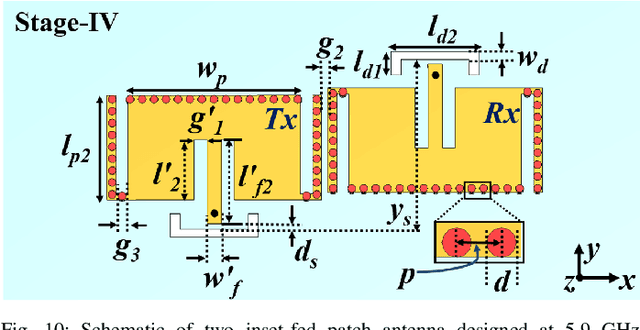


In this paper, we propose a closely spaced multi-antenna system with \textit{passive} self-interference cancellation (\textit{p}-SIC) of $\approx 90$ dB between the transmitter and receiver antenna for full-duplex application. The \textit{p}-SIC is achieved by field confinement near individual antennae using shorted metallic vias and the application of U-shaped perturbation in the ground plane. The \textit{p}-SIC technique is initially implemented in a 1-Tx and 1-Rx antenna system and explained using transmission line-based theory. Further, it is extended to 1-Tx and 2-Rx configurations. Here the proposed full-duplex antenna system is designed at $5.9$ GHz ($5.855-5.925$ GHz, IEEE 802.11p / WAVE technology) intelligent transportation system (ITS) application band using a microstrip patch configuration. The individual antenna exhibits an impedance bandwidth of $93$ MHz ($5.850-5.944$ GHz), $5.63$ dBi gain at $5.9$ GHz operating frequency and X-pol level less than $20$ dB in the broad side direction. The proposed FD configuration exhibits $|S_{ij}|$ of less than $-50$ dB over the complete operating band and $\approx -90$ dB is achieved at the operating frequency between the Tx and Rx. Similarly, $|S_{ij}|$ of less the $-30$ dB is achieved between 2-Rx antennas for a three-element FD configuration. The design procedure of the proposed FD configuration is explained and verified using fabrication and measurement. An experimental demonstration of the self-interference channel and its suppression using the proposed \textit{p}-SIC technique is also provided. Further, to study the diversity performance of the proposed multi-antenna configuration, the MIMO performance metrics such as \textit{ECC} and \textit{CCL} are evaluated using simulation and measurement.