 Add to Chrome
 Add to Firefox
 Add to Edge
A Cross-lingual Comparison of Human and Classification Model Entrainment Behavior in Code-switched Speech Settings
Jul 28, 2026
Conversational entrainment is well-studied in monolingual and written contexts, but remains underexplored in spoken code-switching (CSW). We present a novel cross-lingual analysis of entrainment in Mandarin-English, Hindi-English, and Spanish-English dialogue and show that, while lexical entrainment generalizes across language pairs, entrainment over acoustic-prosodic and CSW style aspects exhibits context-specific variation. We build on these findings by asking whether classification models capture these human behavioral patterns. Applying feature importance and ablation analyses, we find that classical and Transformer-based classifiers detect entrainment reasonably well but consistently prioritize features other than those most salient to human entraining behavior. Our approach introduces a human-grounded framework for evaluating model decision-making in multilingual stylistic contexts, and suggests future challenges for developing conversational agents capable of producing naturalistic code-switched speech.

Code-switching in text and speech reveals information-theoretic audience design
Aug 08, 2024In this work, we use language modeling to investigate the factors that influence code-switching. Code-switching occurs when a speaker alternates between one language variety (the primary language) and another (the secondary language), and is widely observed in multilingual contexts. Recent work has shown that code-switching is often correlated with areas of high information load in the primary language, but it is unclear whether high primary language load only makes the secondary language relatively easier to produce at code-switching points (speaker-driven code-switching), or whether code-switching is additionally used by speakers to signal the need for greater attention on the part of listeners (audience-driven code-switching). In this paper, we use bilingual Chinese-English online forum posts and transcripts of spontaneous Chinese-English speech to replicate prior findings that high primary language (Chinese) information load is correlated with switches to the secondary language (English). We then demonstrate that the information load of the English productions is even higher than that of meaning equivalent Chinese alternatives, and these are therefore not easier to produce, providing evidence of audience-driven influences in code-switching at the level of the communication channel, not just at the sociolinguistic level, in both writing and speech.
Measuring Entrainment in Spontaneous Code-switched Speech
Nov 13, 2023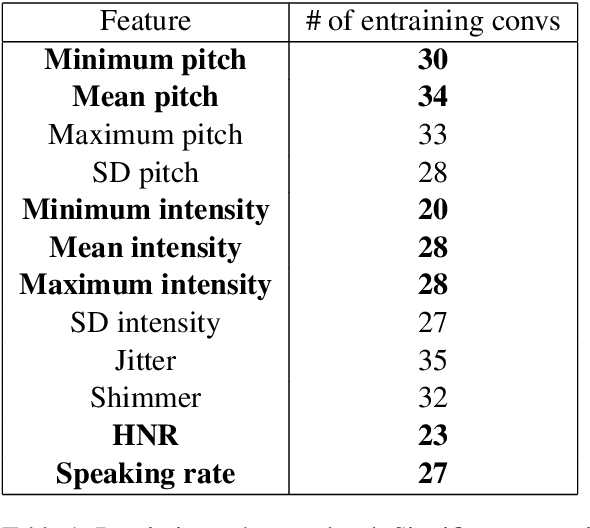
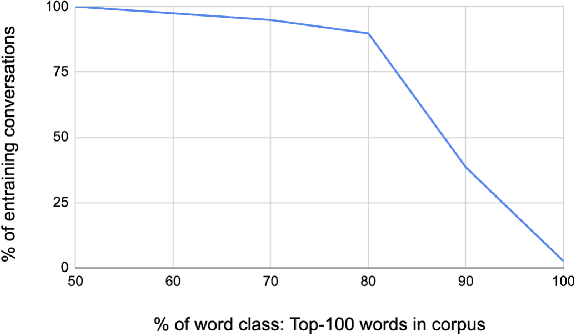
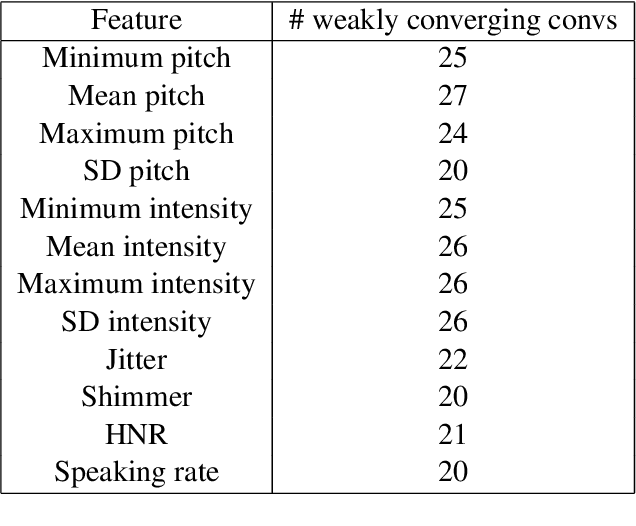
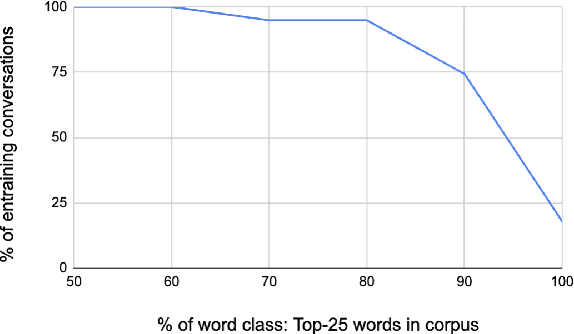
It is well-known that interlocutors who entrain to one another have more successful conversations than those who do not. Previous research has shown that interlocutors entrain on linguistic features in both written and spoken monolingual domains. More recent work on code-switched communication has also shown preliminary evidence of entrainment on certain aspects of code-switching (CSW). However, such studies of entrainment in code-switched domains have been extremely few and restricted to human-machine textual interactions. Our work studies code-switched spontaneous speech between humans by answering the following questions: 1) Do patterns of written and spoken entrainment in monolingual settings generalize to code-switched settings? 2) Do patterns of entrainment on code-switching in generated text generalize to spontaneous code-switched speech? We find evidence of affirmative answers to both of these questions, with important implications for the potentially "universal" nature of entrainment as a communication phenomenon, and potential applications in inclusive and interactive speech technology.
Examining Racial Bias in an Online Abuse Corpus with Structural Topic Modeling
May 26, 2020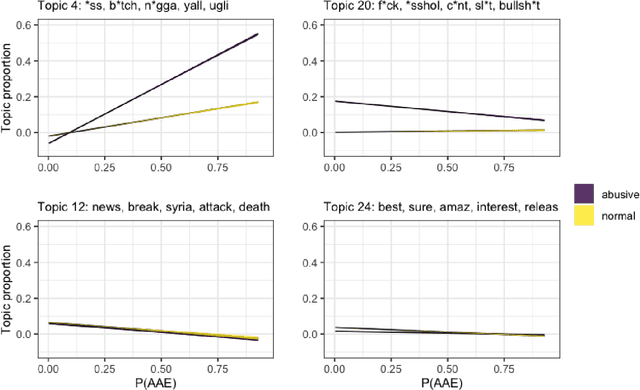
We use structural topic modeling to examine racial bias in data collected to train models to detect hate speech and abusive language in social media posts. We augment the abusive language dataset by adding an additional feature indicating the predicted probability of the tweet being written in African-American English. We then use structural topic modeling to examine the content of the tweets and how the prevalence of different topics is related to both abusiveness annotation and dialect prediction. We find that certain topics are disproportionately racialized and considered abusive. We discuss how topic modeling may be a useful approach for identifying bias in annotated data.
Racial Bias in Hate Speech and Abusive Language Detection Datasets
May 29, 2019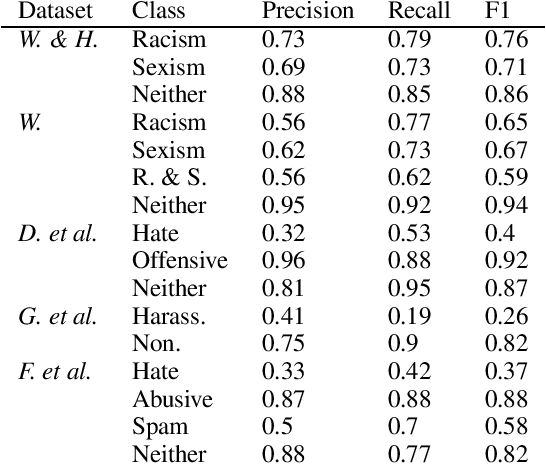
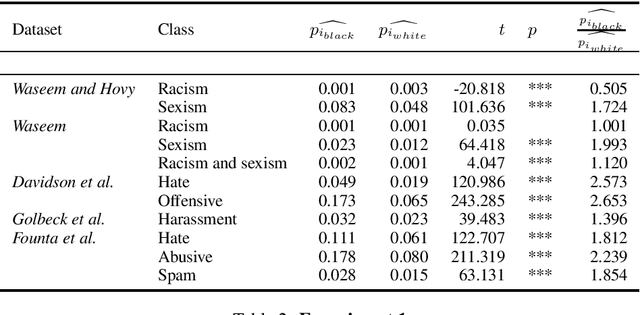
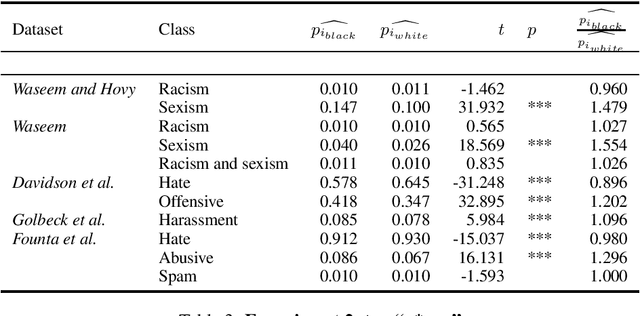
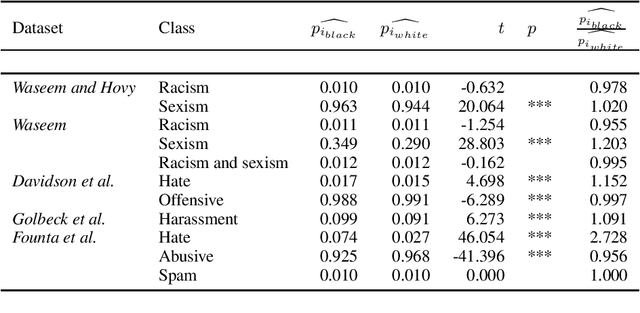
Technologies for abusive language detection are being developed and applied with little consideration of their potential biases. We examine racial bias in five different sets of Twitter data annotated for hate speech and abusive language. We train classifiers on these datasets and compare the predictions of these classifiers on tweets written in African-American English with those written in Standard American English. The results show evidence of systematic racial bias in all datasets, as classifiers trained on them tend to predict that tweets written in African-American English are abusive at substantially higher rates. If these abusive language detection systems are used in the field they will therefore have a disproportionate negative impact on African-American social media users. Consequently, these systems may discriminate against the groups who are often the targets of the abuse we are trying to detect.