 Add to Chrome
 Add to Firefox
 Add to Edge
Communicating about Space: Language-Mediated Spatial Integration Across Partial Views
Apr 01, 2026
Humans build shared spatial understanding by communicating partial, viewpoint-dependent observations. We ask whether Multimodal Large Language Models (MLLMs) can do the same, aligning distinct egocentric views through dialogue to form a coherent, allocentric mental model of a shared environment. To study this systematically, we introduce COSMIC, a benchmark for Collaborative Spatial Communication. In this setting, two static MLLM agents observe a 3D indoor environment from different viewpoints and exchange natural-language messages to solve spatial queries. COSMIC contains 899 diverse scenes and 1250 question-answer pairs spanning five tasks. We find a capability hierarchy, MLLMs are most reliable at identifying shared anchor objects across views, perform worse on relational reasoning, and largely fail at building globally consistent maps, performing near chance, even for frontier models. Moreover, we find thinking capability yields gains in anchor grounding, but is insufficient for higher-level spatial communication. To contextualize model behavior, we collect 250 human-human dialogues. Humans achieve 95% aggregate accuracy, while the best model, Gemini-3-Pro-Thinking, reaches 72%, leaving substantial room for improvement. Moreover, human conversations grow more precise as partners align on a shared spatial understanding, whereas MLLMs keep exploring without converging, suggesting limited capacity to form and sustain a robust shared mental model throughout the dialogue. Our code and data is available at https://github.com/ankursikarwar/Cosmic.

What if I ask in \textit{alia lingua}? Measuring Functional Similarity Across Languages
Sep 04, 2025How similar are model outputs across languages? In this work, we study this question using a recently proposed model similarity metric $\kappa_p$ applied to 20 languages and 47 subjects in GlobalMMLU. Our analysis reveals that a model's responses become increasingly consistent across languages as its size and capability grow. Interestingly, models exhibit greater cross-lingual consistency within themselves than agreement with other models prompted in the same language. These results highlight not only the value of $\kappa_p$ as a practical tool for evaluating multilingual reliability, but also its potential to guide the development of more consistent multilingual systems.
A Cognac shot to forget bad memories: Corrective Unlearning in GNNs
Dec 01, 2024

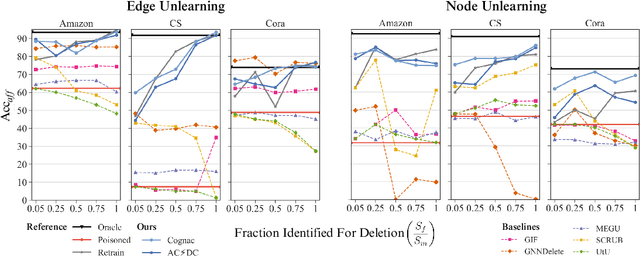

Graph Neural Networks (GNNs) are increasingly being used for a variety of ML applications on graph data. As graph data does not follow the independently and identically distributed (i.i.d) assumption, adversarial manipulations or incorrect data can propagate to other data points through message passing, deteriorating the model's performance. To allow model developers to remove the adverse effects of manipulated entities from a trained GNN, we study the recently formulated problem of Corrective Unlearning. We find that current graph unlearning methods fail to unlearn the effect of manipulations even when the whole manipulated set is known. We introduce a new graph unlearning method, Cognac, which can unlearn the effect of the manipulation set even when only 5% of it is identified. It recovers most of the performance of a strong oracle with fully corrected training data, even beating retraining from scratch without the deletion set while being 8x more efficient. We hope our work guides GNN developers in fixing harmful effects due to issues in real-world data post-training.