 Add to Chrome
 Add to Firefox
 Add to Edge
Characterization and Mitigation of Polyphase-Code Artifacts in 5G NR ISAC
Aug 08, 2026
Target sensing utilizing 5G NR reference signals has emerged as a prominent research direction in both academia and industry. However, non-ideal factors in practical deployments exert a significant detrimental impact on target sensing performance, manifesting as artifacts in the RV spectrum. These artifacts mask weak targets and cause severe false alarms. To address these challenges, this paper establishes a theoretical model of artifacts and constructs a data-physics-driven deep learning paradigm for artifact mitigation. First, the origin of artifacts and their characteristics are theoretically derived. These analyses demonstrate that the artifacts are associated with polyphase codes, e.g., Zadoff-Chu sequences, and reveal their characteristics, including periodic extensions in the range domain and spectral spreading in the velocity domain. Then, the physical priors of artifacts are formalized as temporal continuity and spatial consistency, informing the design of the training mechanism for the proposed network. Guided by these insights, we propose a PIAENet. At its core is a multi-frame selective-masked encoder-decoder module, explicitly designed to incorporate the above priors. Specifically, temporal continuity is implemented via a multi-frame mechanism to capture features across consecutive RV spectra. Meanwhile, spatial consistency is realized through a selective masking mechanism to enhance reconstruction of artifact-affected regions. Extensive validation is conducted using real-world measured data collected with commercial mmWave equipment. The polyphase-code-related characteristics of the artifacts are experimentally validated. Meanwhile, the experimental results demonstrate that the proposed PIAENet not only effectively reduces the false target count but also improves the detection probability from 79.58% to 98.88%.

Access Point Deployment for Localizing Accuracy and User Rate in Cell-Free Systems
Dec 10, 2024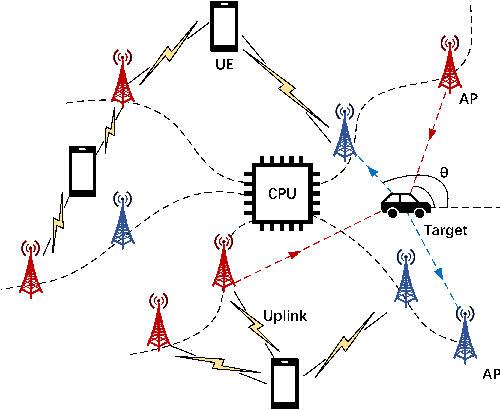
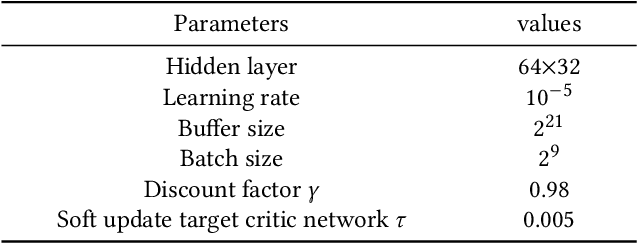
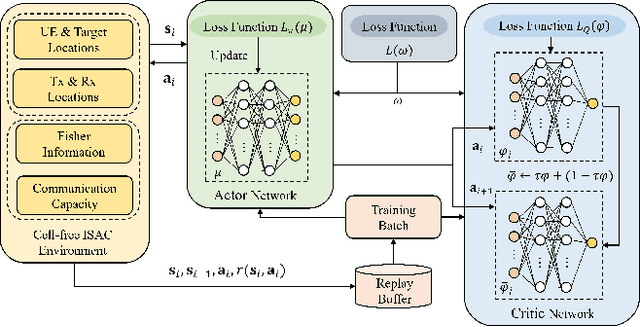
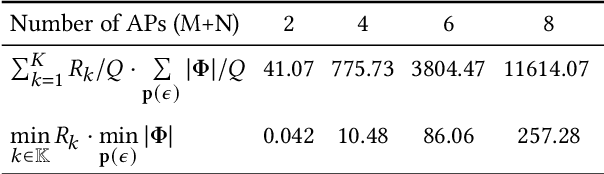
Evolving next-generation mobile networks is designed to provide ubiquitous coverage and networked sensing. With utility of multi-view sensing and multi-node joint transmission, cell-free is a promising technique to realize this prospect. This paper aims to tackle the problem of access point (AP) deployment in cell-free systems to balance the sensing accuracy and user rate. By merging the D-optimality with Euclidean criterion, a novel integrated metric is proposed to be the objective function for both max-sum and max-min problems, which respectively guarantee the overall and lowest performance in multi-user communication and target tracking scenario. To solve the corresponding high dimensional non-convex multi-objective problem, the Soft actor-critic (SAC) is utilized to avoid risk of local optimal result. Numerical results demonstrate that proposed SAC-based APs deployment method achieves $20\%$ of overall performance and $120\%$ of lowest performance.
Theoretical Limit of Radar Parameter Estimation
Jul 11, 2021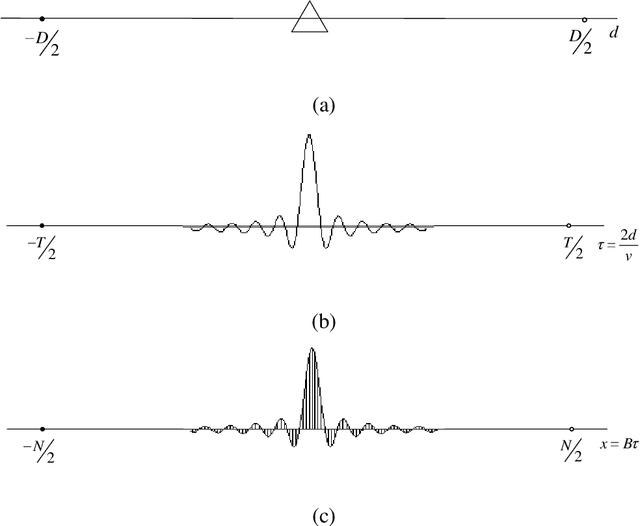


In the field of radar parameter estimation, Cramer-Rao bound (CRB) is a commonly used theoretical limit. However, CRB is only achievable under high signal-to-noise (SNR) and does not adequately characterize performance in low and medium SNRs. In this paper, we employ the thoughts and methodologies of Shannon's information theory to study the theoretical limit of radar parameter estimation. Based on the posteriori probability density function of targets' parameters, joint range-scattering information and entropy error (EE) are defined to evaluate the performance. The closed-form approximation of EE is derived, which indicates that EE degenerates to the CRB in the high SNR region. For radar ranging, it is proved that the range information and the entropy error can be achieved by the sampling a posterior probability estimator, whose performance is entirely determined by the theoretical posteriori probability density function of the radar parameter estimation system. The range information and the entropy error are simulated with sampling a posterior probability estimator, where they are shown to outperform the CRB as they can be achieved under all SNR conditions