 Add to Chrome
 Add to Firefox
 Add to Edge
Fly, Track, Land: Infrastructure-less Magnetic Localization for Heterogeneous UAV-UGV Teaming
Mar 09, 2026
We present a complete infrastructure-less magneto-inductive (MI) localization system enabling a lightweight UAV to autonomously hover, track, and land with centimeter precision on a mobile quadruped robot acting as a dynamic docking pad. This work advances the vision of heterogeneous robot collaboration, where ultra-lightweight flying robots serve as mobile perception agents for ground-based Unmanned Ground Vehicles (UGVs). By extending the sensing horizon and providing complementary viewpoints, the UAVs enhance exploration efficiency and improve the quality of data collection in large-scale, unknown environments. The proposed system aims to complements traditional localization modalities with a compact, embedded, and infrastructure-less magnetic sensing approach, providing accurate short-range relative positioning to bridge the gap between coarse navigation and precise UAV docking. A single lightweight receive coil and a fully embedded estimation pipeline on the UAV deliver 20 Hz relative pose estimates in the UGV's frame, achieving a 3D position root-mean-square error (RMSE) of 5 cm. The system uses real-time estimation and a warm-started solver to estimate the 3D position, which is then fused with inertial and optical-flow measurements in the onboard extended Kalman filter. Real-world experiments validate the effectiveness of the framework, demonstrating significant improvements in UAV--UGV teaming in infrastructure-less scenarios compared to state-of-the-art methods, requiring no external anchors or global positioning. In dynamic scenarios, the UAV tracks and docks with a moving UGV while maintaining a 7.2 cm RMSE and achieving successful autonomous landings.

Eco-WakeLoc: An Energy-Neutral and Cooperative UWB Real-Time Locating System
Jan 06, 2026Indoor localization systems face a fundamental trade-off between efficiency and responsiveness, which is especially important for emerging use cases such as mobile robots operating in GPS-denied environments. Traditional RTLS either require continuously powered infrastructure, limiting their scalability, or are limited by their responsiveness. This work presents Eco-WakeLoc, designed to achieve centimeter-level UWB localization while remaining energy-neutral by combining ultra-low power wake-up radios (WuRs) with solar energy harvesting. By activating anchor nodes only on demand, the proposed system eliminates constant energy consumption while achieving centimeter-level positioning accuracy. To reduce coordination overhead and improve scalability, Eco-WakeLoc employs cooperative localization where active tags initiate ranging exchanges (trilateration), while passive tags opportunistically reuse these messages for TDOA positioning. An additive-increase/multiplicative-decrease (AIMD)-based energy-aware scheduler adapts localization rates according to the harvested energy, thereby maximizing the overall performance of the sensor network while ensuring long-term energy neutrality. The measured energy consumption is only 3.22mJ per localization for active tags, 951uJ for passive tags, and 353uJ for anchors. Real-world deployment on a quadruped robot with nine anchors confirms the practical feasibility, achieving an average accuracy of 43cm in dynamic indoor environments. Year-long simulations show that tags achieve an average of 2031 localizations per day, retaining over 7% battery capacity after one year -- demonstrating that the RTLS achieves sustained energy-neutral operation. Eco-WakeLoc demonstrates that high-accuracy indoor localization can be achieved at scale without continuous infrastructure operation, combining energy neutrality, cooperative positioning, and adaptive scheduling.
Noise Analysis and Modeling of the PMD Flexx2 Depth Camera for Robotic Applications
Dec 19, 2024Time of Flight ToF cameras renowned for their ability to capture realtime 3D information have become indispensable for agile mobile robotics These cameras utilize light signals to accurately measure distances enabling robots to navigate complex environments with precision Innovative depth cameras characterized by their compact size and lightweight design such as the recently released PMD Flexx2 are particularly suited for mobile robots Capable of achieving high frame rates while capturing depth information this innovative sensor is suitable for tasks such as robot navigation and terrain mapping Operating on the ToF measurement principle the sensor offers multiple benefits over classic stereobased depth cameras However the depth images produced by the camera are subject to noise from multiple sources complicating their simulation This paper proposes an accurate quantification and modeling of the nonsystematic noise of the PMD Flexx2 We propose models for both axial and lateral noise across various camera modes assuming Gaussian distributions Axial noise modeled as a function of distance and incidence angle demonstrated a low average KullbackLeibler KL divergence of 0015 nats reflecting precise noise characterization Lateral noise deviating from a Gaussian distribution was modeled conservatively yielding a satisfactory KL divergence of 0868 nats These results validate our noise models crucial for accurately simulating sensor behavior in virtual environments and reducing the simtoreal gap in learningbased control approaches
* Accepted by COINS 2024
Autonomous Navigation in Dynamic Human Environments with an Embedded 2D LiDAR-based Person Tracker
Dec 19, 2024

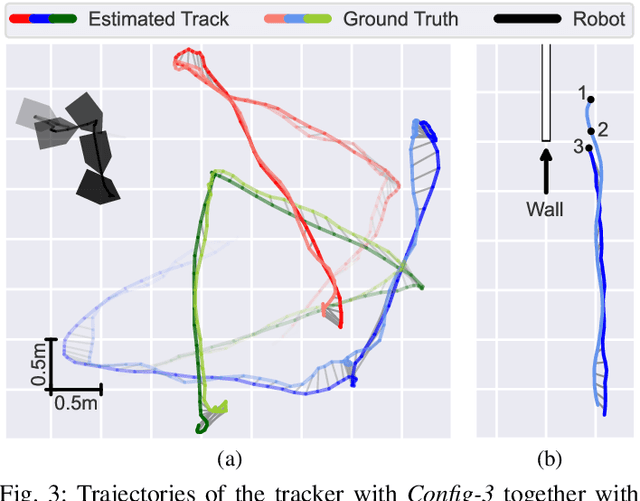
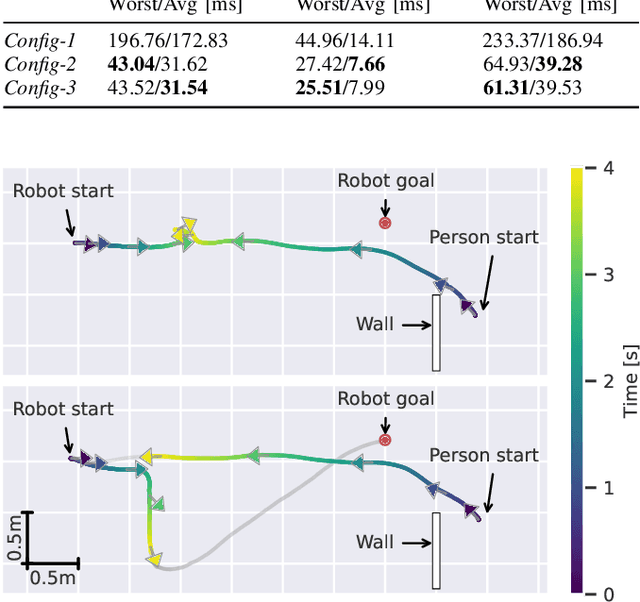
In the rapidly evolving landscape of autonomous mobile robots, the emphasis on seamless human-robot interactions has shifted towards autonomous decision-making. This paper delves into the intricate challenges associated with robotic autonomy, focusing on navigation in dynamic environments shared with humans. It introduces an embedded real-time tracking pipeline, integrated into a navigation planning framework for effective person tracking and avoidance, adapting a state-of-the-art 2D LiDAR-based human detection network and an efficient multi-object tracker. By addressing the key components of detection, tracking, and planning separately, the proposed approach highlights the modularity and transferability of each component to other applications. Our tracking approach is validated on a quadruped robot equipped with 270{\deg} 2D-LiDAR against motion capture system data, with the preferred configuration achieving an average MOTA of 85.45% in three newly recorded datasets, while reliably running in real-time at 20 Hz on the NVIDIA Jetson Xavier NX embedded GPU-accelerated platform. Furthermore, the integrated tracking and avoidance system is evaluated in real-world navigation experiments, demonstrating how accurate person tracking benefits the planner in optimizing the generated trajectories, enhancing its collision avoidance capabilities. This paper contributes to safer human-robot cohabitation, blending recent advances in human detection with responsive planning to navigate shared spaces effectively and securely.
* Accepted by SAS 2024