 Add to Chrome
 Add to Firefox
 Add to Edge
Improving Neural Argumentative Stance Classification in Controversial Topics with Emotion-Lexicon Features
Feb 26, 2026
Argumentation mining comprises several subtasks, among which stance classification focuses on identifying the standpoint expressed in an argumentative text toward a specific target topic. While arguments-especially about controversial topics-often appeal to emotions, most prior work has not systematically incorporated explicit, fine-grained emotion analysis to improve performance on this task. In particular, prior research on stance classification has predominantly utilized non-argumentative texts and has been restricted to specific domains or topics, limiting generalizability. We work on five datasets from diverse domains encompassing a range of controversial topics and present an approach for expanding the Bias-Corrected NRC Emotion Lexicon using DistilBERT embeddings, which we feed into a Neural Argumentative Stance Classification model. Our method systematically expands the emotion lexicon through contextualized embeddings to identify emotionally charged terms not previously captured in the lexicon. Our expanded NRC lexicon (eNRC) improves over the baseline across all five datasets (up to +6.2 percentage points in F1 score), outperforms the original NRC on four datasets (up to +3.0), and surpasses the LLM-based approach on nearly all corpora. We provide all resources-including eNRC, the adapted corpora, and model architecture-to enable other researchers to build upon our work.

Moving Pictures of Thought: Extracting Visual Knowledge in Charles S. Peirce's Manuscripts with Vision-Language Models
Nov 17, 2025Diagrams are crucial yet underexplored tools in many disciplines, demonstrating the close connection between visual representation and scholarly reasoning. However, their iconic form poses obstacles to visual studies, intermedial analysis, and text-based digital workflows. In particular, Charles S. Peirce consistently advocated the use of diagrams as essential for reasoning and explanation. His manuscripts, often combining textual content with complex visual artifacts, provide a challenging case for studying documents involving heterogeneous materials. In this preliminary study, we investigate whether Visual Language Models (VLMs) can effectively help us identify and interpret such hybrid pages in context. First, we propose a workflow that (i) segments manuscript page layouts, (ii) reconnects each segment to IIIF-compliant annotations, and (iii) submits fragments containing diagrams to a VLM. In addition, by adopting Peirce's semiotic framework, we designed prompts to extract key knowledge about diagrams and produce concise captions. Finally, we integrated these captions into knowledge graphs, enabling structured representations of diagrammatic content within composite sources.
E2MoCase: A Dataset for Emotional, Event and Moral Observations in News Articles on High-impact Legal Cases
Sep 13, 2024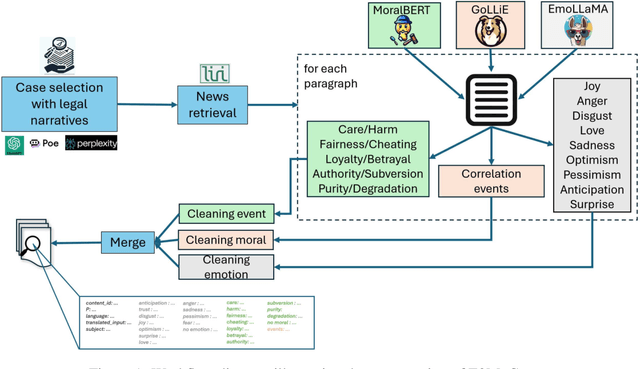
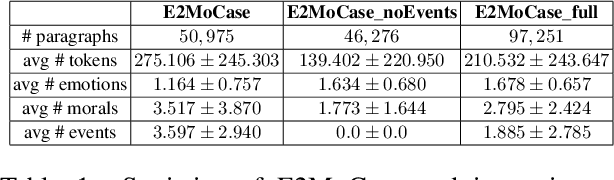
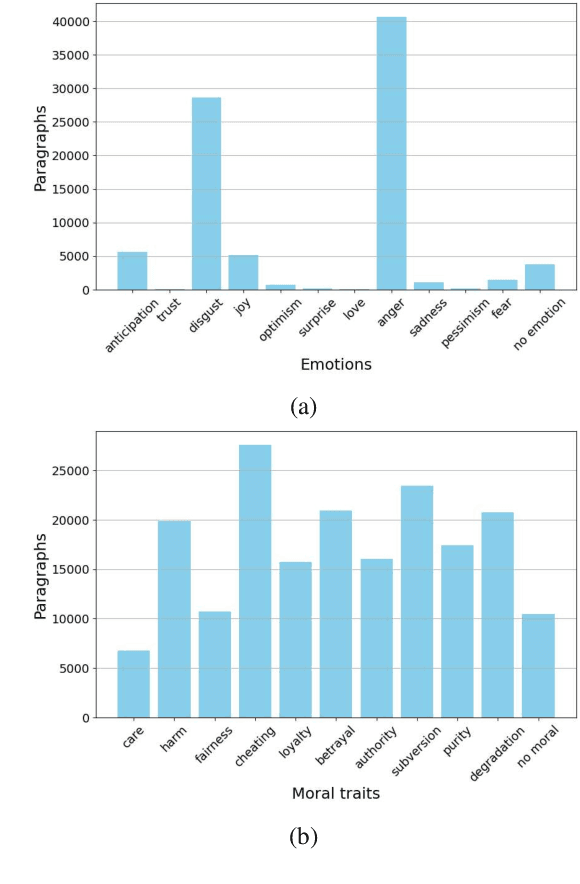

The way media reports on legal cases can significantly shape public opinion, often embedding subtle biases that influence societal views on justice and morality. Analyzing these biases requires a holistic approach that captures the emotional tone, moral framing, and specific events within the narratives. In this work we introduce E2MoCase, a novel dataset designed to facilitate the integrated analysis of emotions, moral values, and events within legal narratives and media coverage. By leveraging advanced models for emotion detection, moral value identification, and event extraction, E2MoCase offers a multi-dimensional perspective on how legal cases are portrayed in news articles.