 Add to Chrome
 Add to Firefox
 Add to Edge
Luminol-AIDetect: Fast Zero-shot Machine-Generated Text Detection based on Perplexity under Text Shuffling
Apr 28, 2026
Machine-generated text (MGT) detection requires identifying structurally invariant signals across generation models, rather than relying on model-specific fingerprints. In this respect, we hypothesize that while large language models excel at local semantic consistency, their autoregressive nature results in a specific kind of structural fragility compared to human writing. We propose Luminol-AIDetect, a novel, zero-shot statistical approach that exposes this fragility through coherence disruption. By applying a simple randomized text-shuffling procedure, we demonstrate that the resulting shift in perplexity serves as a principled, model-agnostic discriminant, as MGT displays a characteristic dispersion in perplexity-under-shuffling that differs markedly from the more stable structural variability of human-written text. Luminol-AIDetect leverages this distinction to inform its decision process, where a handful of perplexity-based scalar features are extracted from an input text and its shuffled version, then detection is performed via density estimation and ensemble-based prediction. Evaluated across 8 content domains, 11 adversarial attack types, and 18 languages, Luminol-AIDetect demonstrates state-of-the-art performance, with gains up to 17x lower FPR while being cheaper than prior methods.

The CriticalSet problem: Identifying Critical Contributors in Bipartite Dependency Networks
Apr 23, 2026Identifying critical nodes in complex networks is a fundamental task in graph mining. Yet, methods addressing an all-or-nothing coverage mechanics in a bipartite dependency network, a graph with two types of nodes where edges represent dependency relationships across the two groups only, remain largely unexplored. We formalize the CriticalSet problem: given an arbitrary bipartite graph modeling dependencies of items on contributors, identify the set of k contributors whose removal isolates the largest number of items. We prove that this problem is NP-hard and requires maximizing a supermodular set function, for which standard forward greedy algorithms provide no approximation guarantees. Consequently, we model CriticalSet as a coalitional game, deriving a closed-form centrality, ShapleyCov, based on the Shapley value. This measure can be interpreted as the expected number of items isolated by a contributor's departure. Leveraging these insights, we propose MinCov, a linear-time iterative peeling algorithm that explicitly accounts for connection redundancy, prioritizing contributors who uniquely support many items. Extensive experiments on synthetic and large-scale real datasets, including a Wikipedia graph with over 250 million edges, reveal that MinCov and ShapleyCov significantly outperform traditional baselines. Notably, MinCov achieves near-optimal performance, within 0.02 AUC of a Stochastic Hill Climbing metaheuristic, while remaining several orders of magnitude faster.
Culturally Grounded Personas in Large Language Models: Characterization and Alignment with Socio-Psychological Value Frameworks
Jan 29, 2026Despite the growing utility of Large Language Models (LLMs) for simulating human behavior, the extent to which these synthetic personas accurately reflect world and moral value systems across different cultural conditionings remains uncertain. This paper investigates the alignment of synthetic, culturally-grounded personas with established frameworks, specifically the World Values Survey (WVS), the Inglehart-Welzel Cultural Map, and Moral Foundations Theory. We conceptualize and produce LLM-generated personas based on a set of interpretable WVS-derived variables, and we examine the generated personas through three complementary lenses: positioning on the Inglehart-Welzel map, which unveils their interpretation reflecting stable differences across cultural conditionings; demographic-level consistency with the World Values Survey, where response distributions broadly track human group patterns; and moral profiles derived from a Moral Foundations questionnaire, which we analyze through a culture-to-morality mapping to characterize how moral responses vary across different cultural configurations. Our approach of culturally-grounded persona generation and analysis enables evaluation of cross-cultural structure and moral variation.
Machines in the Crowd? Measuring the Footprint of Machine-Generated Text on Reddit
Oct 08, 2025Generative Artificial Intelligence is reshaping online communication by enabling large-scale production of Machine-Generated Text (MGT) at low cost. While its presence is rapidly growing across the Web, little is known about how MGT integrates into social media environments. In this paper, we present the first large-scale characterization of MGT on Reddit. Using a state-of-the-art statistical method for detection of MGT, we analyze over two years of activity (2022-2024) across 51 subreddits representative of Reddit's main community types such as information seeking, social support, and discussion. We study the concentration of MGT across communities and over time, and compared MGT to human-authored text in terms of social signals it expresses and engagement it receives. Our very conservative estimate of MGT prevalence indicates that synthetic text is marginally present on Reddit, but it can reach peaks of up to 9% in some communities in some months. MGT is unevenly distributed across communities, more prevalent in subreddits focused on technical knowledge and social support, and often concentrated in the activity of a small fraction of users. MGT also conveys distinct social signals of warmth and status giving typical of language of AI assistants. Despite these stylistic differences, MGT achieves engagement levels comparable than human-authored content and in a few cases even higher, suggesting that AI-generated text is becoming an organic component of online social discourse. This work offers the first perspective on the MGT footprint on Reddit, paving the way for new investigations involving platform governance, detection strategies, and community dynamics.
OpenTuringBench: An Open-Model-based Benchmark and Framework for Machine-Generated Text Detection and Attribution
Apr 15, 2025Open Large Language Models (OLLMs) are increasingly leveraged in generative AI applications, posing new challenges for detecting their outputs. We propose OpenTuringBench, a new benchmark based on OLLMs, designed to train and evaluate machine-generated text detectors on the Turing Test and Authorship Attribution problems. OpenTuringBench focuses on a representative set of OLLMs, and features a number of challenging evaluation tasks, including human/machine-manipulated texts, out-of-domain texts, and texts from previously unseen models. We also provide OTBDetector, a contrastive learning framework to detect and attribute OLLM-based machine-generated texts. Results highlight the relevance and varying degrees of difficulty of the OpenTuringBench tasks, with our detector achieving remarkable capabilities across the various tasks and outperforming most existing detectors. Resources are available on the OpenTuringBench Hugging Face repository at https://huggingface.co/datasets/MLNTeam-Unical/OpenTuringBench
Heuristic-Informed Mixture of Experts for Link Prediction in Multilayer Networks
Jan 29, 2025Link prediction algorithms for multilayer networks are in principle required to effectively account for the entire layered structure while capturing the unique contexts offered by each layer. However, many existing approaches excel at predicting specific links in certain layers but struggle with others, as they fail to effectively leverage the diverse information encoded across different network layers. In this paper, we present MoE-ML-LP, the first Mixture-of-Experts (MoE) framework specifically designed for multilayer link prediction. Building on top of multilayer heuristics for link prediction, MoE-ML-LP synthesizes the decisions taken by diverse experts, resulting in significantly enhanced predictive capabilities. Our extensive experimental evaluation on real-world and synthetic networks demonstrates that MoE-ML-LP consistently outperforms several baselines and competing methods, achieving remarkable improvements of +60% in Mean Reciprocal Rank, +82% in Hits@1, +55% in Hits@5, and +41% in Hits@10. Furthermore, MoE-ML-LP features a modular architecture that enables the seamless integration of newly developed experts without necessitating the re-training of the entire framework, fostering efficiency and scalability to new experts, paving the way for future advancements in link prediction.
Safeguarding Decentralized Social Media: LLM Agents for Automating Community Rule Compliance
Sep 13, 2024Ensuring content compliance with community guidelines is crucial for maintaining healthy online social environments. However, traditional human-based compliance checking struggles with scaling due to the increasing volume of user-generated content and a limited number of moderators. Recent advancements in Natural Language Understanding demonstrated by Large Language Models unlock new opportunities for automated content compliance verification. This work evaluates six AI-agents built on Open-LLMs for automated rule compliance checking in Decentralized Social Networks, a challenging environment due to heterogeneous community scopes and rules. Analyzing over 50,000 posts from hundreds of Mastodon servers, we find that AI-agents effectively detect non-compliant content, grasp linguistic subtleties, and adapt to diverse community contexts. Most agents also show high inter-rater reliability and consistency in score justification and suggestions for compliance. Human-based evaluation with domain experts confirmed the agents' reliability and usefulness, rendering them promising tools for semi-automated or human-in-the-loop content moderation systems.
E2MoCase: A Dataset for Emotional, Event and Moral Observations in News Articles on High-impact Legal Cases
Sep 13, 2024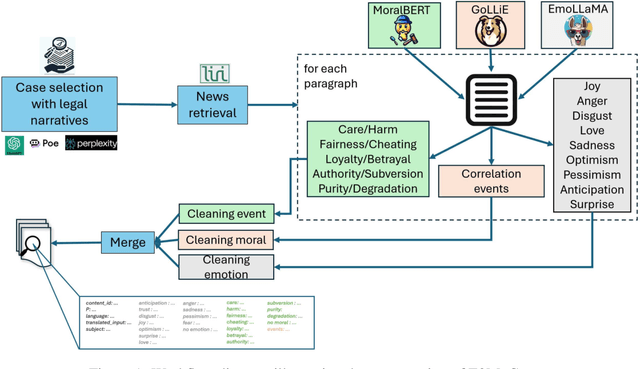
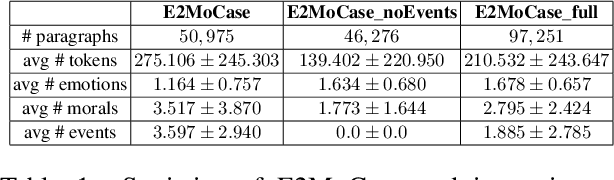
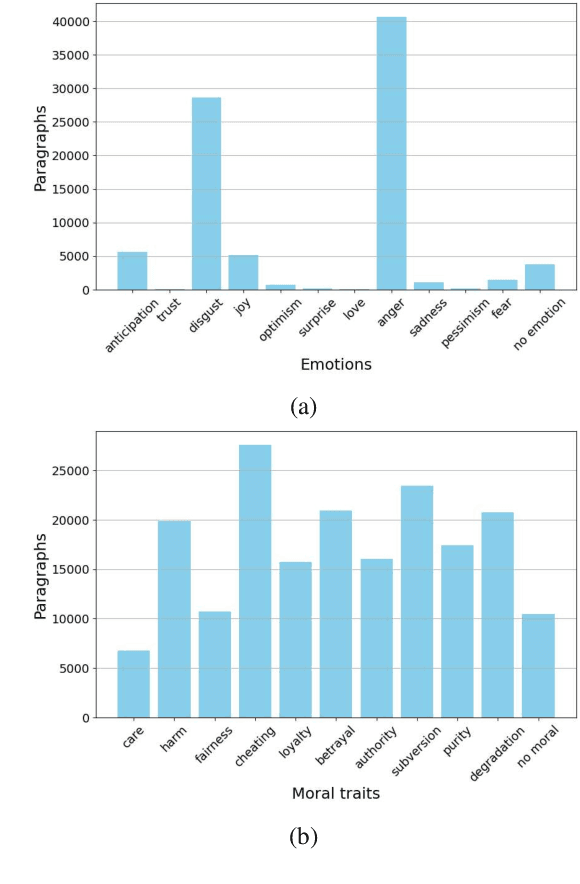

The way media reports on legal cases can significantly shape public opinion, often embedding subtle biases that influence societal views on justice and morality. Analyzing these biases requires a holistic approach that captures the emotional tone, moral framing, and specific events within the narratives. In this work we introduce E2MoCase, a novel dataset designed to facilitate the integrated analysis of emotions, moral values, and events within legal narratives and media coverage. By leveraging advanced models for emotion detection, moral value identification, and event extraction, E2MoCase offers a multi-dimensional perspective on how legal cases are portrayed in news articles.
Is Contrasting All You Need? Contrastive Learning for the Detection and Attribution of AI-generated Text
Jul 12, 2024The significant progress in the development of Large Language Models has contributed to blurring the distinction between human and AI-generated text. The increasing pervasiveness of AI-generated text and the difficulty in detecting it poses new challenges for our society. In this paper, we tackle the problem of detecting and attributing AI-generated text by proposing WhosAI, a triplet-network contrastive learning framework designed to predict whether a given input text has been generated by humans or AI and to unveil the authorship of the text. Unlike most existing approaches, our proposed framework is conceived to learn semantic similarity representations from multiple generators at once, thus equally handling both detection and attribution tasks. Furthermore, WhosAI is model-agnostic and scalable to the release of new AI text-generation models by incorporating their generated instances into the embedding space learned by our framework. Experimental results on the TuringBench benchmark of 200K news articles show that our proposed framework achieves outstanding results in both the Turing Test and Authorship Attribution tasks, outperforming all the methods listed in the TuringBench benchmark leaderboards.
Talking the Talk Does Not Entail Walking the Walk: On the Limits of Large Language Models in Lexical Entailment Recognition
Jun 21, 2024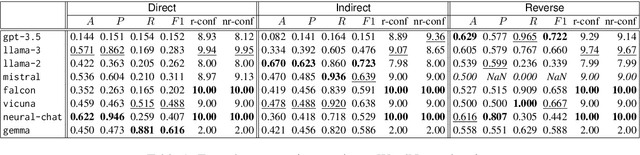

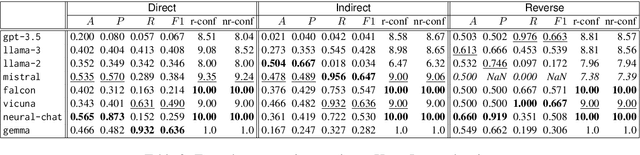
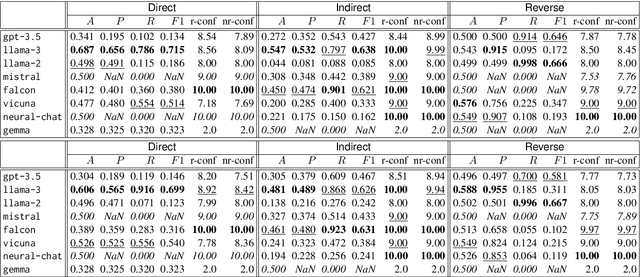
Verbs form the backbone of language, providing the structure and meaning to sentences. Yet, their intricate semantic nuances pose a longstanding challenge. Understanding verb relations through the concept of lexical entailment is crucial for comprehending sentence meanings and grasping verb dynamics. This work investigates the capabilities of eight Large Language Models in recognizing lexical entailment relations among verbs through differently devised prompting strategies and zero-/few-shot settings over verb pairs from two lexical databases, namely WordNet and HyperLex. Our findings unveil that the models can tackle the lexical entailment recognition task with moderately good performance, although at varying degree of effectiveness and under different conditions. Also, utilizing few-shot prompting can enhance the models' performance. However, perfectly solving the task arises as an unmet challenge for all examined LLMs, which raises an emergence for further research developments on this topic.