 Add to Chrome
 Add to Firefox
 Add to Edge
Earnings25: A Comprehensive 500-Hour Speech Benchmark for Finance
Jul 26, 2026
We introduce Earnings25, a finance-domain benchmark for evaluating automatic speech recognition (ASR) on English-language earnings calls under realistic conditions. Earnings25 comprises two complementary test sets: (i) testset-full, 498 hours of full English-language S&P 500 earnings calls from Q4 2025, and (ii) testset-segmented, a 46-hour industry-balanced set of 290 segments sampled from English-language U.S. earnings calls in 2025. The benchmark provides aligned transcripts and structured metadata, including speaker roles, industry labels, and call structure, enabling speaker- and industry-aware evaluation beyond aggregate word error rate (WER). We report reproducible baselines for Whisper and Parakeet-TDT using standardized scoring.

Reconstructing the Mind's Eye: fMRI-to-Image with Contrastive Learning and Diffusion Priors
May 29, 2023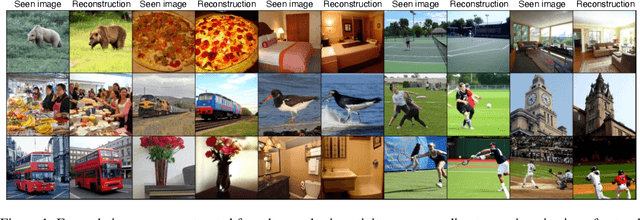
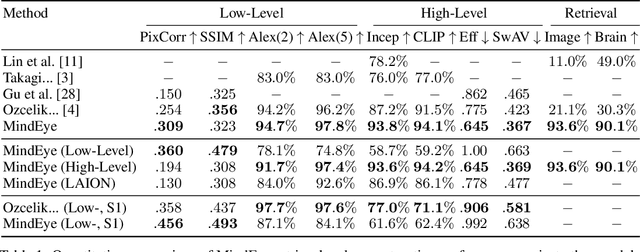
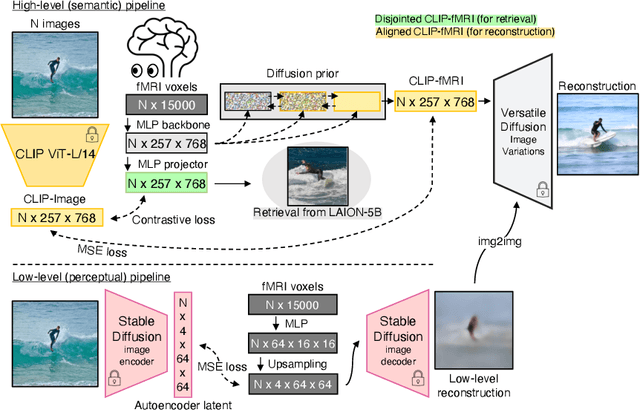
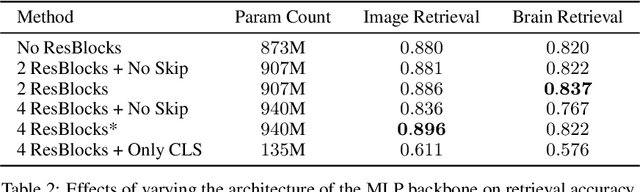
We present MindEye, a novel fMRI-to-image approach to retrieve and reconstruct viewed images from brain activity. Our model comprises two parallel submodules that are specialized for retrieval (using contrastive learning) and reconstruction (using a diffusion prior). MindEye can map fMRI brain activity to any high dimensional multimodal latent space, like CLIP image space, enabling image reconstruction using generative models that accept embeddings from this latent space. We comprehensively compare our approach with other existing methods, using both qualitative side-by-side comparisons and quantitative evaluations, and show that MindEye achieves state-of-the-art performance in both reconstruction and retrieval tasks. In particular, MindEye can retrieve the exact original image even among highly similar candidates indicating that its brain embeddings retain fine-grained image-specific information. This allows us to accurately retrieve images even from large-scale databases like LAION-5B. We demonstrate through ablations that MindEye's performance improvements over previous methods result from specialized submodules for retrieval and reconstruction, improved training techniques, and training models with orders of magnitude more parameters. Furthermore, we show that MindEye can better preserve low-level image features in the reconstructions by using img2img, with outputs from a separate autoencoder. All code is available on GitHub.