 Add to Chrome
 Add to Firefox
 Add to Edge
The Cost of Binarizing Survival Outcomes in Clinical Prognostic Modeling
Aug 04, 2026
Survival analysis is an established framework for analyzing time-to-event data, yet many clinical machine learning studies still binarize the outcome before model training. This practice excludes censored patients, collapses temporal information into a single threshold, and can affect which features are selected as prognostically relevant. We examine the cost of this binarization in the context of Bayesian network (BN) feature selection, using two recent publications as case studies: one that applies BN-based feature selection to a head-and-neck cancer cohort and a second surgical cohort study that, while not BN-based, likewise binarizes its survival endpoint. We replace the binary scoring function with the Cox partial log-likelihood for feature-to-outcome edges, a modification we call the Survival-Aware Bayesian network, and recover prognostic features that binarization misses. Our ablation experiment confirms that the improvement is driven by the time-to-event scoring formulation rather than by retaining more patients. The results generalize across five endpoint-cohort combinations in head-and-neck cancer and extend to three further cancer types (breast, colorectal, and kidney). We propose that clinical studies with survival outcomes should use time-to-event methods by default, as binarization discards the prognostic signal retained by survival analysis.

The Daily Dose: Workflow-Integrated Large Language Model Automation for Clinical Summarization and Trial Identification in Radiation Oncology
May 25, 2026Objective: To describe the design and early clinical evaluation of The Daily Dose (TDD), an LLM-driven, automated clinical summarization and clinical-trial identification system integrated into routine radiation oncology practice. Design: Mixed-methods evaluation using a cross-sectional, anonymous clinician survey administered after 1 month of system deployment. Exposure: Daily automated delivery of physician-specific email summaries generated using RadOnc-GPT, including patient schedules, concise EHR-derived clinical-status summaries, and automated identification of potentially relevant clinical trials for new or consult visits. Main Outcomes and Measures: Primary outcomes included self-reported usability, satisfaction, perceived usefulness, perceived impact on workflow, time savings, and intention for continued use. Internal consistency reliability was assessed using Cronbach's $α$. Results: Among 55 respondents, 52 (94.5\%) worked in radiation oncology, and 38 (69.1\%) were attending physicians. Most participants (83.6\%) reported using TDD daily or several times per week. Mean (SD) scores were 3.89 (1.04) for usability and satisfaction, 3.43 (1.24) for perceived usefulness, and 3.80 (1.17) for impact and future use (5-point Likert scale). Overall satisfaction was positively associated with perceived time savings ($p < .001$). Participants reported variable time savings, with 27\% estimating $\geq 10$ minutes saved per day. The questionnaire demonstrated excellent internal consistency (overall Cronbach's $α$ = 0.97).
Retrospective Comparative Analysis of Prostate Cancer In-Basket Messages: Responses from Closed-Domain LLM vs. Clinical Teams
Sep 26, 2024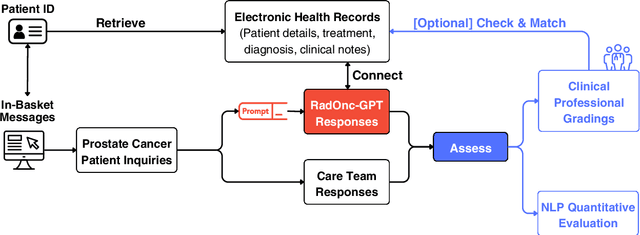

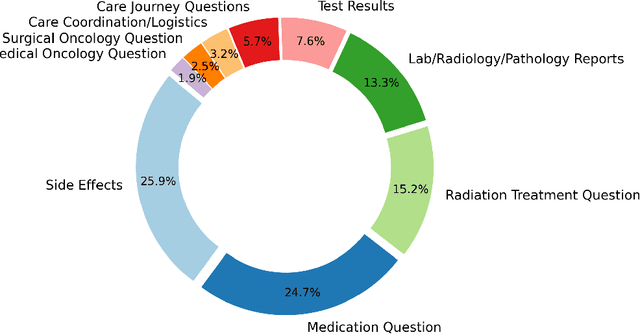
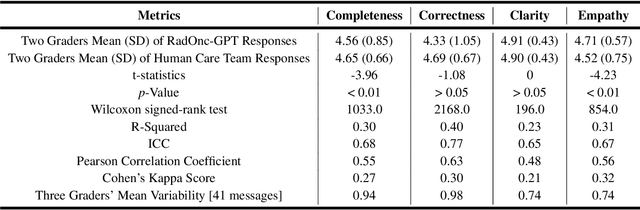
In-basket message interactions play a crucial role in physician-patient communication, occurring during all phases (pre-, during, and post) of a patient's care journey. However, responding to these patients' inquiries has become a significant burden on healthcare workflows, consuming considerable time for clinical care teams. To address this, we introduce RadOnc-GPT, a specialized Large Language Model (LLM) powered by GPT-4 that has been designed with a focus on radiotherapeutic treatment of prostate cancer with advanced prompt engineering, and specifically designed to assist in generating responses. We integrated RadOnc-GPT with patient electronic health records (EHR) from both the hospital-wide EHR database and an internal, radiation-oncology-specific database. RadOnc-GPT was evaluated on 158 previously recorded in-basket message interactions. Quantitative natural language processing (NLP) analysis and two grading studies with clinicians and nurses were used to assess RadOnc-GPT's responses. Our findings indicate that RadOnc-GPT slightly outperformed the clinical care team in "Clarity" and "Empathy," while achieving comparable scores in "Completeness" and "Correctness." RadOnc-GPT is estimated to save 5.2 minutes per message for nurses and 2.4 minutes for clinicians, from reading the inquiry to sending the response. Employing RadOnc-GPT for in-basket message draft generation has the potential to alleviate the workload of clinical care teams and reduce healthcare costs by producing high-quality, timely responses.