 Add to Chrome
 Add to Firefox
 Add to Edge
Broadband Hyperspectral 3D Imaging using Dispersed Structured Light
May 25, 2026
Hyperspectral 3D imaging enables the capture of dense spectral information and scene geometry but has traditionally been confined to narrow spectral windows, typically the visible range. In this work, we introduce a broadband hyperspectral 3D imaging (BH3D) method to extend this capability across the full visible-near-infrared and short-wavelength infrared (SWIR) spectrum (450-1500 nm). This broad coverage is critical as it captures complementary physical cues: visible wavelengths reveal surface appearance, while SWIR bands provide insight into subsurface properties and material composition. However, realizing BH3D is challenging due to fundamental sensor constraints between visible-spectrum silicon and SWIR-spectrum InGaAs sensors, which necessitate complex multi-spectrograph designs. Here we propose a single-spectrograph BH3D system, using a stereo setup comprising visible and SWIR cameras, that reconstructs dense broadband hyperspectral reflectance together with accurate 3D geometry. Our key idea is to extend dispersed structured light to the broadband regime using a single spectrograph. We model the image formation of broadband dispersed structured light, and estimate hyperspectral reflectance and depth. We validate our approach on diverse real-world scenes, demonstrating accurate reconstruction with a mean spectral angle mapper of 0.13 rad, root mean square error of 0.03, and mean depth error of 4.5 mm. We further demonstrate identifying metameric materials, performing imaging through opaque layers, uncovering hidden features on banknotes, and revealing blood vessels.

Scale-Agnostic Super-Resolution in MRI using Feature-Based Coordinate Networks
Oct 18, 2022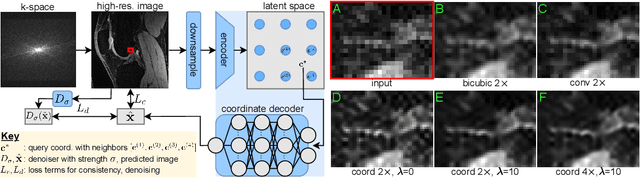
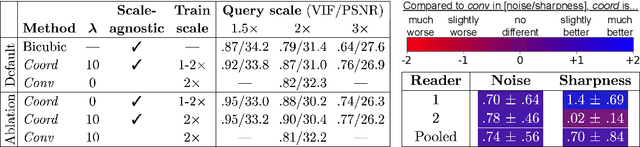
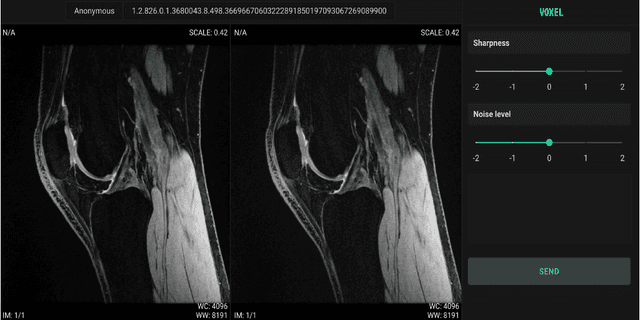
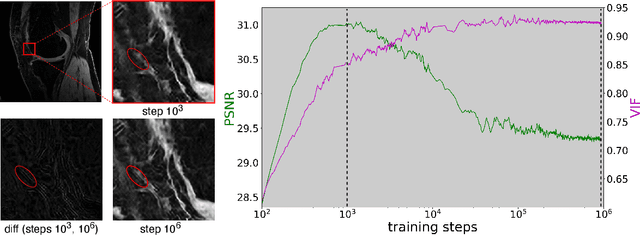
We propose using a coordinate network decoder for the task of super-resolution in MRI. The continuous signal representation of coordinate networks enables this approach to be scale-agnostic, i.e. one can train over a continuous range of scales and subsequently query at arbitrary resolutions. Due to the difficulty of performing super-resolution on inherently noisy data, we analyze network behavior under multiple denoising strategies. Lastly we compare this method to a standard convolutional decoder using both quantitative metrics and a radiologist study implemented in Voxel, our newly developed tool for web-based evaluation of medical images.
Non-line-of-sight Imaging with Partial Occluders and Surface Normals
Apr 04, 2018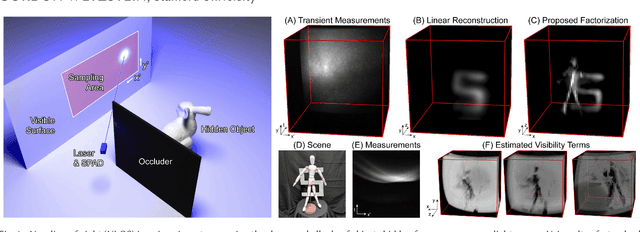
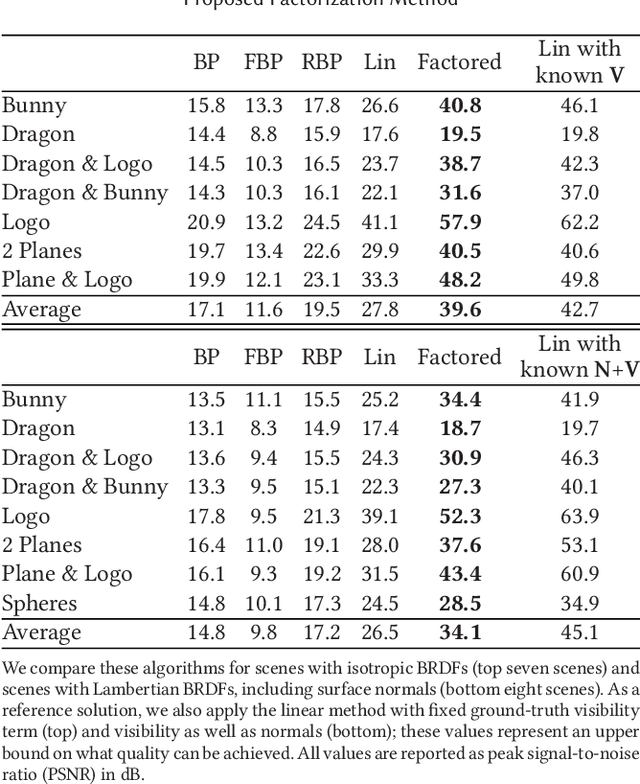
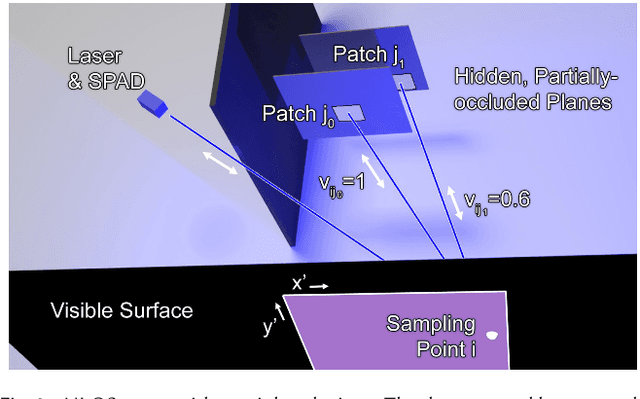
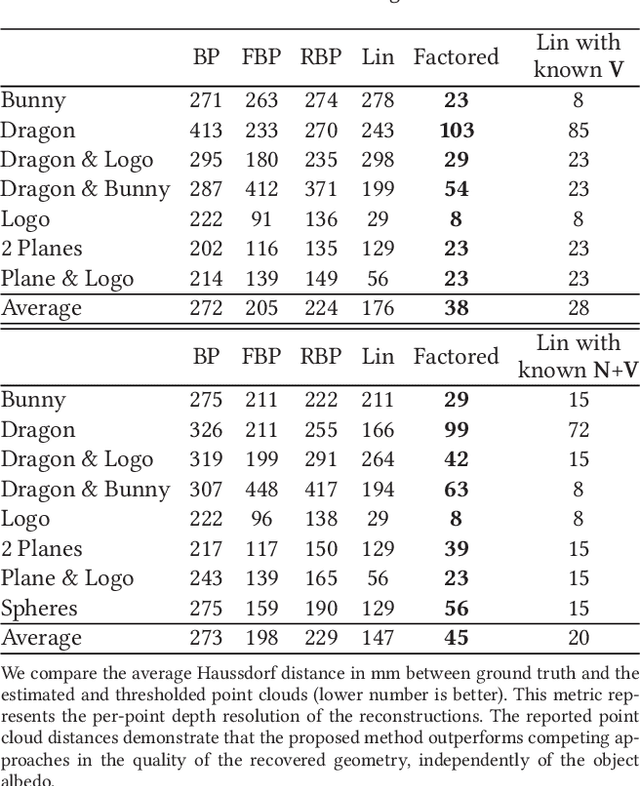
Imaging objects obscured by occluders is a significant challenge for many applications. A camera that could "see around corners" could help improve navigation and mapping capabilities of autonomous vehicles or make search and rescue missions more effective. Time-resolved single-photon imaging systems have recently been demonstrated to record optical information of a scene that can lead to an estimation of the shape and reflectance of objects hidden from the line of sight of a camera. However, existing non-line-of-sight (NLOS) reconstruction algorithms have been constrained in the types of light transport effects they model for the hidden scene parts. We introduce a factored NLOS light transport representation that accounts for partial occlusions and surface normals. Based on this model, we develop a factorization approach for inverse time-resolved light transport and demonstrate high-fidelity NLOS reconstructions for challenging scenes both in simulation and with an experimental NLOS imaging system.