 Add to Chrome
 Add to Firefox
 Add to Edge
De Jure: Iterative LLM Self-Refinement for Structured Extraction of Regulatory Rules
Apr 02, 2026
Regulatory documents encode legally binding obligations that LLM-based systems must respect. Yet converting dense, hierarchically structured legal text into machine-readable rules remains a costly, expert-intensive process. We present De Jure, a fully automated, domain-agnostic pipeline for extracting structured regulatory rules from raw documents, requiring no human annotation, domain-specific prompting, or annotated gold data. De Jure operates through four sequential stages: normalization of source documents into structured Markdown; LLM-driven semantic decomposition into structured rule units; multi-criteria LLM-as-a-judge evaluation across 19 dimensions spanning metadata, definitions, and rule semantics; and iterative repair of low-scoring extractions within a bounded regeneration budget, where upstream components are repaired before rule units are evaluated. We evaluate De Jure across four models on three regulatory corpora spanning finance, healthcare, and AI governance. On the finance domain, De Jure yields consistent and monotonic improvement in extraction quality, reaching peak performance within three judge-guided iterations. De Jure generalizes effectively to healthcare and AI governance, maintaining high performance across both open- and closed-source models. In a downstream compliance question-answering evaluation via RAG, responses grounded in De Jure extracted rules are preferred over prior work in 73.8% of cases at single-rule retrieval depth, rising to 84.0% under broader retrieval, confirming that extraction fidelity translates directly into downstream utility. These results demonstrate that explicit, interpretable evaluation criteria can substitute for human annotation in complex regulatory domains, offering a scalable and auditable path toward regulation-grounded LLM alignment.

A flexible integer linear programming formulation for scheduling clinician on-call service in hospitals
Oct 18, 2019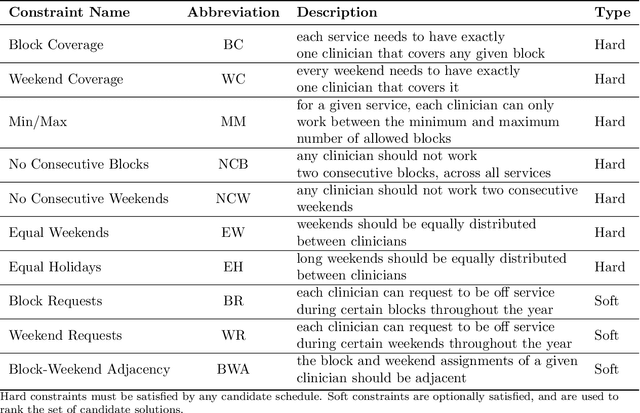
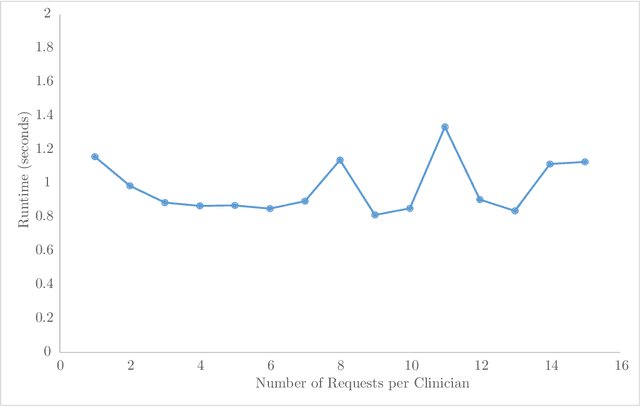
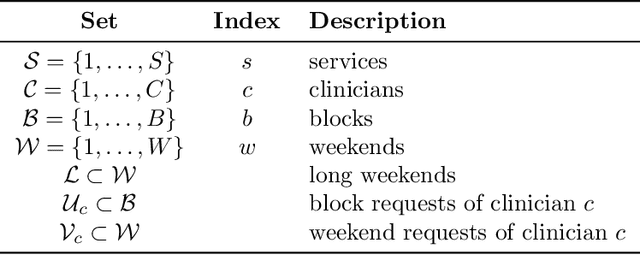
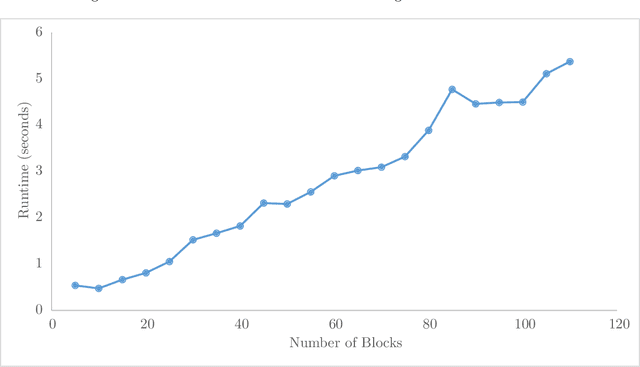
Scheduling of personnel in a hospital environment is vital to improving the service provided to patients and balancing the workload assigned to clinicians. Many approaches have been tried and successfully applied to generate efficient schedules in such settings. However, due to the computational complexity of the scheduling problem in general, most approaches resort to heuristics to find a non-optimal solution in a reasonable amount of time. We designed an integer linear programming formulation to find an optimal schedule in a clinical division of a hospital. Our formulation mitigates issues related to computational complexity by minimizing the set of constraints, yet retains sufficient flexibility so that it can be adapted to a variety of clinical divisions. We then conducted a case study for our approach using data from the Infectious Diseases division at St. Michael's Hospital in Toronto, Canada. We analyzed and compared the results of our approach to manually-created schedules at the hospital, and found improved adherence to departmental constraints and clinician preferences. We used simulated data to examine the sensitivity of the runtime of our linear program for various parameters and observed reassuring results, signifying the practicality and generalizability of our approach in different real-world scenarios.