 Add to Chrome
 Add to Firefox
 Add to Edge
MassSpecGym in the Wild: Uncovering and Correcting Evaluation Pitfalls in AI-Driven Molecule Discovery
Jun 17, 2026
Reliable benchmarking is critical for developing machine learning models for tandem mass spectrometry (MS/MS) based molecule discovery. Subtle issues in experimental design and model evaluation procedures can degrade the trustworthiness of such benchmarks and lead to erroneous conclusions. We conduct a thorough review of model evaluation issues in the recent MS/MS machine learning literature, using the standard MassSpecGym benchmark suite as a case study to illustrate the impact of these issues. We find evaluation issues in at least 17 of 26 papers reporting MassSpecGym benchmark results in the first year of its adoption. We isolate three classes of failures: (i) data leakage, (ii) shortcut learning, and (iii) implementation bugs and metric divergence. Through extensive experimentation and code replication, we quantify the impact of these issues and show how they corrupt the evaluation standards MassSpecGym was designed to enforce. We distill our findings into recommendations generalizable to MS/MS challenges, benchmarks, and custom evaluation setups. We also release MassSpecGym v1.5, an implementation of our recommendations in the MassSpecGym benchmarking suite which addresses the failure modes identified in this audit. MassSpecGym v1.5 is publicly available at https://github.com/pluskal-lab/MassSpecGym.

Efficiently predicting high resolution mass spectra with graph neural networks
Jan 26, 2023
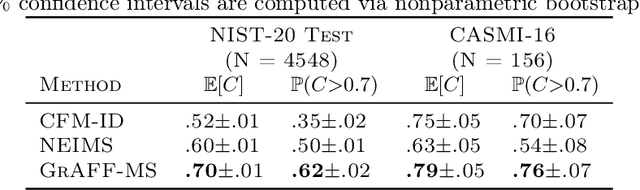

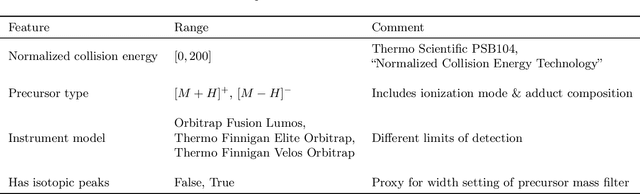
Identifying a small molecule from its mass spectrum is the primary open problem in computational metabolomics. This is typically cast as information retrieval: an unknown spectrum is matched against spectra predicted computationally from a large database of chemical structures. However, current approaches to spectrum prediction model the output space in ways that force a tradeoff between capturing high resolution mass information and tractable learning. We resolve this tradeoff by casting spectrum prediction as a mapping from an input molecular graph to a probability distribution over molecular formulas. We discover that a large corpus of mass spectra can be closely approximated using a fixed vocabulary constituting only 2% of all observed formulas. This enables efficient spectrum prediction using an architecture similar to graph classification - GrAFF-MS - achieving significantly lower prediction error and orders-of-magnitude faster runtime than state-of-the-art methods.
Multi-scale Sinusoidal Embeddings Enable Learning on High Resolution Mass Spectrometry Data
Jul 06, 2022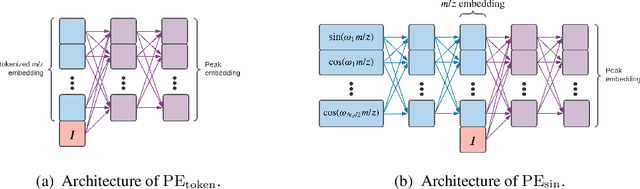
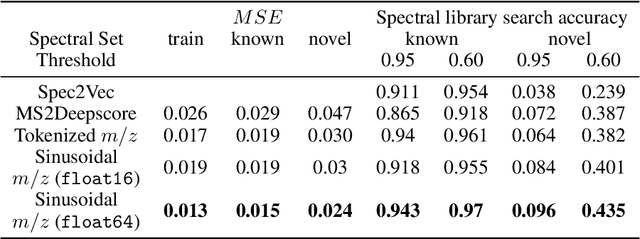
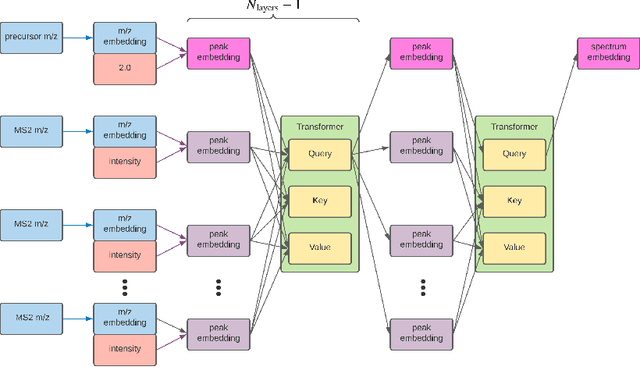
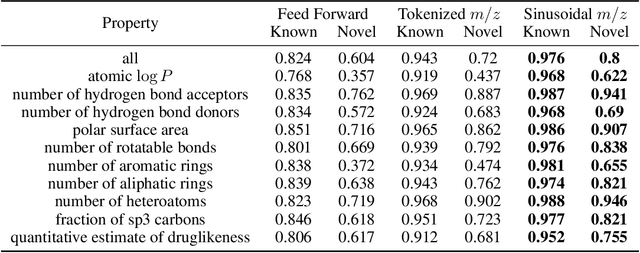
Small molecules in biological samples are studied to provide information about disease states, environmental toxins, natural product drug discovery, and many other applications. The primary window into the composition of small molecule mixtures is tandem mass spectrometry (MS2), which produces data that are of high sensitivity and part per million resolution. We adopt multi-scale sinusoidal embeddings of the mass data in MS2 designed to meet the challenge of learning from the full resolution of MS2 data. Using these embeddings, we provide a new state of the art model for spectral library search, the standard task for initial evaluation of MS2 data. We also introduce a new task, chemical property prediction from MS2 data, that has natural applications in high-throughput MS2 experiments and show that an average $R^2$ of 80\% for novel compounds can be achieved across 10 chemical properties prioritized by medicinal chemists. We use dimensionality reduction techniques and experiments with different floating point resolutions to show the essential role multi-scale sinusoidal embeddings play in learning from MS2 data.