 Add to Chrome
 Add to Firefox
 Add to Edge
ZoomR: Memory Efficient Reasoning through Multi-Granularity Key Value Retrieval
Apr 13, 2026
Large language models (LLMs) have shown great performance on complex reasoning tasks but often require generating long intermediate thoughts before reaching a final answer. During generation, LLMs rely on a key-value (KV) cache for autoregressive decoding. However, the memory footprint of the KV cache grows with output length. Prior work on KV cache optimization mostly focus on compressing the long input context, while retaining the full KV cache for decoding. For tasks requiring long output generation, this leads to increased computational and memory costs. In this paper, we introduce ZoomR, a novel approach that enables LLMs to adaptively compress verbose reasoning thoughts into summaries and uses a dynamic KV cache selection policy that leverages these summaries while also strategically "zooming in" on fine-grained details. By using summary keys as a coarse-grained index during decoding, ZoomR uses the query to retrieve details for only the most important thoughts. This hierarchical strategy significantly reduces memory usage by avoiding full-cache attention at each step. Experiments across math and reasoning tasks show that our approach achieves competitive performance compared to baselines, while reducing inference memory requirements by more than $4\times$. These results demonstrate that a multi-granularity KV selection enables more memory efficient decoding, especially for long output generation.

SentenceKV: Efficient LLM Inference via Sentence-Level Semantic KV Caching
Apr 01, 2025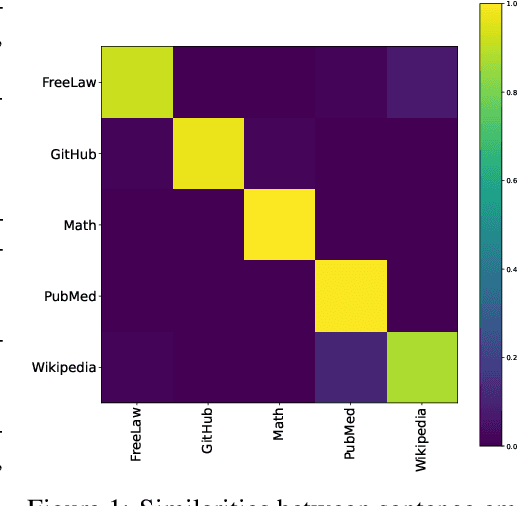
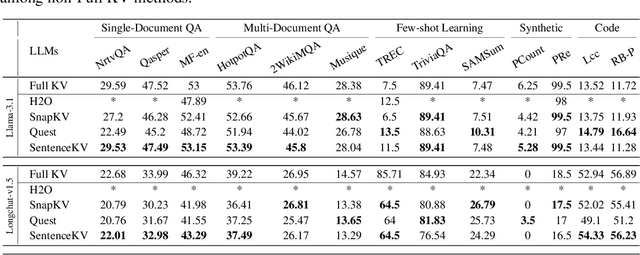

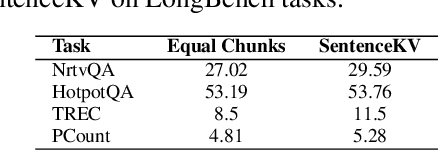
Large language models face significant computational and memory challenges when processing long contexts. During inference, efficient management of the key-value (KV) cache, which stores intermediate activations for autoregressive generation, is critical to reducing memory overhead and improving computational efficiency. Traditional token-level efficient KV caching methods overlook semantic information, treating tokens independently without considering their semantic relationships. Meanwhile, existing semantic-preserving KV cache management approaches often suffer from substantial memory usage and high time-to-first-token. To address these limitations, we propose SentenceKV, a novel sentence-level semantic KV caching approach designed to enhance inference efficiency while preserving semantic coherence. During prefilling, SentenceKV groups tokens based on sentence-level semantic similarity, compressing sentence representations into concise semantic vectors stored directly on the GPU, while individual KV pairs are offloaded to CPU. During decoding, SentenceKV generates tokens by selectively retrieving semantically relevant sentence-level KV entries, leveraging the semantic similarity between the prefilling-stage semantic vectors and decoding-stage queries. This ensures efficient and contextually accurate predictions, minimizing the loading of redundant or irrelevant data into GPU memory and significantly reducing memory overhead while maintaining stable inference latency, even for extremely long contexts. Extensive evaluations on benchmarks including PG-19, LongBench, and Needle-In-A-Haystack demonstrate that SentenceKV significantly outperforms state-of-the-art methods in both efficiency and memory usage, without compromising model accuracy.