 Add to Chrome
 Add to Firefox
 Add to Edge
Semantic Bandits: In-Context Exploration-Exploitation is Biased by Semantic Priors
Aug 17, 2026
Large language models (LLMs) are increasingly deployed as decision-making agents in settings that require sophisticated environmental exploration. However, existing work has raised questions about how LLMs actually balance exploration and exploitation. Unlike classical agents, LLM agents engage with tasks through natural language, exposing them to semantic information with no formal counterpart in the task structure. We introduce the semantic bandit, an extension of the multi-armed bandit setting that explicitly considers the textual labels assigned to actions, and use it to study how semantic priors --- inductive biases arising from associations between language and expected reward learned during pre-training, shape LLM exploration behaviour. We find that semantically informative action labels reduce exploration in favour of exploitation, improving performance when aligned with the reward structure and severely degrading it when misaligned. We further find that negative rewards trigger substantially more exploration than equivalent positive rewards, consistent with an expected-scale bias induced by reward conventions common in pre-training data. Overall, we argue that the use of language to define the environment and rewards introduces unavoidable biases derived from the fact that the model is trained on word co-occurence, with implications for the reliability and robustness of LLM agents in real-world decision-making settings.

Bayesian Optimization with LLM-Based Acquisition Functions for Natural Language Preference Elicitation
May 02, 2024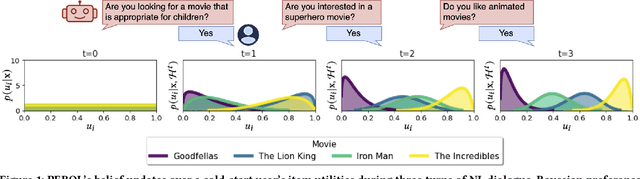
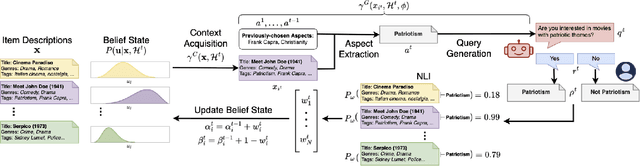
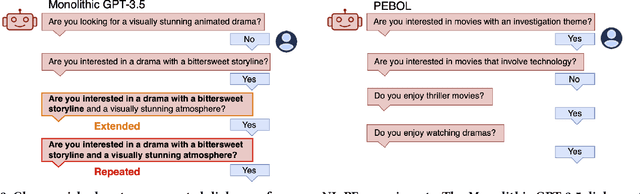

Designing preference elicitation (PE) methodologies that can quickly ascertain a user's top item preferences in a cold-start setting is a key challenge for building effective and personalized conversational recommendation (ConvRec) systems. While large language models (LLMs) constitute a novel technology that enables fully natural language (NL) PE dialogues, we hypothesize that monolithic LLM NL-PE approaches lack the multi-turn, decision-theoretic reasoning required to effectively balance the NL exploration and exploitation of user preferences towards an arbitrary item set. In contrast, traditional Bayesian optimization PE methods define theoretically optimal PE strategies, but fail to use NL item descriptions or generate NL queries, unrealistically assuming users can express preferences with direct item ratings and comparisons. To overcome the limitations of both approaches, we formulate NL-PE in a Bayesian Optimization (BO) framework that seeks to generate NL queries which actively elicit natural language feedback to reduce uncertainty over item utilities to identify the best recommendation. We demonstrate our framework in a novel NL-PE algorithm, PEBOL, which uses Natural Language Inference (NLI) between user preference utterances and NL item descriptions to maintain preference beliefs and BO strategies such as Thompson Sampling (TS) and Upper Confidence Bound (UCB) to guide LLM query generation. We numerically evaluate our methods in controlled experiments, finding that PEBOL achieves up to 131% improvement in MAP@10 after 10 turns of cold start NL-PE dialogue compared to monolithic GPT-3.5, despite relying on a much smaller 400M parameter NLI model for preference inference.