 Add to Chrome
 Add to Firefox
 Add to Edge
STAR-NT: Spatiotemporal Acceleration of Real-Time Neural Transparency Rendering
Jun 15, 2026
Neural order-independent transparency delivers high-quality rendering of overlapping transparent surfaces, but its geometry passes and network input generation remain costly, particularly on mobile and legacy hardware. We present a spatiotemporal acceleration framework that exploits spatial and temporal coherence to reduce this overhead while preserving visual quality. Spatially, we use adaptive quadtree-based screen-space subdivision to scale geometry pass resolution according to local color variance. Temporally, selected frames reuse the previous transparency result through depth-based reprojection instead of full rendering. Together, these optimizations reduce rendering cost and integrate efficiently into existing real-time rendering pipelines.

An Advert Creation System for 3D Product Placements
Jun 26, 2020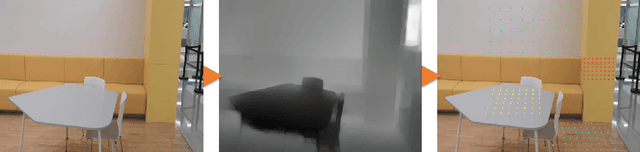
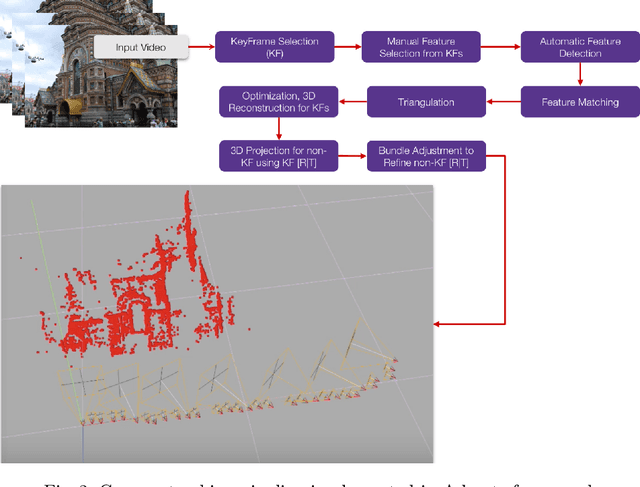
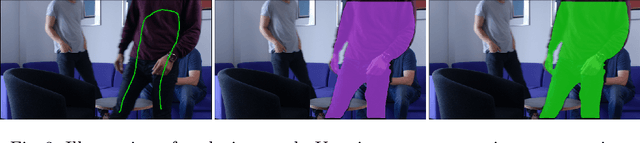
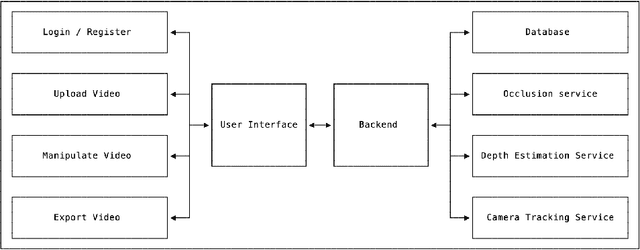
Over the past decade, the evolution of video-sharing platforms has attracted a significant amount of investments on contextual advertising. The common contextual advertising platforms utilize the information provided by users to integrate 2D visual ads into videos. The existing platforms face many technical challenges such as ad integration with respect to occluding objects and 3D ad placement. This paper presents a Video Advertisement Placement & Integration (Adverts) framework, which is capable of perceiving the 3D geometry of the scene and camera motion to blend 3D virtual objects in videos and create the illusion of reality. The proposed framework contains several modules such as monocular depth estimation, object segmentation, background-foreground separation, alpha matting and camera tracking. Our experiments conducted using Adverts framework indicates the significant potential of this system in contextual ad integration, and pushing the limits of advertising industry using mixed reality technologies.