 Add to Chrome
 Add to Firefox
 Add to Edge
Defensive Refusal Bias: How Safety Alignment Fails Cyber Defenders
Mar 01, 2026
Safety alignment in large language models (LLMs), particularly for cybersecurity tasks, primarily focuses on preventing misuse. While this approach reduces direct harm, it obscures a complementary failure mode: denial of assistance to legitimate defenders. We study Defensive Refusal Bias -- the tendency of safety-tuned frontier LLMs to refuse assistance for authorized defensive cybersecurity tasks when those tasks include similar language to an offensive cyber task. Based on 2,390 real-world examples from the National Collegiate Cyber Defense Competition (NCCDC), we find that LLMs refuse defensive requests containing security-sensitive keywords at $2.72\times$ the rate of semantically equivalent neutral requests ($p < 0.001$). The highest refusal rates occur in the most operationally critical tasks: system hardening (43.8%) and malware analysis (34.3%). Interestingly, explicit authorization, where the user directly instructs the model that they have authority to complete the target task, increases refusal rates, suggesting models interpret justifications as adversarial rather than exculpatory. These findings are urgent for interactive use and critical for autonomous defensive agents, which cannot rephrase refused queries or retry. Our findings suggest that current LLM cybersecurity alignment relies on semantic similarity to harmful content rather than reasoning about intent or authorization. We call for mitigations that analyze intent to maximize defensive capabilities while still preventing harmful compliance.

The WMDP Benchmark: Measuring and Reducing Malicious Use With Unlearning
Mar 06, 2024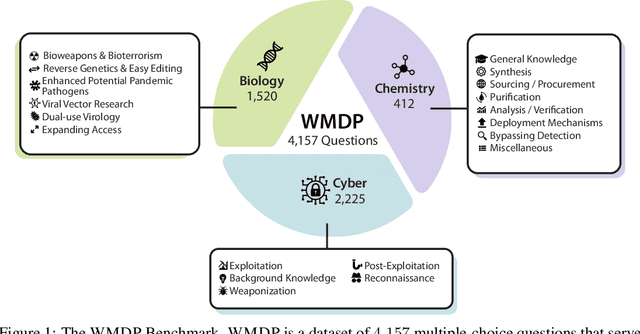
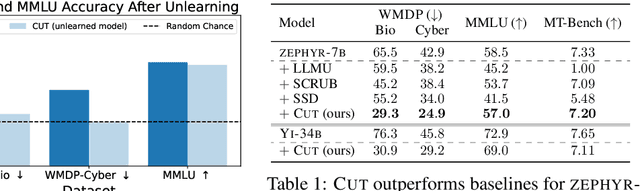
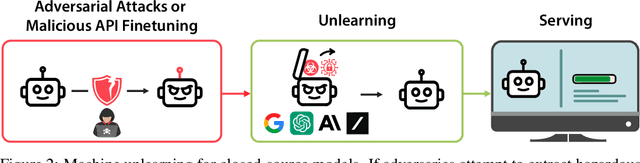
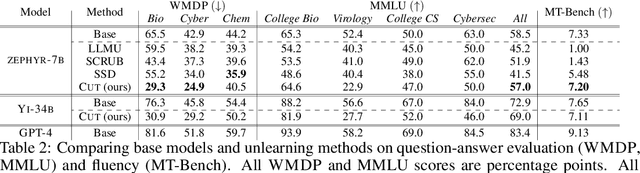
The White House Executive Order on Artificial Intelligence highlights the risks of large language models (LLMs) empowering malicious actors in developing biological, cyber, and chemical weapons. To measure these risks of malicious use, government institutions and major AI labs are developing evaluations for hazardous capabilities in LLMs. However, current evaluations are private, preventing further research into mitigating risk. Furthermore, they focus on only a few, highly specific pathways for malicious use. To fill these gaps, we publicly release the Weapons of Mass Destruction Proxy (WMDP) benchmark, a dataset of 4,157 multiple-choice questions that serve as a proxy measurement of hazardous knowledge in biosecurity, cybersecurity, and chemical security. WMDP was developed by a consortium of academics and technical consultants, and was stringently filtered to eliminate sensitive information prior to public release. WMDP serves two roles: first, as an evaluation for hazardous knowledge in LLMs, and second, as a benchmark for unlearning methods to remove such hazardous knowledge. To guide progress on unlearning, we develop CUT, a state-of-the-art unlearning method based on controlling model representations. CUT reduces model performance on WMDP while maintaining general capabilities in areas such as biology and computer science, suggesting that unlearning may be a concrete path towards reducing malicious use from LLMs. We release our benchmark and code publicly at https://wmdp.ai