 Add to Chrome
 Add to Firefox
 Add to Edge
NutriMLLM: Multimodal Large Language Models for Dietary Micronutrient Analysis
Jun 08, 2026
Comprehensive estimation of dietary micronutrients from food images could improve clinical nutrition care, but training such models requires large multimodal datasets linking diverse foods to complete nutrient profiles. We first show that existing multimodal large language models (MLLMs), including leading proprietary models, are unreliable for this task. Across five model families and four independent evaluation benchmarks (ASA24, SNAPMe, FNDDS, and NutriBench), models frequently abstained or returned statistically implausible values. To address this gap without costly expert annotation, we repurposed a decade of population-scale 24-hour dietary recalls as structured prompts for text-to-image generation. This pipeline produced a synthetic corpus of about 1.1 million image-description-nutrient triplets, each pairing a generated food image with a complete 65-nutrient label. To our knowledge, this is the largest synthetic food-image corpus with comprehensive micronutrient annotation planned for public release upon publication. Fine-tuning Qwen3-VL (2B/4B/8B/30B) and GLM-4.6V-Flash on this corpus yielded NutriMLLM, the first family of vision-language models specialized for comprehensive dietary micronutrient estimation. We evaluate these models with a four-component framework that separately measures abstention, hallucination, overall usability, and per-nutrient numerical accuracy. On real food images, every NutriMLLM variant achieved near-complete coverage across all 65 nutrients, and the largest variant matched or exceeded proprietary baselines (GPT-5, Gemini 3, and Claude Sonnet 4.5) in accuracy on most nutrients. These results show that recall-driven synthetic supervision can make image-based comprehensive micronutrient estimation a tractable engineering problem and support dietary assessment, personalized nutrition guidance, and population-scale micronutrient surveillance.

LoopFM: Learning frOm HistOrical RePresentations of Foundation Model for Recommendation
May 28, 2026Knowledge distillation (KD) transfers a single scalar prediction from a large foundation model (FM) to compact vertical models (VMs), suffering from diminishing transfer ratio -- the fraction of FM improvement captured by the VM -- as a single scalar cannot convey the rich intermediate knowledge that larger FMs learn. To address this bottleneck, we propose LoopFM (Learning frOm HistOrical ReP*resentations of FM), a framework that opens a high-bandwidth transfer channel by structuring FM intermediate embeddings as input features (e.g., user history sequence) for downstream VMs, without requiring real-time FM inference at serving and architectural coupling between FM and VM. We provide a theoretical framework for LoopFM with a gain decomposition and transfer-ratio analysis. On three public benchmarks, LoopFM demonstrates strong AUC improvements (e.g., 6\%+ on TaobaoAd) and complementary knowledge transfer capability with KD. On industrial-scale systems (billions of examples, trillion-parameter FMs), LoopFM approximately doubles the knowledge transfer ratio on top of KD, delivering a +0.5\% conversion improvement in Y1H1, and a +1.03\% and +1.22\% conversion improvement from two individual launches respectively in Y1H2.
Kunlun: Establishing Scaling Laws for Massive-Scale Recommendation Systems through Unified Architecture Design
Feb 13, 2026Deriving predictable scaling laws that govern the relationship between model performance and computational investment is crucial for designing and allocating resources in massive-scale recommendation systems. While such laws are established for large language models, they remain challenging for recommendation systems, especially those processing both user history and context features. We identify poor scaling efficiency as the main barrier to predictable power-law scaling, stemming from inefficient modules with low Model FLOPs Utilization (MFU) and suboptimal resource allocation. We introduce Kunlun, a scalable architecture that systematically improves model efficiency and resource allocation. Our low-level optimizations include Generalized Dot-Product Attention (GDPA), Hierarchical Seed Pooling (HSP), and Sliding Window Attention. Our high-level innovations feature Computation Skip (CompSkip) and Event-level Personalization. These advances increase MFU from 17% to 37% on NVIDIA B200 GPUs and double scaling efficiency over state-of-the-art methods. Kunlun is now deployed in major Meta Ads models, delivering significant production impact.
Large Language Model Empowered Privacy-Protected Framework for PHI Annotation in Clinical Notes
Apr 22, 2025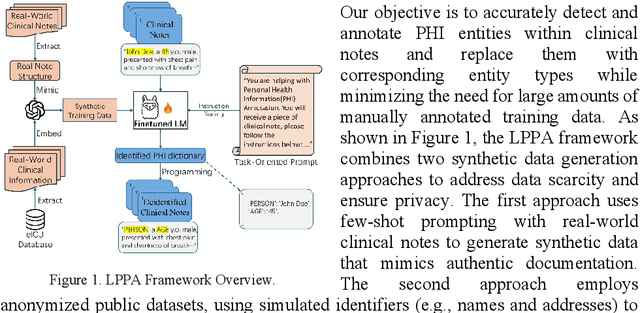
The de-identification of private information in medical data is a crucial process to mitigate the risk of confidentiality breaches, particularly when patient personal details are not adequately removed before the release of medical records. Although rule-based and learning-based methods have been proposed, they often struggle with limited generalizability and require substantial amounts of annotated data for effective performance. Recent advancements in large language models (LLMs) have shown significant promise in addressing these issues due to their superior language comprehension capabilities. However, LLMs present challenges, including potential privacy risks when using commercial LLM APIs and high computational costs for deploying open-source LLMs locally. In this work, we introduce LPPA, an LLM-empowered Privacy-Protected PHI Annotation framework for clinical notes, targeting the English language. By fine-tuning LLMs locally with synthetic notes, LPPA ensures strong privacy protection and high PHI annotation accuracy. Extensive experiments demonstrate LPPA's effectiveness in accurately de-identifying private information, offering a scalable and efficient solution for enhancing patient privacy protection.
Evaluation of General Large Language Models in Contextually Assessing Semantic Concepts Extracted from Adult Critical Care Electronic Health Record Notes
Jan 24, 2024The field of healthcare has increasingly turned its focus towards Large Language Models (LLMs) due to their remarkable performance. However, their performance in actual clinical applications has been underexplored. Traditional evaluations based on question-answering tasks don't fully capture the nuanced contexts. This gap highlights the need for more in-depth and practical assessments of LLMs in real-world healthcare settings. Objective: We sought to evaluate the performance of LLMs in the complex clinical context of adult critical care medicine using systematic and comprehensible analytic methods, including clinician annotation and adjudication. Methods: We investigated the performance of three general LLMs in understanding and processing real-world clinical notes. Concepts from 150 clinical notes were identified by MetaMap and then labeled by 9 clinicians. Each LLM's proficiency was evaluated by identifying the temporality and negation of these concepts using different prompts for an in-depth analysis. Results: GPT-4 showed overall superior performance compared to other LLMs. In contrast, both GPT-3.5 and text-davinci-003 exhibit enhanced performance when the appropriate prompting strategies are employed. The GPT family models have demonstrated considerable efficiency, evidenced by their cost-effectiveness and time-saving capabilities. Conclusion: A comprehensive qualitative performance evaluation framework for LLMs is developed and operationalized. This framework goes beyond singular performance aspects. With expert annotations, this methodology not only validates LLMs' capabilities in processing complex medical data but also establishes a benchmark for future LLM evaluations across specialized domains.