 Add to Chrome
 Add to Firefox
 Add to Edge
Inversion-Free Natural Gradient Descent on Riemannian Manifolds
Apr 03, 2026
The natural gradient method is widely used in statistical optimization, but its standard formulation assumes a Euclidean parameter space. This paper proposes an inversion-free stochastic natural gradient method for probability distributions whose parameters lie on a Riemannian manifold. The manifold setting offers several advantages: one can implicitly enforce parameter constraints such as positive definiteness and orthogonality, ensure parameters are identifiable, or guarantee regularity properties of the objective like geodesic convexity. Building on an intrinsic formulation of the Fisher information matrix (FIM) on a manifold, our method maintains an online approximation of the inverse FIM, which is efficiently updated at quadratic cost using score vectors sampled at successive iterates. In the Riemannian setting, these score vectors belong to different tangent spaces and must be combined using transport operations. We prove almost-sure convergence rates of $O(\log{s}/s^α)$ for the squared distance to the minimizer when the step size exponent $α>2/3$. We also establish almost-sure rates for the approximate FIM, which now accumulates transport-based errors. A limited-memory variant of the algorithm with sub-quadratic storage complexity is proposed. Finally, we demonstrate the effectiveness of our method relative to its Euclidean counterparts on variational Bayes with Gaussian approximations and normalizing flows.

Covariate Dependent Mixture of Bayesian Networks
Jan 10, 2025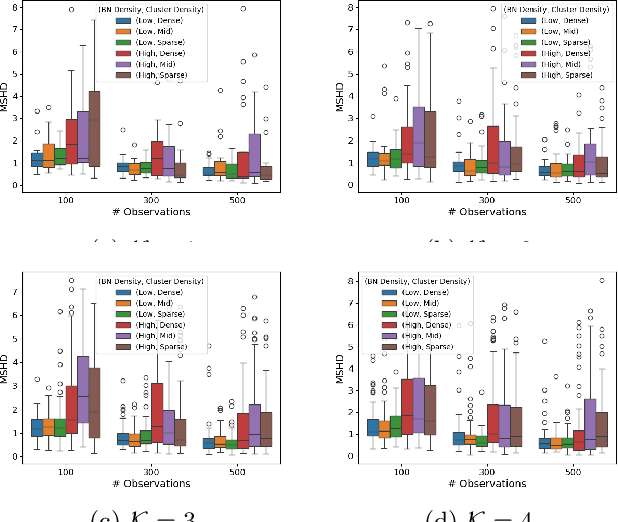
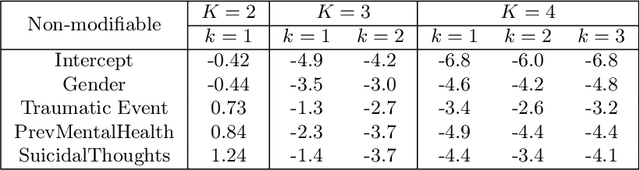
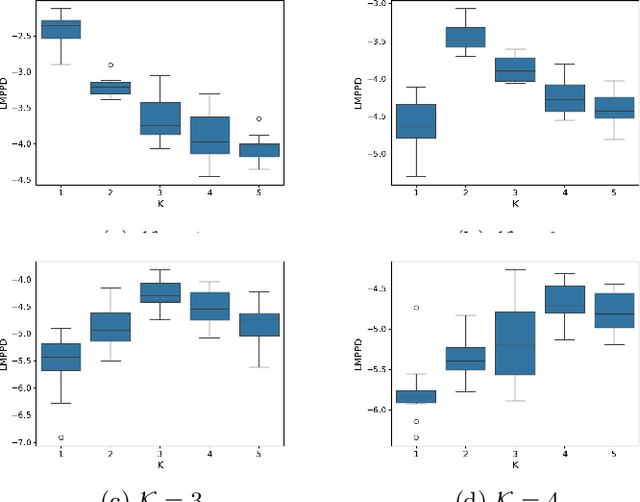
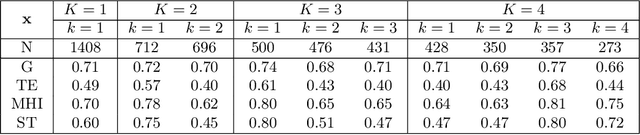
Learning the structure of Bayesian networks from data provides insights into underlying processes and the causal relationships that generate the data, but its usefulness depends on the homogeneity of the data population, a condition often violated in real-world applications. In such cases, using a single network structure for inference can be misleading, as it may not capture sub-population differences. To address this, we propose a novel approach of modelling a mixture of Bayesian networks where component probabilities depend on individual characteristics. Our method identifies both network structures and demographic predictors of sub-population membership, aiding personalised interventions. We evaluate our method through simulations and a youth mental health case study, demonstrating its potential to improve tailored interventions in health, education, and social policy.