 Add to Chrome
 Add to Firefox
 Add to Edge
Agent Mentor: Framing Agent Knowledge through Semantic Trajectory Analysis
Apr 12, 2026
AI agent development relies heavily on natural language prompting to define agents' tasks, knowledge, and goals. These prompts are interpreted by Large Language Models (LLMs), which govern agent behavior. Consequently, agentic performance is susceptible to variability arising from imprecise or ambiguous prompt formulations. Identifying and correcting such issues requires examining not only the agent's code, but also the internal system prompts generated throughout its execution lifecycle, as reflected in execution logs. In this work, we introduce an analytics pipeline implemented as part of the Agent Mentor open-source library that monitors and incrementally adapts the system prompts defining another agent's behavior. The pipeline improves performance by systematically injecting corrective instructions into the agent's knowledge. We describe its underlying mechanism, with particular emphasis on identifying semantic features associated with undesired behaviors and using them to derive corrective statements. We evaluate the proposed pipeline across three exemplar agent configurations and benchmark tasks using repeated execution runs to assess effectiveness. These experiments provide an initial exploration of automating such a mentoring pipeline within future agentic governance frameworks. Overall, the approach demonstrates consistent and measurable accuracy improvements across diverse configurations, particularly in settings dominated by specification ambiguity. For reproducibility, we released our code as open source under the Agent Mentor library.

Beyond Black-Box Benchmarking: Observability, Analytics, and Optimization of Agentic Systems
Mar 09, 2025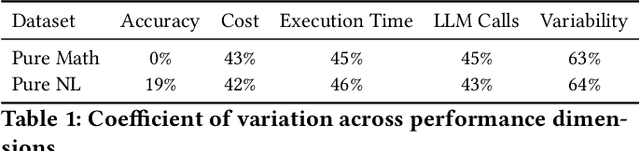
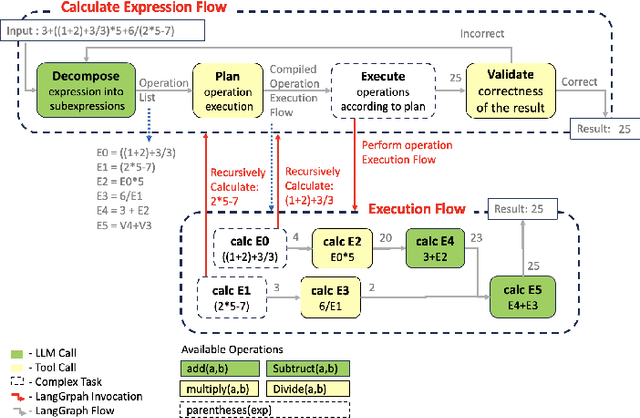
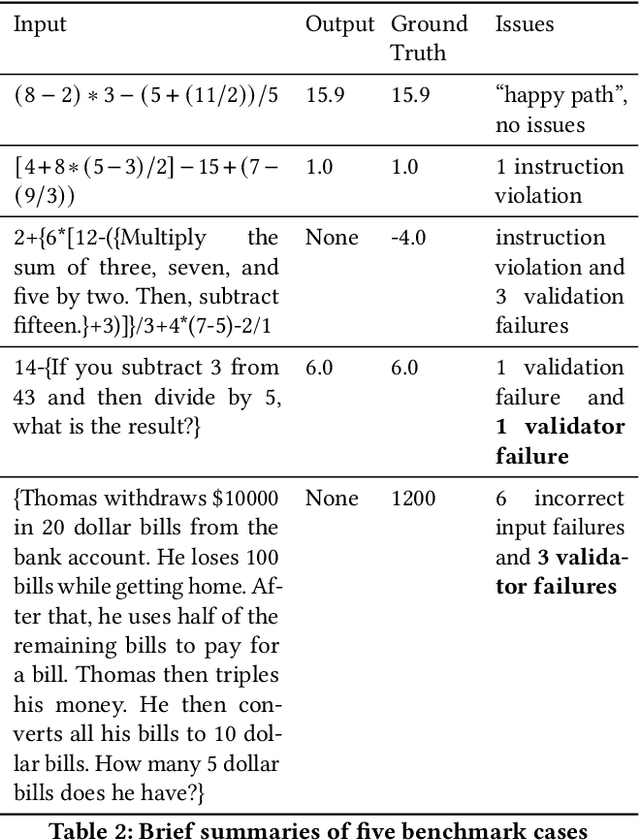
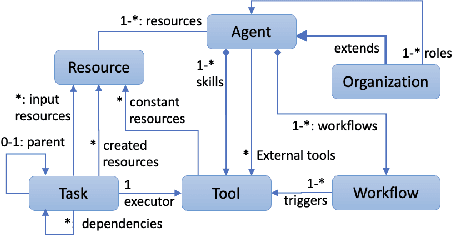
The rise of agentic AI systems, where agents collaborate to perform diverse tasks, poses new challenges with observing, analyzing and optimizing their behavior. Traditional evaluation and benchmarking approaches struggle to handle the non-deterministic, context-sensitive, and dynamic nature of these systems. This paper explores key challenges and opportunities in analyzing and optimizing agentic systems across development, testing, and maintenance. We explore critical issues such as natural language variability and unpredictable execution flows, which hinder predictability and control, demanding adaptive strategies to manage input variability and evolving behaviors. Through our user study, we supported these hypotheses. In particular, we showed a 79% agreement that non deterministic flow of agentic systems acts as a major challenge. Finally, we validated our statements empirically advocating the need for moving beyond classical benchmarking. To bridge these gaps, we introduce taxonomies to present expected analytics outcomes and the ways to collect them by extending standard observability frameworks. Building on these foundations, we introduce and demonstrate novel approach for benchmarking of agent evaluation systems. Unlike traditional "black box" performance evaluation approaches, our benchmark is built from agent runtime logs as input, and analytics outcome including discovered flows and issues. By addressing key limitations in existing methodologies, we aim to set the stage for more advanced and holistic evaluation strategies, which could foster the development of adaptive, interpretable, and robust agentic AI systems.