 Add to Chrome
 Add to Firefox
 Add to Edge
On-Device Continual Learning with Dual-Stage Buffer and Dynamic Loss for Point-of-Care Pneumonia Diagnosis
May 19, 2026
Deep learning models detect pneumonia from chest X-rays with high accuracy, but the performance declines under domain shifts caused by differences in devices, patients, or institutions. We present PneumoNet, a domain-incremental learning method for point-of-care pneumonia diagnosis in resource-limited settings. PneumoNet combines a lightweight CNN for on-device prediction, a dual-stage balanced buffer for class-balanced replay, and a dynamic class-weighted loss to correct training-batch imbalances. Evaluated on a domain-shifted PneumoniaMNIST dataset simulating five realistic domain change scenarios, PneumoNet achieves 86.6% accuracy with 1.4% forgetting while being smaller and faster than existing baselines. These results highlight PneumoNet's potential to enable adaptive, privacy-preserving diagnostic AI directly on point-of-care medical devices in real-world and pandemic-ready healthcare.

Improving Unsupervised Image Clustering With Robust Learning
Dec 21, 2020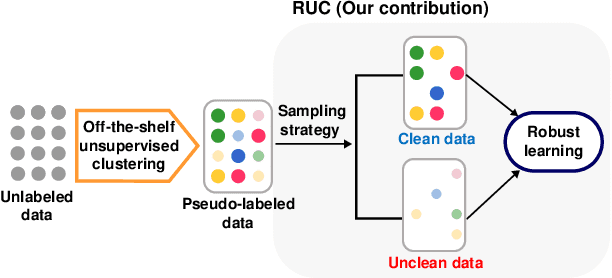
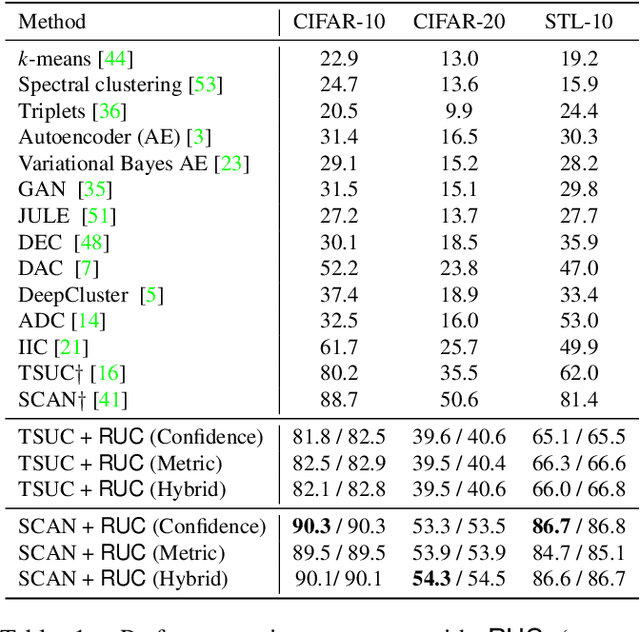
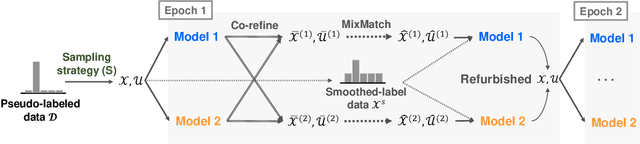
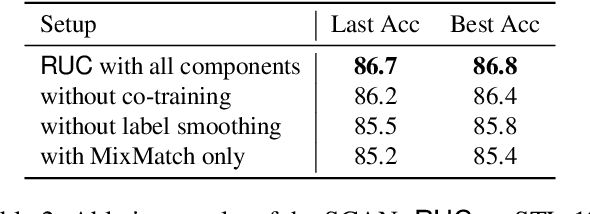
Unsupervised image clustering methods often introduce alternative objectives to indirectly train the model and are subject to faulty predictions and overconfident results. To overcome these challenges, the current research proposes an innovative model RUC that is inspired by robust learning. RUC's novelty is at utilizing pseudo-labels of existing image clustering models as a noisy dataset that may include misclassified samples. Its retraining process can revise misaligned knowledge and alleviate the overconfidence problem in predictions. This model's flexible structure makes it possible to be used as an add-on module to state-of-the-art clustering methods and helps them achieve better performance on multiple datasets. Extensive experiments show that the proposed model can adjust the model confidence with better calibration and gain additional robustness against adversarial noise.