 Add to Chrome
 Add to Firefox
 Add to Edge
Recirculation
Aug 18, 2026
We describe an inference-time architectural enhancement for off-the-shelf foundation models that markedly reduces perplexity and boosts accuracy across generation and reasoning tasks. Our approach incurs essentially no additional latency during generation, though it requires serial processing in the prefill phase. Motivated by the fundamental limitation that state updates in feedforward transformers are bounded by model depth, our technique, recirculation, introduces a specific form of recurrence that allows the model to act as a dynamical system and track belief states. We distinguish this technique from chain-of-thought computation---which is better reserved for complex inferences rather than basic state tracking---as well as from popular depth-recurrence techniques (looping) and the costly training of recurrent transformers. We also propose and evaluate an adaptive variant of recirculation which requires only light tuning of hyperparameters while freezing the original model weights. Relative to the off-the-shelf baseline, adaptive recirculation achieves remarkable gains on the Gemma3 family, including a 23% reduction in perplexity on a suite of datasets, a 21% increase in accuracy on GSM8k, and reliable improvements in accuracy on other downstream tasks. Our training-free approach succeeds by leveraging the model itself to inform architectural modifications, suggesting a route to architectural evolution guided by a trained network's properties rather than forced, arbitrary design choices.

Graph schemas as abstractions for transfer learning, inference, and planning
Feb 14, 2023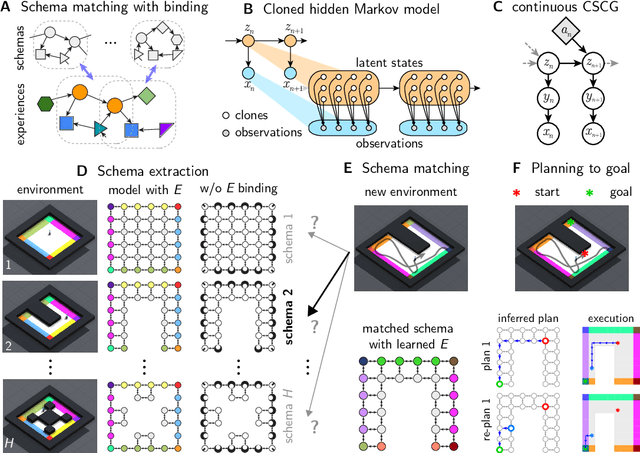
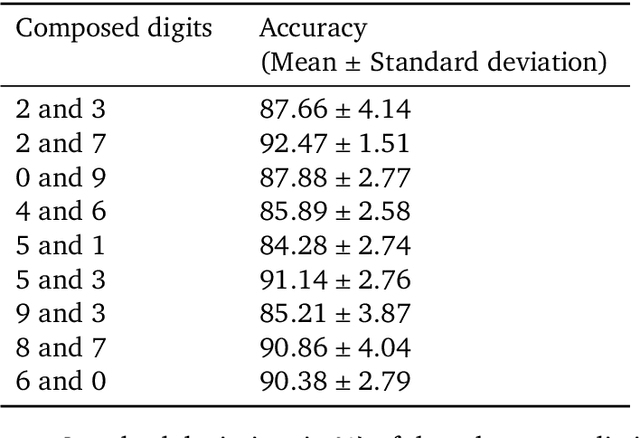
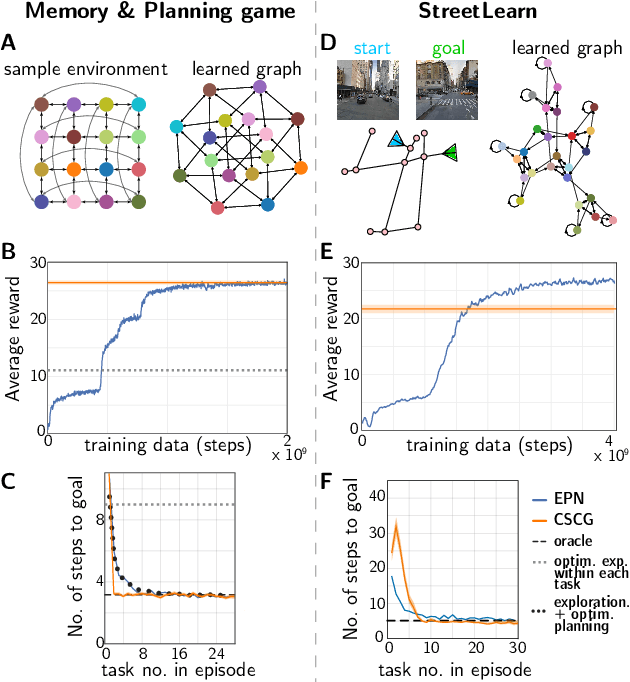
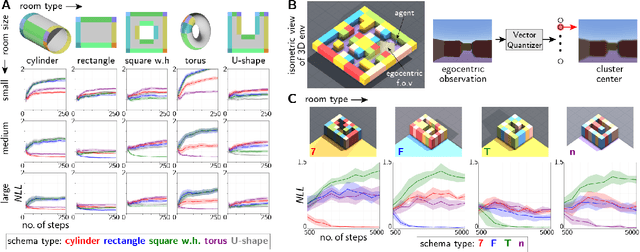
We propose schemas as a model for abstractions that can be used for rapid transfer learning, inference, and planning. Common structured representations of concepts and behaviors -- schemas -- have been proposed as a powerful way to encode abstractions. Latent graph learning is emerging as a new computational model of the hippocampus to explain map learning and transitive inference. We build on this work to show that learned latent graphs in these models have a slot structure -- schemas -- that allow for quick knowledge transfer across environments. In a new environment, an agent can rapidly learn new bindings between the sensory stream to multiple latent schemas and select the best fitting one to guide behavior. To evaluate these graph schemas, we use two previously published challenging tasks: the memory & planning game and one-shot StreetLearn, that are designed to test rapid task solving in novel environments. Graph schemas can be learned in far fewer episodes than previous baselines, and can model and plan in a few steps in novel variations of these tasks. We further demonstrate learning, matching, and reusing graph schemas in navigation tasks in more challenging environments with aliased observations and size variations, and show how different schemas can be composed to model larger 2D and 3D environments.