 Add to Chrome
 Add to Firefox
 Add to Edge
Gumbel Machine: Counterfactual Student Writing Generation via Gumbel Noise Steering
May 26, 2026
An effective method of teaching across disciplines is to provide examples of high-quality work. However, an example may be significantly different from a student's current work, making it challenging for them to emulate. An ideal learning demonstration is a counterfactual version of the student work, an improved version that is still similar to their own. Existing automated approaches for counterfactual text generation using Large Language Models (LLMs) result in domain-specific systems that are difficult to translate into practical applications. We present the Gumbel Machine, a flexible, modular approach to generating counterfactuals that leverages LLM instruction-following capabilities while encouraging similarity to a reference factual text. Central to our approach is a novel, controlled decoding algorithm, $β$-Hindsight control, which uses latent randomness as a tunable similarity control mechanism during counterfactual generation. Experiments on datasets of student writing, scored on various criteria, demonstrate the effectiveness of our approach at generating counterfactuals both rubric-consistent and similar to a reference.

Cognitively Diverse Multiple-Choice Question Generation: A Hybrid Multi-Agent Framework with Large Language Models
Feb 03, 2026Recent advances in large language models (LLMs) have made automated multiple-choice question (MCQ) generation increasingly feasible; however, reliably producing items that satisfy controlled cognitive demands remains a challenge. To address this gap, we introduce ReQUESTA, a hybrid, multi-agent framework for generating cognitively diverse MCQs that systematically target text-based, inferential, and main idea comprehension. ReQUESTA decomposes MCQ authoring into specialized subtasks and coordinates LLM-powered agents with rule-based components to support planning, controlled generation, iterative evaluation, and post-processing. We evaluated the framework in a large-scale reading comprehension study using academic expository texts, comparing ReQUESTA-generated MCQs with those produced by a single-pass GPT-5 zero-shot baseline. Psychometric analyses of learner responses assessed item difficulty and discrimination, while expert raters evaluated question quality across multiple dimensions, including topic relevance and distractor quality. Results showed that ReQUESTA-generated items were consistently more challenging, more discriminative, and more strongly aligned with overall reading comprehension performance. Expert evaluations further indicated stronger alignment with central concepts and superior distractor linguistic consistency and semantic plausibility, particularly for inferential questions. These findings demonstrate that hybrid, agentic orchestration can systematically improve the reliability and controllability of LLM-based generation, highlighting workflow design as a key lever for structured artifact generation beyond single-pass prompting.
Choose Your Own Adventure: Interactive E-Books to Improve Word Knowledge and Comprehension Skills
Mar 04, 2024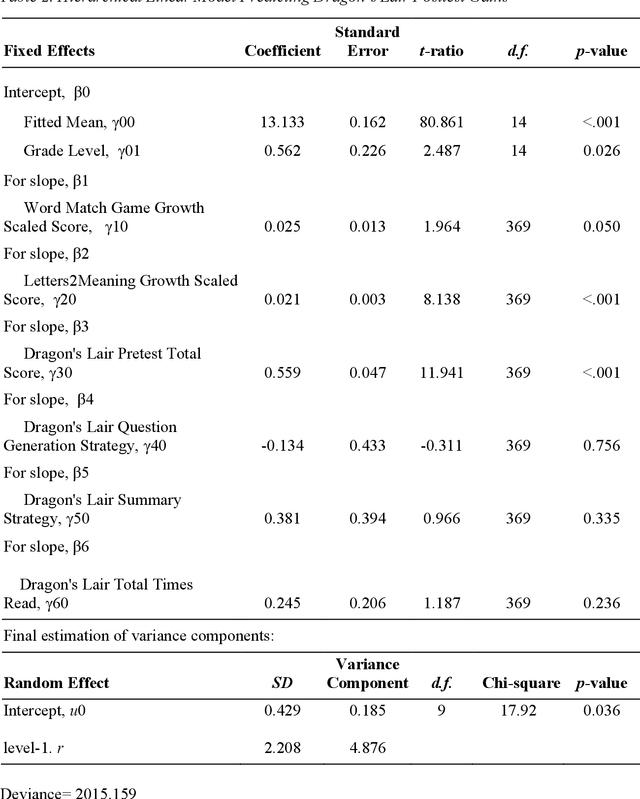
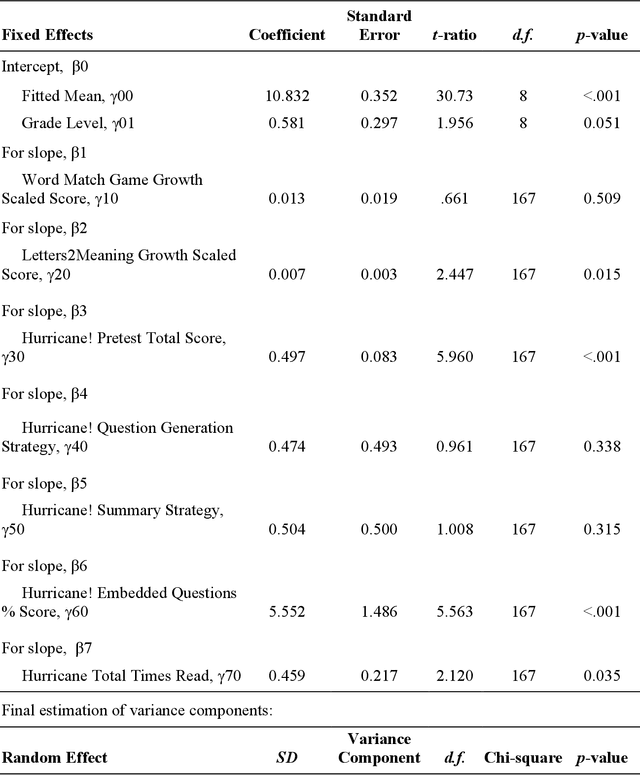
The purpose of this feasibility study was to examine the potential impact of reading digital interactive e-books on essential skills that support reading comprehension with third-fifth grade students. Students read two e-Books that taught word learning and comprehension monitoring strategies in the service of learning difficult vocabulary and targeted science concepts about hurricanes. We investigated whether specific comprehension strategies including word learning and strategies that supported general reading comprehension, summarization, and question generation, show promise of effectiveness in building vocabulary knowledge and comprehension skills in the e-Books. Students were assigned to read one of three versions of each of the e-Books, each version implemented one strategy. The books employed a choose-your-adventure format with embedded comprehension questions that provided students with immediate feedback on their responses. Paired samples t-tests were run to examine pre-to-post differences in learning the targeted vocabulary and science concepts taught in both e-Books. For both e-Books, students demonstrated significant gains in word learning and on the targeted hurricane concepts. Additionally, Hierarchical Linear Modeling (HLM) revealed that no one strategy was more associated with larger gains than the other. Performance on the embedded questions in the books was also associated with greater posttest outcomes for both e-Books. This work discusses important considerations for implementation and future development of e-books that can enhance student engagement and improve reading comprehension.