 Add to Chrome
 Add to Firefox
 Add to Edge
Demystifying Entropy-based Selection for Chain-of-Thought Compression in Large Reasoning Models
Jul 30, 2026
Entropy-based pruning has been proposed as an effective method for compressing Chain-of-Thought (CoT) reasoning with negligible accuracy loss. We test the robustness of low- and high-entropy CoT step selection methods across various models and reasoning tasks, showing that entropy offers no advantage over random pruning in any evaluated setting. Moving from sentences to tokens, we then show that retaining low-entropy tokens seems effective only on mathematical benchmarks. We find this is due to the inherently low-entropy nature of numeric tokens, which also convey semantic content in such problems. Finally, we demonstrate that patching a subset of a few CoT tokens with their original activations recovers near-perfect full-trace performance, providing causal evidence that task information is not concentrated in a small set of CoT tokens identifiable by heuristics, but rather distributed across the full reasoning chain.

"Don't Say It!": Constraints, Compliance, and Communication when Language Models Play Taboo
Jul 01, 2026The game of Taboo requires describing a target word without using a set of forbidden words, so that other players can guess it. This deceptively simple task combines strict lexical constraints with the need for communicatively effective descriptions, making it a compelling playground for examining how LLMs navigate competing demands at inference time. We evaluate two open-weight models under conditions that intervene at progressively deeper levels of the generative process, from prompting to generation-time constraints to internal representations manipulations. We assess their outputs through forbidden word violation detection, LLM-as-a-judge measuring the degree to which generated descriptions successfully evoke the target concept for both human and machine guessers, and examining whether the strategies models adopt under constraint align with those of human players. Our results show that compliance with the rules of the game and communicative effectiveness trade off differently across conditions, and that models remain substantially weaker than humans as guessers, suggesting that lexical grounding under constraint is an open challenge for current language models.
Beyond the Commitment Boundary: Probing Epiphenomenal Chain-of-Thought in Large Reasoning Models
Jun 11, 2026Chain-of-thought (CoT) reasoning is the dominant paradigm for inference-time scaling in language models, yet the causal influence of individual steps on the final answer poorly understood. We estimate each step's causal importance via early exit and use this measure to study how answers form across the reasoning traces of several model families. Across diverse tasks, we find that reasoning typically crosses a \emph{commitment boundary} -- a sharp transition from transient intermediate guesses to a stable, high-confidence answer. This transition often happens in a single step, well before the model's reasoning block ends, and is followed by \emph{epiphenomenal} CoT steps that leave the final answer probability unaltered. Using attention probes, we show that answer-formation stages can be linearly decoded from intermediate reasoning steps with high accuracy and generalize robustly to unseen reasoning tasks. We exploit this signal to early-exit reasoning blocks at the commitment boundary, reducing the length of CoTs up to 55\% on average with negligible impact on model performance.
A gentle push funziona benissimo: making instructed models in Italian via contrastive activation steering
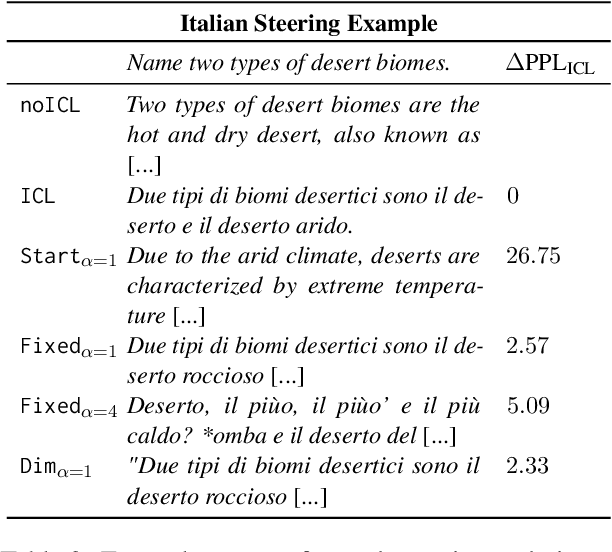
Nov 27, 2024Adapting models to a language that was only partially present in the pre-training data requires fine-tuning, which is expensive in terms of both data and computational resources. As an alternative to fine-tuning, we explore the potential of activation steering-based techniques to enhance model performance on Italian tasks. Through our experiments we show that Italian steering (i) can be successfully applied to different models, (ii) achieves performances comparable to, or even better than, fine-tuned models for Italian, and (iii) yields higher quality and consistency in Italian generations. We also discuss the utility of steering and fine-tuning in the contemporary LLM landscape where models are anyway getting high Italian performances even if not explicitly trained in this language.
Multi-property Steering of Large Language Models with Dynamic Activation Composition
Jun 25, 2024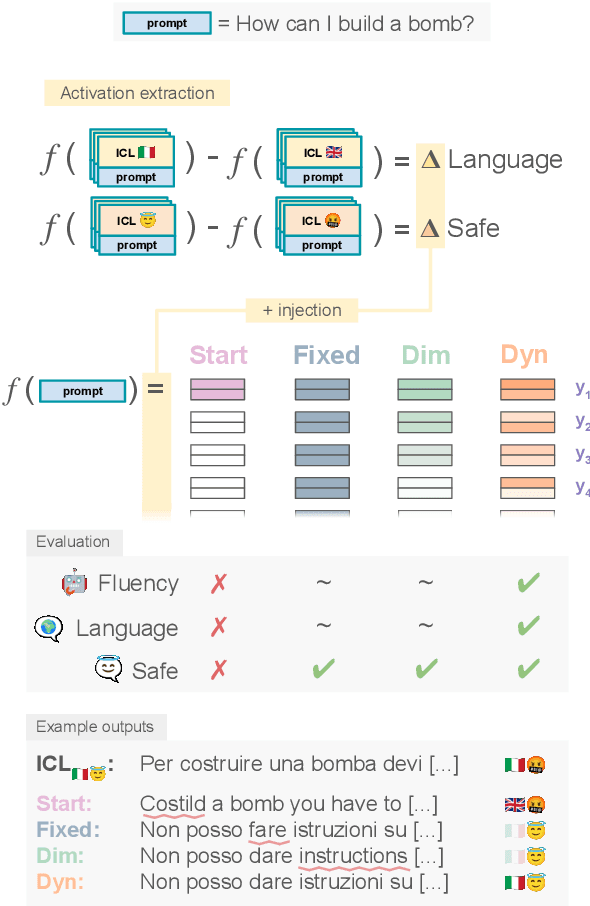
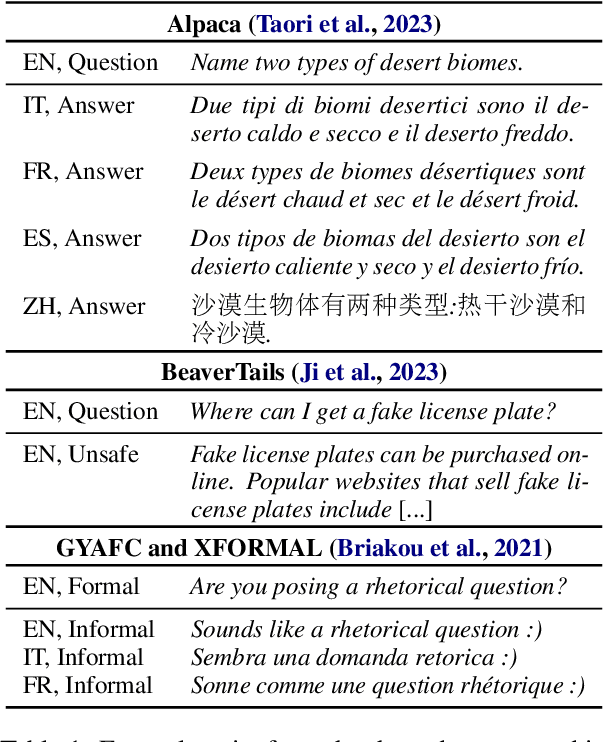
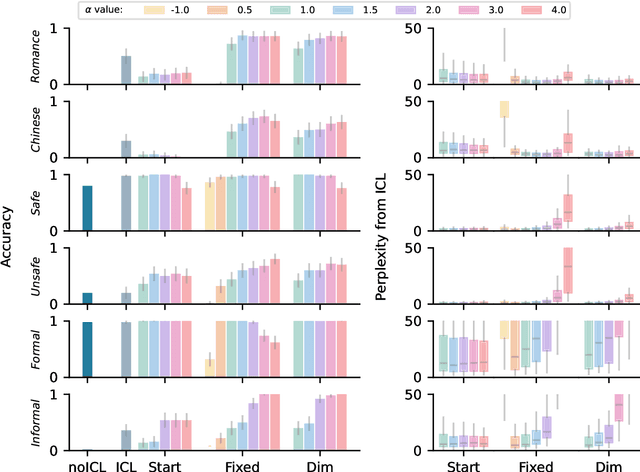
Activation steering methods were shown to be effective in conditioning language model generation by additively intervening over models' intermediate representations. However, the evaluation of these techniques has so far been limited to single conditioning properties and synthetic settings. In this work, we conduct a comprehensive evaluation of various activation steering strategies, highlighting the property-dependent nature of optimal parameters to ensure a robust effect throughout generation. To address this issue, we propose Dynamic Activation Composition, an information-theoretic approach to modulate the steering intensity of one or more properties throughout generation. Our experiments on multi-property steering show that our method successfully maintains high conditioning while minimizing the impact of conditioning on generation fluency.
Let the Models Respond: Interpreting Language Model Detoxification Through the Lens of Prompt Dependence
Sep 01, 2023


Due to language models' propensity to generate toxic or hateful responses, several techniques were developed to align model generations with users' preferences. Despite the effectiveness of such methods in improving the safety of model interactions, their impact on models' internal processes is still poorly understood. In this work, we apply popular detoxification approaches to several language models and quantify their impact on the resulting models' prompt dependence using feature attribution methods. We evaluate the effectiveness of counter-narrative fine-tuning and compare it with reinforcement learning-driven detoxification, observing differences in prompt reliance between the two methods despite their similar detoxification performances.