 Add to Chrome
 Add to Firefox
 Add to Edge
Towards Autonomous Railway Operations: A Semi-Hierarchical Deep Reinforcement Learning Approach to the Vehicle Rescheduling Problem
May 11, 2026
Managing disruptions in railway traffic management is a major challenge. Rising traffic density and infrastructure limits increase complexity, making the Vehicle Routing and Scheduling Problem (VRSP) difficult to solve reliably and in real time. While Operational Research (OR) methods are widely used, most dispatching still relies on human expertise due to the problem's exponential combinatorial complexity. Reinforcement Learning (RL) has gained attention for its potential in multi-agent coordination, but existing RL approaches often underperform OR methods and struggle to scale in dense rail networks. This paper addresses this gap from a machine learning perspective by introducing a semi-hierarchical RL formulation tailored to operational railway constraints. The method separates dispatching from routing through dedicated action and observation spaces, enabling policies to specialise in distinct decision scopes and addressing the imbalance between rare dispatch decisions and frequent routing updates. The approach is evaluated on the Flatland-RL simulator across five difficulty levels and 50 random seeds, with 7 to 80 trains. Results show substantially improved coordination, resource utilisation, and robustness compared with heuristic baselines and monolithic RL, nearly doubling the number of trains reaching their destinations, while keeping deadlock rates below 5% and adaptively sequencing, delaying, or cancelling trains under heavy congestion.

A Conceptual Framework for AI-based Decision Systems in Critical Infrastructures
Apr 21, 2025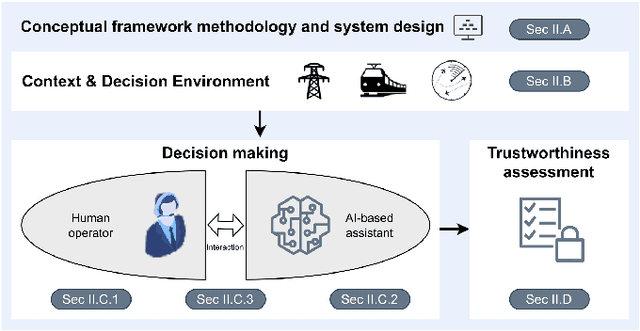
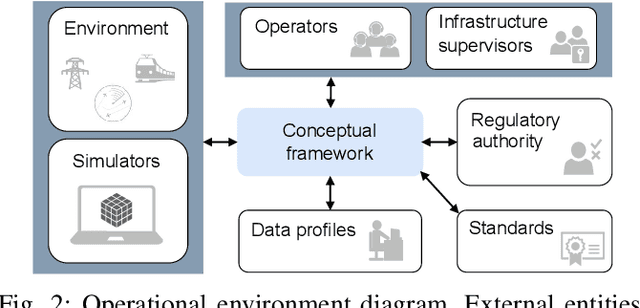
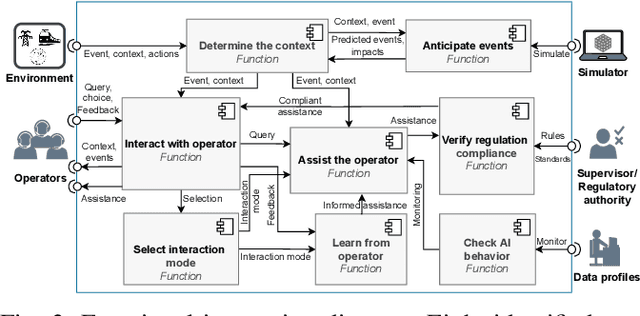
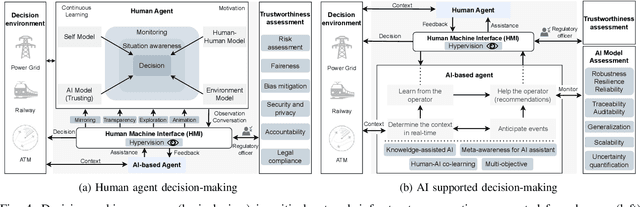
The interaction between humans and AI in safety-critical systems presents a unique set of challenges that remain partially addressed by existing frameworks. These challenges stem from the complex interplay of requirements for transparency, trust, and explainability, coupled with the necessity for robust and safe decision-making. A framework that holistically integrates human and AI capabilities while addressing these concerns is notably required, bridging the critical gaps in designing, deploying, and maintaining safe and effective systems. This paper proposes a holistic conceptual framework for critical infrastructures by adopting an interdisciplinary approach. It integrates traditionally distinct fields such as mathematics, decision theory, computer science, philosophy, psychology, and cognitive engineering and draws on specialized engineering domains, particularly energy, mobility, and aeronautics. The flexibility in its adoption is also demonstrated through its instantiation on an already existing framework.