 Add to Chrome
 Add to Firefox
 Add to Edge
Solution space path planning for supporting en-route air traffic control
Jun 30, 2026
As technology advances, many path-planning algorithms have been proposed for Air Traffic Management, yet their operational adoption in tactical control remains limited, revealing a misalignment between algorithmic design priorities and air traffic controllers' needs. This underscores the need for decision-support solutions that are inherently interpretable, computationally efficient, and explicitly designed for human use. Focusing on this design challenge, this study develops a conflict-free path-planning algorithm for en-route Air Traffic Control (ATC) designed to be compatible with two guiding considerations: (1) the interpretability and flexibility offered by solution-space displays, which motivate constructing an algorithm that exposes all feasible safe actions and accommodates shifting optimization goals; and (2) the decision logic controllers naturally apply when enforcing operational constraints, such as separation standards, maneuverability limits, waypoint minimization, and routing practicality. Centered on these principles, the algorithm integrates three intent-based conflict detection methods -- distance-based, time-interval-based, and zone-based -- within a solution-space framework to identify conflict-free paths in computationally efficient ways. Additionally, vertex-based and edge-based search nodes are proposed for solution space path planning (SSPP), resulting in two variants -- SSPPV and SSPPE, respectively, which are evaluated in terms of computational speed and solution quality. Empirical results show that SSPPV paired with zone-based conflict detection achieves the best performance, computing paths in 3.69 ms on average in operational-relevant scenarios based on the Delta sector of the Maastricht Upper Area Control Centre (MUAC) using a 5 nmi grid.

Optimal any-angle path planning in static and dynamic environments
Jun 30, 2026Any-angle path planning extends traditional graph-based path planning by allowing movement between any pair of vertices, rather than being restricted by predefined edges. It can find straighter and shorter paths in continuous space with graphs, making it particularly suitable for navigation in open areas such as airspaces, warehouses, and oceans. Many any-angle path-planning algorithms have been proposed, but only a few can guarantee optimal solutions, especially in the presence of dynamic obstacles. To address this challenge, this article focuses on optimal any-angle path planning on grids and introduces two general techniques that accelerate computation while preserving optimality in both static and dynamic environments: 1) elliptical forward expansion, which leverages ellipse-based neighborhoods to restrict the search space, and 2) field of view, which replaces traditional line-of-sight methods to speed up visibility checks. To integrate these two techniques, inverted and forward scanning are introduced. Inverted scanning establishes visual connections from open nodes, whereas forward scanning initiates scans from closed nodes. Building on the proposed techniques, Zeta* and Zeta*-SIPP are developed for static and dynamic environments respectively. Zeta*, when combined with forward scanning, is similar to the state-of-the-art algorithm Anya and attains comparable performance. Unlike Anya, Zeta* can be readily extended to other settings, such as dynamic environments (e.g., Zeta*-SIPP). Zeta*-SIPP, with either scanning method, is more than 20 times faster than the corresponding state-of-the-art optimal planner TO-AA-SIPP. Overall, this research identifies the key requirements for achieving optimal any-angle path planning and introduces a unified approach suitable for different environments.
A Conceptual Framework for AI-based Decision Systems in Critical Infrastructures
Apr 21, 2025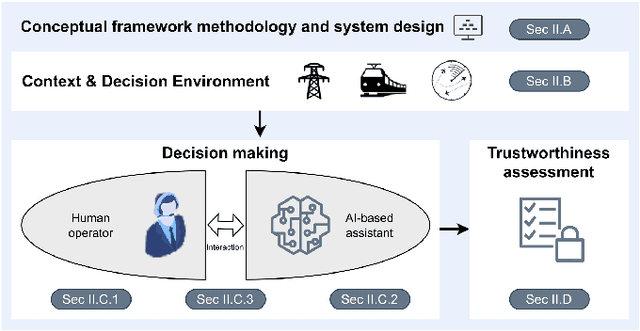
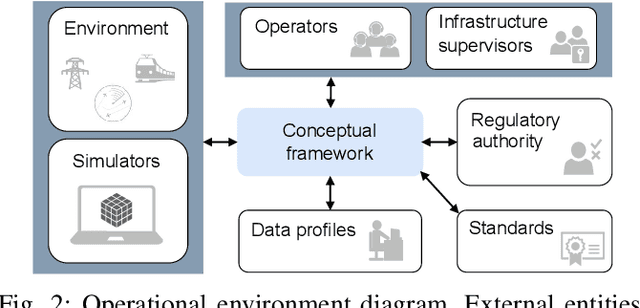
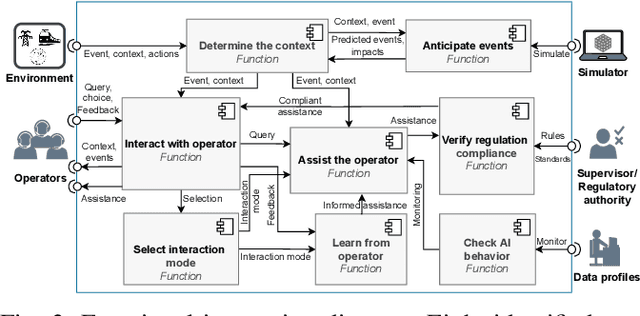
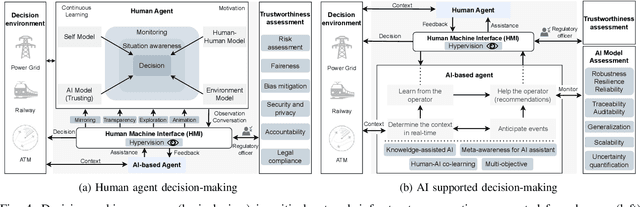
The interaction between humans and AI in safety-critical systems presents a unique set of challenges that remain partially addressed by existing frameworks. These challenges stem from the complex interplay of requirements for transparency, trust, and explainability, coupled with the necessity for robust and safe decision-making. A framework that holistically integrates human and AI capabilities while addressing these concerns is notably required, bridging the critical gaps in designing, deploying, and maintaining safe and effective systems. This paper proposes a holistic conceptual framework for critical infrastructures by adopting an interdisciplinary approach. It integrates traditionally distinct fields such as mathematics, decision theory, computer science, philosophy, psychology, and cognitive engineering and draws on specialized engineering domains, particularly energy, mobility, and aeronautics. The flexibility in its adoption is also demonstrated through its instantiation on an already existing framework.