 Add to Chrome
 Add to Firefox
 Add to Edge
Linear Personality Probing and Steering in LLMs: A Big Five Study
Dec 19, 2025
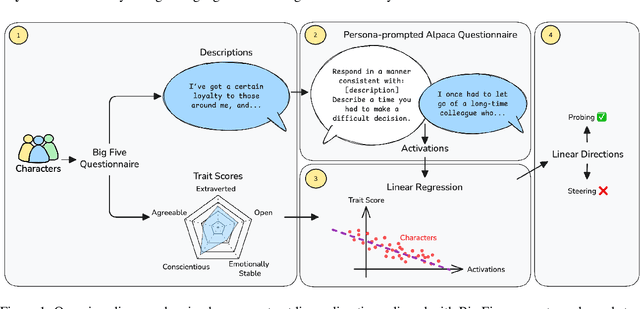
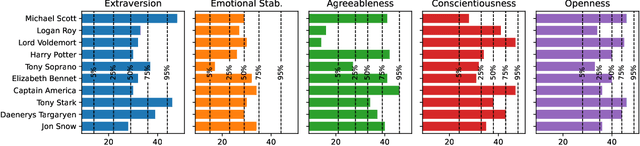
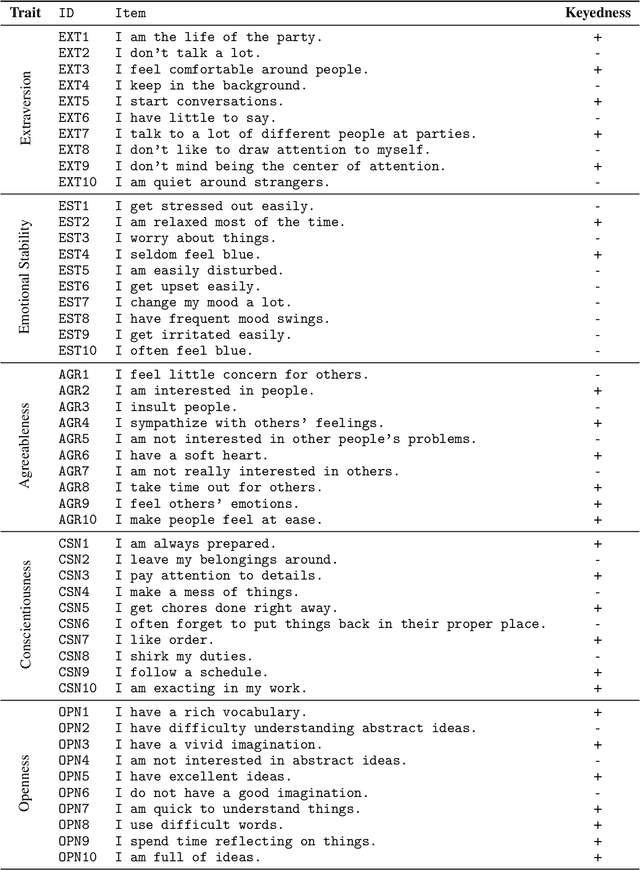
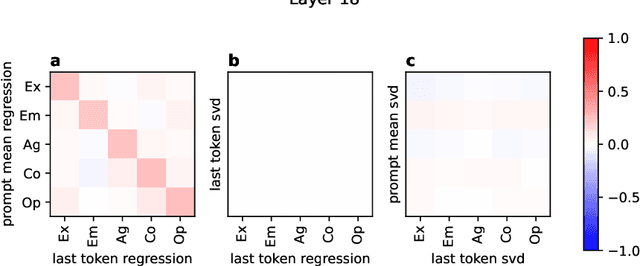
Large language models (LLMs) exhibit distinct and consistent personalities that greatly impact trust and engagement. While this means that personality frameworks would be highly valuable tools to characterize and control LLMs' behavior, current approaches remain either costly (post-training) or brittle (prompt engineering). Probing and steering via linear directions has recently emerged as a cheap and efficient alternative. In this paper, we investigate whether linear directions aligned with the Big Five personality traits can be used for probing and steering model behavior. Using Llama 3.3 70B, we generate descriptions of 406 fictional characters and their Big Five trait scores. We then prompt the model with these descriptions and questions from the Alpaca questionnaire, allowing us to sample hidden activations that vary along personality traits in known, quantifiable ways. Using linear regression, we learn a set of per-layer directions in activation space, and test their effectiveness for probing and steering model behavior. Our results suggest that linear directions aligned with trait-scores are effective probes for personality detection, while their steering capabilities strongly depend on context, producing reliable effects in forced-choice tasks but limited influence in open-ended generation or when additional context is present in the prompt.

Tackling Multimodal Device Distributions in Inverse Photonic Design using Invertible Neural Networks
Aug 29, 2022


Inverse design, the process of matching a device or process parameters to exhibit a desired performance, is applied in many disciplines ranging from material design over chemical processes and to engineering. Machine learning has emerged as a promising approach to overcome current limitations imposed by the dimensionality of the parameter space and multimodal parameter distributions. Most traditional optimization routines assume an invertible one-to-one mapping between the design parameters and the target performance. However, comparable or even identical performance may be realized by different designs, yielding a multimodal distribution of possible solutions to the inverse design problem which confuses the optimization algorithm. Here, we show how a generative modeling approach based on invertible neural networks can provide the full distribution of possible solutions to the inverse design problem and resolve the ambiguity of nanodevice inverse design problems featuring multimodal distributions. We implement a Conditional Invertible Neural Network (cINN) and apply it to a proof-of-principle nanophotonic problem, consisting in tailoring the transmission spectrum of a metallic film milled by subwavelength indentations. We compare our approach with the commonly used conditional Variational Autoencoder (cVAE) framework and show the superior flexibility and accuracy of the proposed cINNs when dealing with multimodal device distributions. Our work shows that invertible neural networks provide a valuable and versatile toolkit for advancing inverse design in nanoscience and nanotechnology.
Enhancing human color vision by breaking binocular redundancy
Jun 11, 2018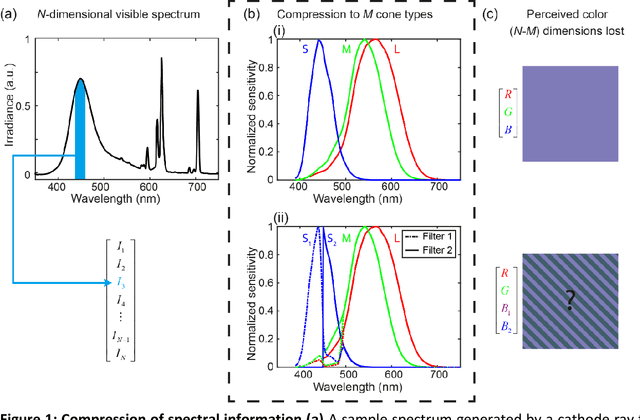
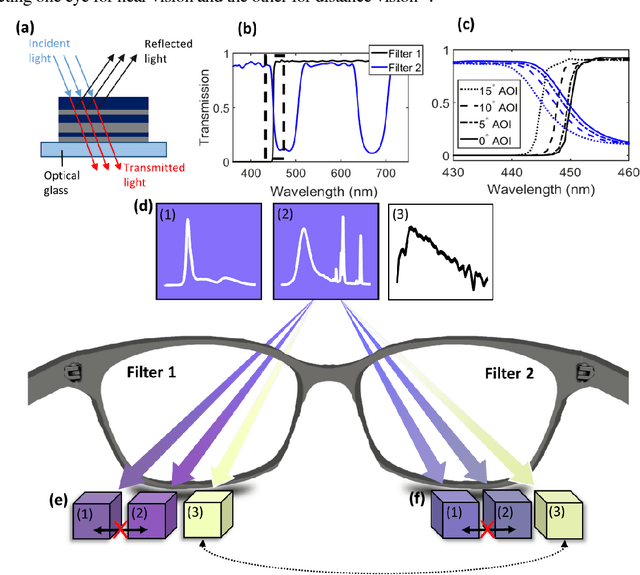
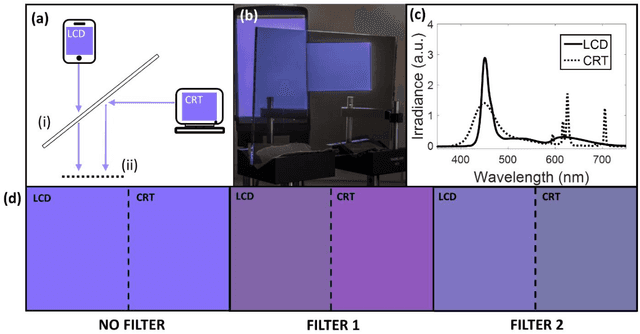
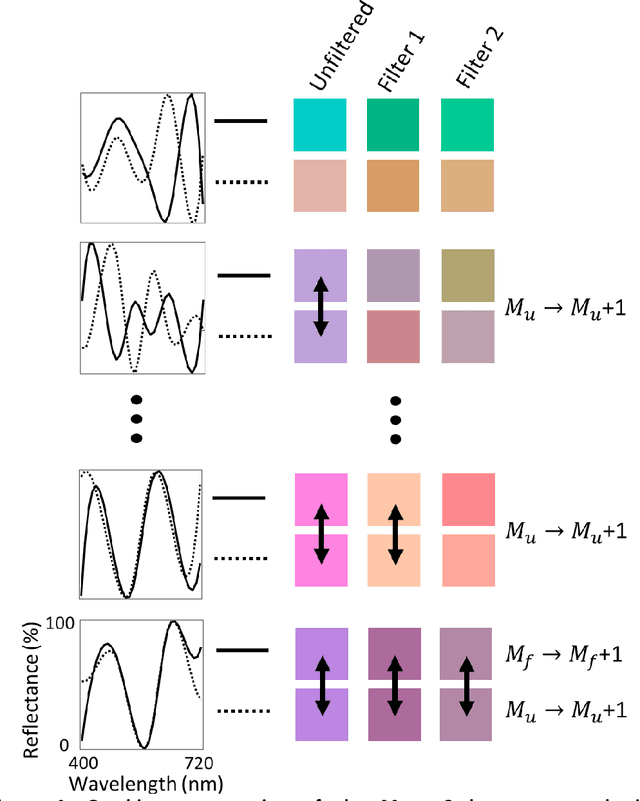
To see color, the human visual system combines the response of three types of cone cells in the retina--a compressive process that discards a significant amount of spectral information. Here, we present an approach to enhance human color vision by breaking its inherent binocular redundancy, providing different spectral content to each eye. We fabricated a set of optical filters that "splits" the response of the short-wavelength cone between the two eyes in individuals with typical trichromatic vision, simulating the presence of approximately four distinct cone types ("tetrachromacy"). Such an increase in the number of effective cone types can reduce the prevalence of metamers--pairs of distinct spectra that resolve to the same tristimulus values. This technique may result in an enhancement of spectral perception, with applications ranging from camouflage detection and anti-counterfeiting to new types of artwork and data visualization.