 Add to Chrome
 Add to Firefox
 Add to Edge
Write Once, Run Everywhere: The Axon DSL for Shape-Safe and Framework-Agnostic LLM Architectures
Aug 20, 2026
The entire ecosystem of open-source language models effectively relies on a single platform. What if this platform was forced to shut down tomorrow? Implementing and maintaining efficient model definitions and translating them between different training and inference regimes is a resource-heavy task that severely limits model efficiency and portability, hindering both scaling and deployment. Here, we present Axon, a strongly typed domain-specific language with Haskell-like syntax, that enables a write-once, run everywhere paradigm for LLM architectures. By basing collaboration on a language specification rather than a specific framework's vision, Axon fosters open cooperation and empowers researchers to implement highly specialized architectures without giving up optimization infrastructure or accepting deployment lock-in. Axon allows for concise, auditable specifications that can be automatically compiled to standalone implementations for leading frameworks: PyTorch, PyTorch with Triton, JAX, MLX and vLLM. In 467 inference benchmarking experiments on models ranging from 135M to 32B parameters, we demonstrate median speedups of 7% on PyTorch, 12% on PyTorch with Triton, 91% on JAX, and 107% on MLX, compared to the reference implementations from Transformers. When deployed as native vLLM architectures with PagedAttention and KV-cache, Axon models achieve a 58% median speedup over Transformers implementations.

A Computational Approach to Language Contact -- A Case Study of Persian
Jan 28, 2026We investigate structural traces of language contact in the intermediate representations of a monolingual language model. Focusing on Persian (Farsi) as a historically contact-rich language, we probe the representations of a Persian-trained model when exposed to languages with varying degrees and types of contact with Persian. Our methodology quantifies the amount of linguistic information encoded in intermediate representations and assesses how this information is distributed across model components for different morphosyntactic features. The results show that universal syntactic information is largely insensitive to historical contact, whereas morphological features such as Case and Gender are strongly shaped by language-specific structure, suggesting that contact effects in monolingual language models are selective and structurally constrained.
Comparative Study of Multilingual Idioms and Similes in Large Language Models
Oct 21, 2024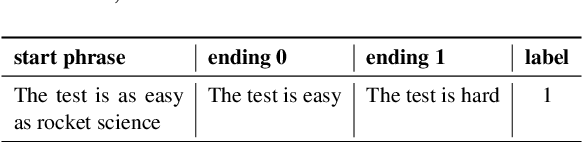
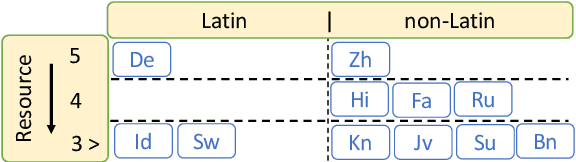
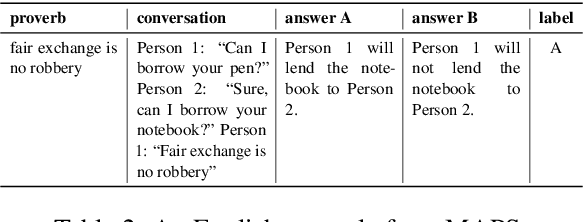
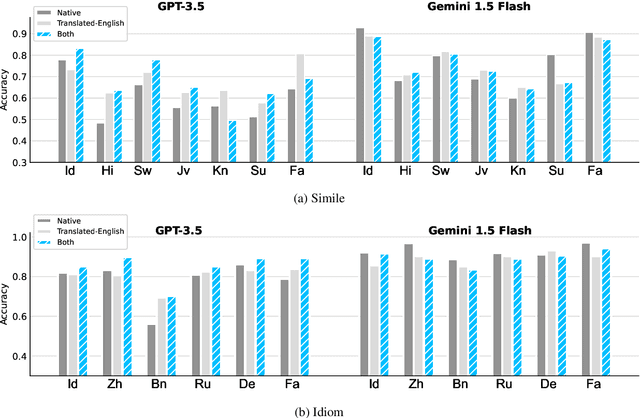
This study addresses the gap in the literature concerning the comparative performance of LLMs in interpreting different types of figurative language across multiple languages. By evaluating LLMs using two multilingual datasets on simile and idiom interpretation, we explore the effectiveness of various prompt engineering strategies, including chain-of-thought, few-shot, and English translation prompts. We extend the language of these datasets to Persian as well by building two new evaluation sets. Our comprehensive assessment involves both closed-source (GPT-3.5, GPT-4o mini, Gemini 1.5), and open-source models (Llama 3.1, Qwen2), highlighting significant differences in performance across languages and figurative types. Our findings reveal that while prompt engineering methods are generally effective, their success varies by figurative type, language, and model. We also observe that open-source models struggle particularly with low-resource languages in similes. Additionally, idiom interpretation is nearing saturation for many languages, necessitating more challenging evaluations.
Benchmarking Large Language Models for Persian: A Preliminary Study Focusing on ChatGPT
Apr 03, 2024
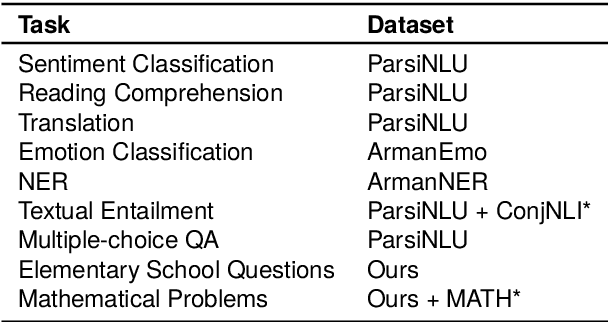
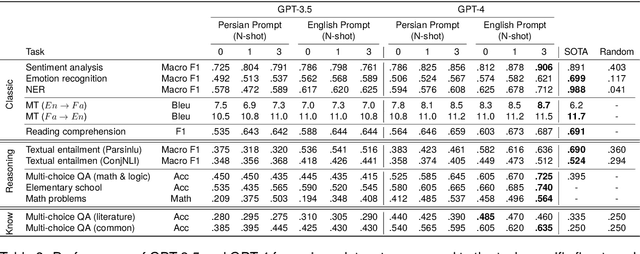
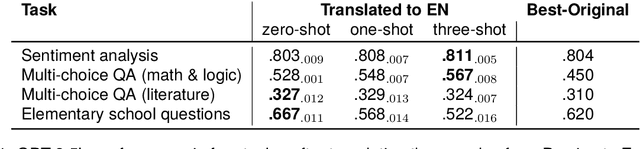
This paper explores the efficacy of large language models (LLMs) for Persian. While ChatGPT and consequent LLMs have shown remarkable performance in English, their efficiency for more low-resource languages remains an open question. We present the first comprehensive benchmarking study of LLMs across diverse Persian language tasks. Our primary focus is on GPT-3.5-turbo, but we also include GPT-4 and OpenChat-3.5 to provide a more holistic evaluation. Our assessment encompasses a diverse set of tasks categorized into classic, reasoning, and knowledge-based domains. To enable a thorough comparison, we evaluate LLMs against existing task-specific fine-tuned models. Given the limited availability of Persian datasets for reasoning tasks, we introduce two new benchmarks: one based on elementary school math questions and another derived from the entrance exams for 7th and 10th grades. Our findings reveal that while LLMs, especially GPT-4, excel in tasks requiring reasoning abilities and a broad understanding of general knowledge, they often lag behind smaller pre-trained models fine-tuned specifically for particular tasks. Additionally, we observe improved performance when test sets are translated to English before inputting them into GPT-3.5. These results highlight the significant potential for enhancing LLM performance in the Persian language. This is particularly noteworthy due to the unique attributes of Persian, including its distinct alphabet and writing styles.