 Add to Chrome
 Add to Firefox
 Add to Edge
Learning Residual Kinematic Corrections for Continuous Neural Decoding via Reinforcement Learning
Jul 13, 2026
Decoding continuous three-dimensional (3D) motor imagery (MI) using non-invasive electroencephalography (EEG)-based brain--computer interfaces (BCIs) remains challenging due to signal variability and residual decoding errors. Deep learning architectures such as convolutional neural network--long short-term memory (CNN--LSTM) models can capture spatial and temporal dynamics for continuous kinematic decoding; however, systematic residual errors persist in predicted trajectories. We propose a two-stage decoding framework that applies reinforcement learning (RL) to perform residual kinematic correction on the outputs of a CNN--LSTM decoder (CNN--LSTM--RL). The RL agent is trained offline without direct EEG input and instead operates on predicted kinematic trajectories to optimize movement accuracy relative to target trajectories. Decoding performance was quantified using Pearson correlation coefficients ($r$) and Root Mean Square Errors (RMSE) along the $x, y$, and $z$ axes. Compared to CNN--LSTM applied alone, CNN--LSTM--RL improved the mean correlation from $0.5076$ to $0.7181$ ($p = 0.0005$) in 2D and from $0.6420$ to $0.7780$ ($p = 0.0059$) in VR, with relative gains of $41.5\%$ and $21.2\%$, respectively. Correspondingly, RMSE was reduced from $0.0890$ to $0.0532$ (2D, $p < 0.0001$) and from $0.0714$ to $0.0441$ (VR, $p < 0.0001$), representing relative reductions of $40.2\%$ and $38.2\%$. These findings demonstrate that this scalable framework enhances 3D BCI MI decoding by correcting kinematic errors via offline residual RL without extra neural data, advancing neurorehabilitation, prosthetics, and virtual interaction.

Performance of data-driven inner speech decoding with same-task EEG-fMRI data fusion and bimodal models
Jun 19, 2023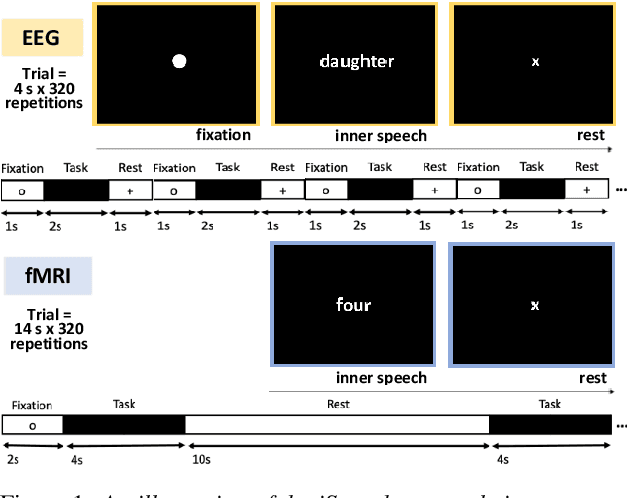
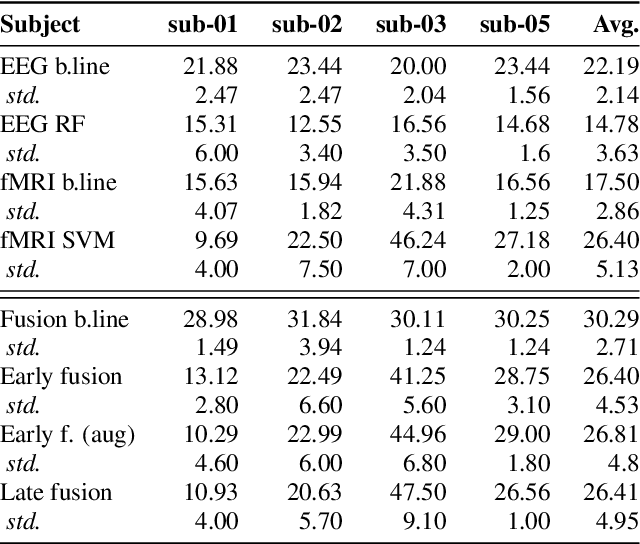
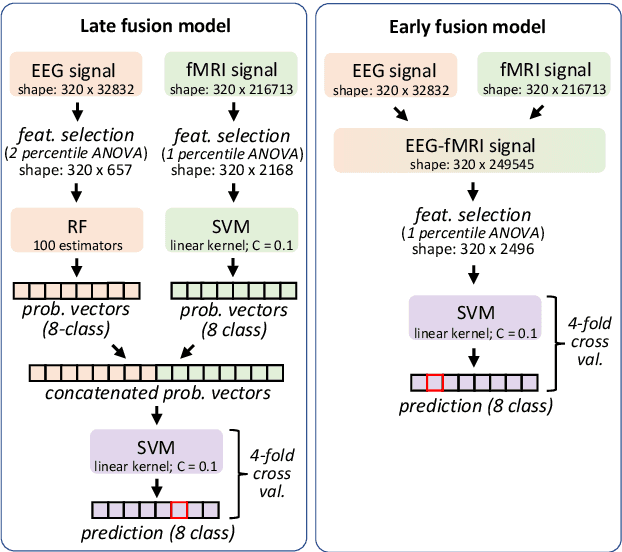
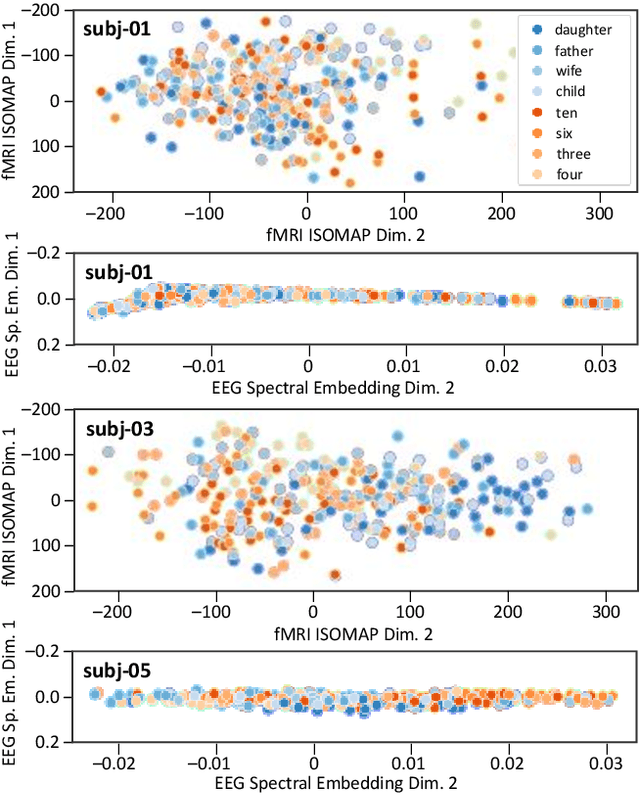
Decoding inner speech from the brain signal via hybridisation of fMRI and EEG data is explored to investigate the performance benefits over unimodal models. Two different bimodal fusion approaches are examined: concatenation of probability vectors output from unimodal fMRI and EEG machine learning models, and data fusion with feature engineering. Same task inner speech data are recorded from four participants, and different processing strategies are compared and contrasted to previously-employed hybridisation methods. Data across participants are discovered to encode different underlying structures, which results in varying decoding performances between subject-dependent fusion models. Decoding performance is demonstrated as improved when pursuing bimodal fMRI-EEG fusion strategies, if the data show underlying structure.