 Add to Chrome
 Add to Firefox
 Add to Edge
Multilingual Cognitive Impairment Detection in the Era of Foundation Models
Apr 08, 2026
We evaluate cognitive impairment (CI) classification from transcripts of speech in English, Slovene, and Korean. We compare zero-shot large language models (LLMs) used as direct classifiers under three input settings -- transcript-only, linguistic-features-only, and combined -- with supervised tabular approaches trained under a leave-one-out protocol. The tabular models operate on engineered linguistic features, transcript embeddings, and early or late fusion of both modalities. Across languages, zero-shot LLMs provide competitive no-training baselines, but supervised tabular models generally perform better, particularly when engineered linguistic features are included and combined with embeddings. Few-shot experiments focusing on embeddings indicate that the value of limited supervision is language-dependent, with some languages benefiting substantially from additional labelled examples while others remain constrained without richer feature representations. Overall, the results suggest that, in small-data CI detection, structured linguistic signals and simple fusion-based classifiers remain strong and reliable signals.

A Computational Analysis of the Dehumanisation of Migrants from Syria and Ukraine in Slovene News Media
Apr 10, 2024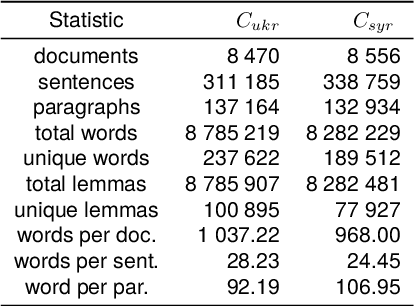

Dehumanisation involves the perception and or treatment of a social group's members as less than human. This phenomenon is rarely addressed with computational linguistic techniques. We adapt a recently proposed approach for English, making it easier to transfer to other languages and to evaluate, introducing a new sentiment resource, the use of zero-shot cross-lingual valence and arousal detection, and a new method for statistical significance testing. We then apply it to study attitudes to migration expressed in Slovene newspapers, to examine changes in the Slovene discourse on migration between the 2015-16 migration crisis following the war in Syria and the 2022-23 period following the war in Ukraine. We find that while this discourse became more negative and more intense over time, it is less dehumanising when specifically addressing Ukrainian migrants compared to others.