 Add to Chrome
 Add to Firefox
 Add to Edge
Few-Shot Domain Adaptation with Temporal References and Static Priors for Glacier Calving Front Delineation
Jan 29, 2026
During benchmarking, the state-of-the-art model for glacier calving front delineation achieves near-human performance. However, when applied in a real-world setting at a novel study site, its delineation accuracy is insufficient for calving front products intended for further scientific analyses. This site represents an out-of-distribution domain for a model trained solely on the benchmark dataset. By employing a few-shot domain adaptation strategy, incorporating spatial static prior knowledge, and including summer reference images in the input time series, the delineation error is reduced from 1131.6 m to 68.7 m without any architectural modifications. These methodological advancements establish a framework for applying deep learning-based calving front segmentation to novel study sites, enabling calving front monitoring on a global scale.

Multi-temporal Calving Front Segmentation
Dec 12, 2025The calving fronts of marine-terminating glaciers undergo constant changes. These changes significantly affect the glacier's mass and dynamics, demanding continuous monitoring. To address this need, deep learning models were developed that can automatically delineate the calving front in Synthetic Aperture Radar imagery. However, these models often struggle to correctly classify areas affected by seasonal conditions such as ice melange or snow-covered surfaces. To address this issue, we propose to process multiple frames from a satellite image time series of the same glacier in parallel and exchange temporal information between the corresponding feature maps to stabilize each prediction. We integrate our approach into the current state-of-the-art architecture Tyrion and accomplish a new state-of-the-art performance on the CaFFe benchmark dataset. In particular, we achieve a Mean Distance Error of 184.4 m and a mean Intersection over Union of 83.6.
SSL4SAR: Self-Supervised Learning for Glacier Calving Front Extraction from SAR Imagery
Jul 02, 2025Glaciers are losing ice mass at unprecedented rates, increasing the need for accurate, year-round monitoring to understand frontal ablation, particularly the factors driving the calving process. Deep learning models can extract calving front positions from Synthetic Aperture Radar imagery to track seasonal ice losses at the calving fronts of marine- and lake-terminating glaciers. The current state-of-the-art model relies on ImageNet-pretrained weights. However, they are suboptimal due to the domain shift between the natural images in ImageNet and the specialized characteristics of remote sensing imagery, in particular for Synthetic Aperture Radar imagery. To address this challenge, we propose two novel self-supervised multimodal pretraining techniques that leverage SSL4SAR, a new unlabeled dataset comprising 9,563 Sentinel-1 and 14 Sentinel-2 images of Arctic glaciers, with one optical image per glacier in the dataset. Additionally, we introduce a novel hybrid model architecture that combines a Swin Transformer encoder with a residual Convolutional Neural Network (CNN) decoder. When pretrained on SSL4SAR, this model achieves a mean distance error of 293 m on the "CAlving Fronts and where to Find thEm" (CaFFe) benchmark dataset, outperforming the prior best model by 67 m. Evaluating an ensemble of the proposed model on a multi-annotator study of the benchmark dataset reveals a mean distance error of 75 m, approaching the human performance of 38 m. This advancement enables precise monitoring of seasonal changes in glacier calving fronts.
Comparison Study: Glacier Calving Front Delineation in Synthetic Aperture Radar Images With Deep Learning
Jan 09, 2025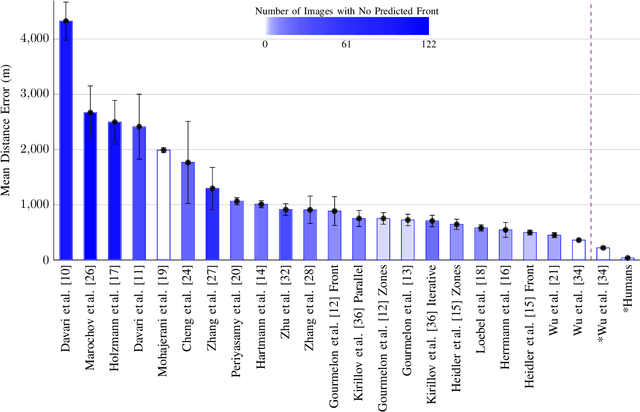
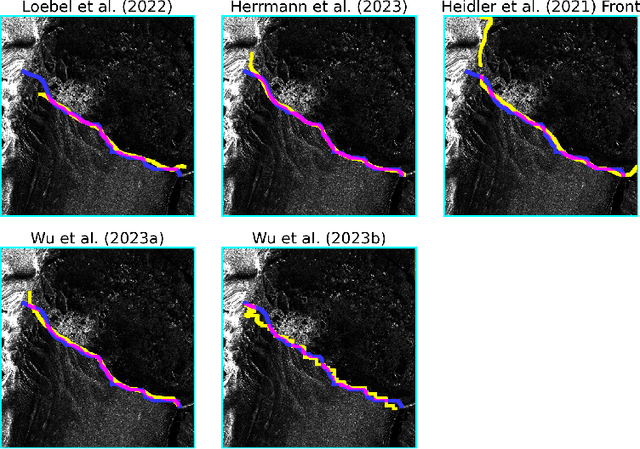
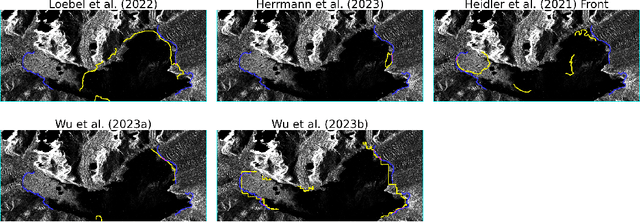
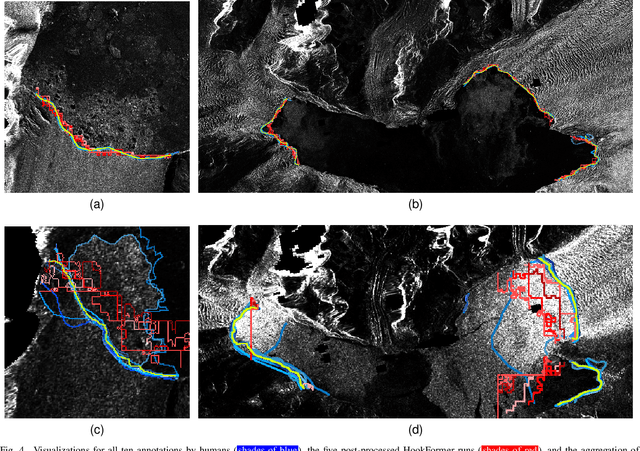
Calving front position variation of marine-terminating glaciers is an indicator of ice mass loss and a crucial parameter in numerical glacier models. Deep Learning (DL) systems can automatically extract this position from Synthetic Aperture Radar (SAR) imagery, enabling continuous, weather- and illumination-independent, large-scale monitoring. This study presents the first comparison of DL systems on a common calving front benchmark dataset. A multi-annotator study with ten annotators is performed to contrast the best-performing DL system against human performance. The best DL model's outputs deviate 221 m on average, while the average deviation of the human annotators is 38 m. This significant difference shows that current DL systems do not yet match human performance and that further research is needed to enable fully automated monitoring of glacier calving fronts. The study of Vision Transformers, foundation models, and the inclusion and processing strategy of more information are identified as avenues for future research.