 Add to Chrome
 Add to Firefox
 Add to Edge
Requirement-Driven Design of Whole-Body Social Tactile Sensing via Virtual Human-Robot Interaction
Jul 13, 2026
Tactile sensing for social-physical human-robot interaction (spHRI) is designed in a hardware-driven manner, where predefined sensor configurations constrain coverage, spatial resolution, and the range of recognizable gestures. We propose a requirement-driven framework that derives sensing requirements, specifically spatial resolution and placement, directly from interaction data. Using a VR-based platform with haptic feedback, we collected high-resolution whole-body contact distributions across multiple social scenarios, from which we identified nine recurring social touch gestures. Eight gestures were selected for controlled data collection with 18 participants, yielding an open-source dataset of 5,520 trials. Analysis of contact distributions and simulated tactile encodings provides quantitative baselines for skin coverage and sensor density on a humanoid robot platform. While demonstrated on a single robot platform, the methodology is designed to be transferable to other robot morphologies, potentially enabling morphology-specific sensing requirements to be derived prior to hardware fabrication.

Social Gesture Recognition in spHRI: Leveraging Fabric-Based Tactile Sensing on Humanoid Robots
Mar 05, 2025Humans are able to convey different messages using only touch. Equipping robots with the ability to understand social touch adds another modality in which humans and robots can communicate. In this paper, we present a social gesture recognition system using a fabric-based, large-scale tactile sensor integrated onto the arms of a humanoid robot. We built a social gesture dataset using multiple participants and extracted temporal features for classification. By collecting real-world data on a humanoid robot, our system provides valuable insights into human-robot social touch, further advancing the development of spHRI systems for more natural and effective communication.
Robustness of Humans and Machines on Object Recognition with Extreme Image Transformations
May 09, 2022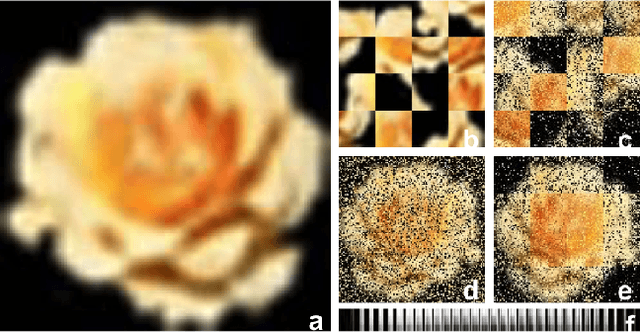
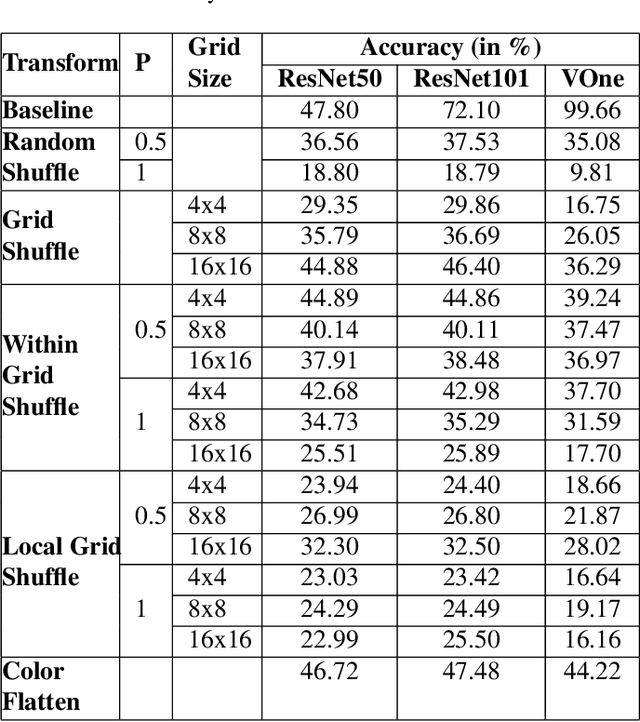
Recent neural network architectures have claimed to explain data from the human visual cortex. Their demonstrated performance is however still limited by the dependence on exploiting low-level features for solving visual tasks. This strategy limits their performance in case of out-of-distribution/adversarial data. Humans, meanwhile learn abstract concepts and are mostly unaffected by even extreme image distortions. Humans and networks employ strikingly different strategies to solve visual tasks. To probe this, we introduce a novel set of image transforms and evaluate humans and networks on an object recognition task. We found performance for a few common networks quickly decreases while humans are able to recognize objects with a high accuracy.