 Add to Chrome
 Add to Firefox
 Add to Edge
CAPID: Context-Aware PII Detection for Question-Answering Systems
Feb 10, 2026
Detecting personally identifiable information (PII) in user queries is critical for ensuring privacy in question-answering systems. Current approaches mainly redact all PII, disregarding the fact that some of them may be contextually relevant to the user's question, resulting in a degradation of response quality. Large language models (LLMs) might be able to help determine which PII are relevant, but due to their closed source nature and lack of privacy guarantees, they are unsuitable for sensitive data processing. To achieve privacy-preserving PII detection, we propose CAPID, a practical approach that fine-tunes a locally owned small language model (SLM) that filters sensitive information before it is passed to LLMs for QA. However, existing datasets do not capture the context-dependent relevance of PII needed to train such a model effectively. To fill this gap, we propose a synthetic data generation pipeline that leverages LLMs to produce a diverse, domain-rich dataset spanning multiple PII types and relevance levels. Using this dataset, we fine-tune an SLM to detect PII spans, classify their types, and estimate contextual relevance. Our experiments show that relevance-aware PII detection with a fine-tuned SLM substantially outperforms existing baselines in span, relevance and type accuracy while preserving significantly higher downstream utility under anonymization.

Adaptive Latent-Space Constraints in Personalized FL
May 12, 2025Federated learning (FL) has become an effective and widely used approach to training deep learning models on decentralized datasets held by distinct clients. FL also strengthens both security and privacy protections for training data. Common challenges associated with statistical heterogeneity between distributed datasets have spurred significant interest in personalized FL (pFL) methods, where models combine aspects of global learning with local modeling specific to each client's unique characteristics. In this work, the efficacy of theoretically supported, adaptive MMD measures within the Ditto framework, a state-of-the-art technique in pFL, are investigated. The use of such measures significantly improves model performance across a variety of tasks, especially those with pronounced feature heterogeneity. While the Ditto algorithm is specifically considered, such measures are directly applicable to a number of other pFL settings, and the results motivate the use of constraints tailored to the various kinds of heterogeneity expected in FL systems.
FENDA-FL: Personalized Federated Learning on Heterogeneous Clinical Datasets
Sep 28, 2023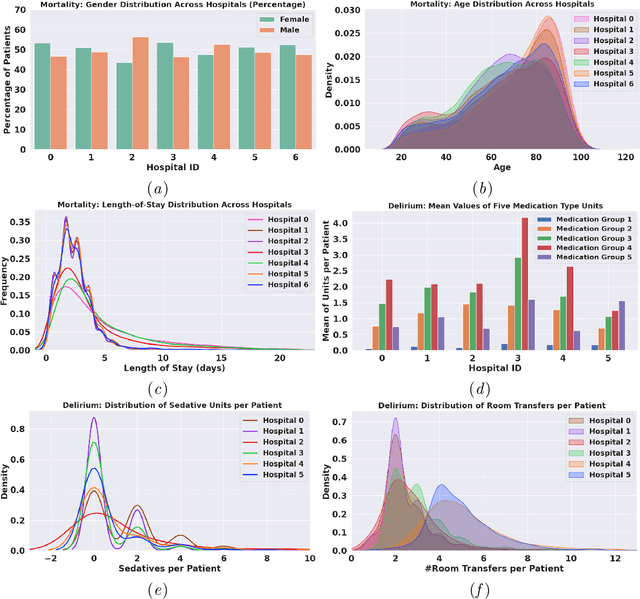
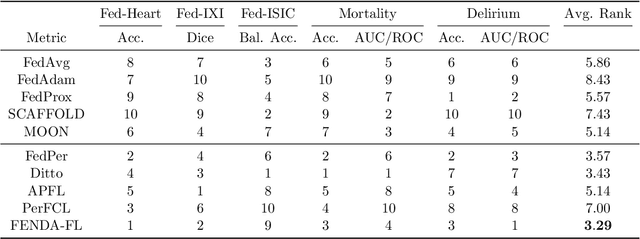
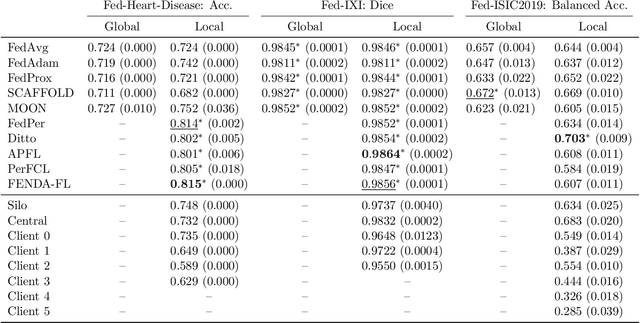
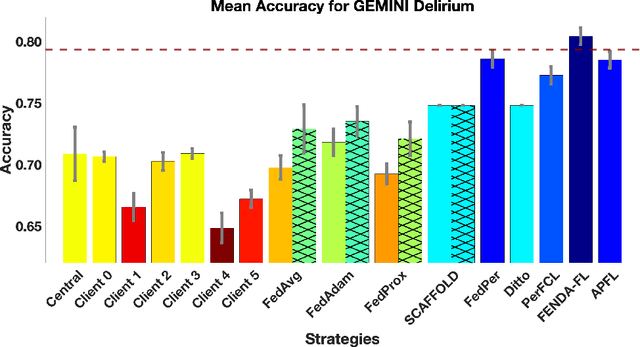
Federated learning (FL) is increasingly being recognized as a key approach to overcoming the data silos that so frequently obstruct the training and deployment of machine-learning models in clinical settings. This work contributes to a growing body of FL research specifically focused on clinical applications along three important directions. First, an extension of the FENDA method (Kim et al., 2016) to the FL setting is proposed. Experiments conducted on the FLamby benchmarks (du Terrail et al., 2022a) and GEMINI datasets (Verma et al., 2017) show that the approach is robust to heterogeneous clinical data and often outperforms existing global and personalized FL techniques. Further, the experimental results represent substantive improvements over the original FLamby benchmarks and expand such benchmarks to include evaluation of personalized FL methods. Finally, we advocate for a comprehensive checkpointing and evaluation framework for FL to better reflect practical settings and provide multiple baselines for comparison.