 Add to Chrome
 Add to Firefox
 Add to Edge
Token Sample Complexity of Attention
Dec 11, 2025
As context windows in large language models continue to expand, it is essential to characterize how attention behaves at extreme sequence lengths. We introduce token-sample complexity: the rate at which attention computed on $n$ tokens converges to its infinite-token limit. We estimate finite-$n$ convergence bounds at two levels: pointwise uniform convergence of the attention map, and convergence of moments for the transformed token distribution. For compactly supported (and more generally sub-Gaussian) distributions, our first result shows that the attention map converges uniformly on a ball of radius $R$ at rate $C(R)/\sqrt{n}$, where $C(R)$ grows exponentially with $R$. For large $R$, this estimate loses practical value, and our second result addresses this issue by establishing convergence rates for the moments of the transformed distribution (the token output of the attention layer). In this case, the rate is $C'(R)/n^β$ with $β<\tfrac{1}{2}$, and $C'(R)$ depends polynomially on the size of the support of the distribution. The exponent $β$ depends on the attention geometry and the spectral properties of the tokens distribution. We also examine the regime in which the attention parameter tends to infinity and the softmax approaches a hardmax, and in this setting, we establish a logarithmic rate of convergence. Experiments on synthetic Gaussian data and real BERT models on Wikipedia text confirm our predictions.

A mathematical perspective on Transformers
Dec 22, 2023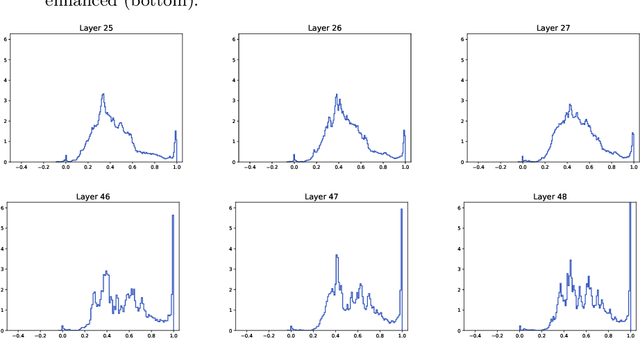

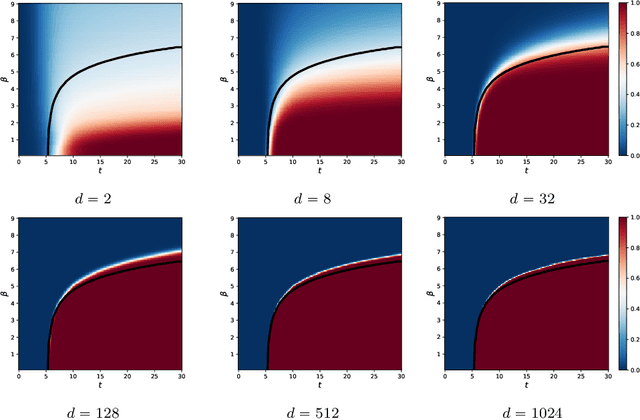
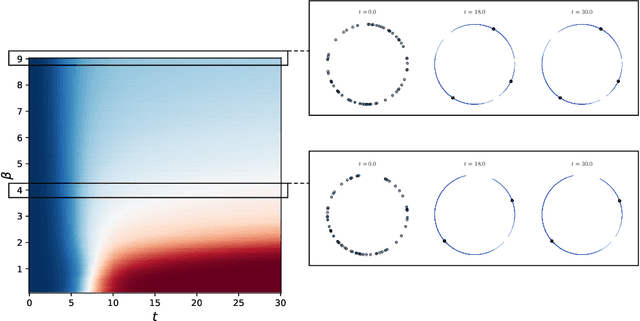
Transformers play a central role in the inner workings of large language models. We develop a mathematical framework for analyzing Transformers based on their interpretation as interacting particle systems, which reveals that clusters emerge in long time. Our study explores the underlying theory and offers new perspectives for mathematicians as well as computer scientists.
The emergence of clusters in self-attention dynamics
May 17, 2023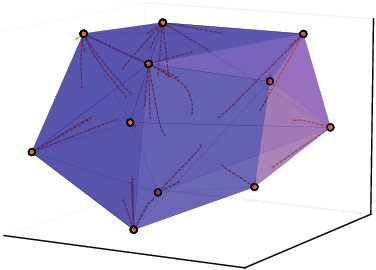

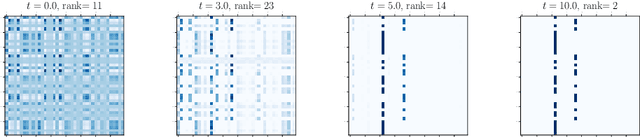
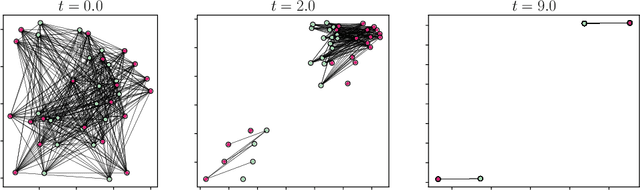
Viewing Transformers as interacting particle systems, we describe the geometry of learned representations when the weights are not time dependent. We show that particles, representing tokens, tend to cluster toward particular limiting objects as time tends to infinity. Cluster locations are determined by the initial tokens, confirming context-awareness of representations learned by Transformers. Using techniques from dynamical systems and partial differential equations, we show that the type of limiting object that emerges depends on the spectrum of the value matrix. Additionally, in the one-dimensional case we prove that the self-attention matrix converges to a low-rank Boolean matrix. The combination of these results mathematically confirms the empirical observation made by Vaswani et al. [VSP'17] that leaders appear in a sequence of tokens when processed by Transformers.