 Add to Chrome
 Add to Firefox
 Add to Edge
SafeImpute: Reliable Clinical Data Imputation via Conformal Selection
Jul 06, 2026
Clinical care often relies on key laboratory indicators, yet real-world patient visits are sparse and tests are ordered irregularly, leading to pervasive missingness. While many imputation methods improve average accuracy, they provide limited guidance on which imputed values are reliable enough for high-stakes downstream use. In this work, we study reliable clinical imputation, aiming to produce accurate imputations while selectively releasing the reliable results, with statistical control over clinically unacceptable errors. To achieve this goal, we propose SafeImpute, a reliable imputation framework for irregular and sparse clinical longitudinal records. SafeImpute constructs an event graph that captures both intra-patient temporal trajectories and inter-patient clinical similarity, and learns imputations with a two-relation GNN and adaptive fusion, regularized by an auxiliary masked reconstruction objective. For reliability guarantees, SafeImpute converts a proxy risk score into conformal p-values and applies the Benjamini--Hochberg procedure to control the false discovery rate (FDR) of unacceptable errors among released imputations at a user-specified tolerance. Experiments on our Mayo Clinic data, the public MIMIC-III and MIMIC-IV datasets show that SafeImpute achieves strong imputation accuracy while providing reliable error control, outperforming diverse baselines in both standard imputation evaluation and FDR-controlled selective-release evaluation.

LLM-Forest for Health Tabular Data Imputation
Oct 28, 2024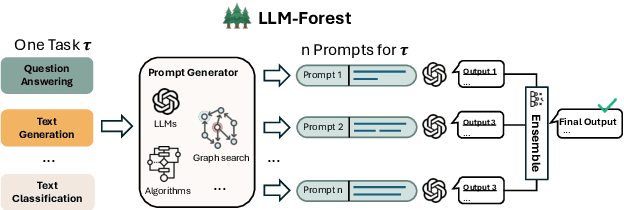
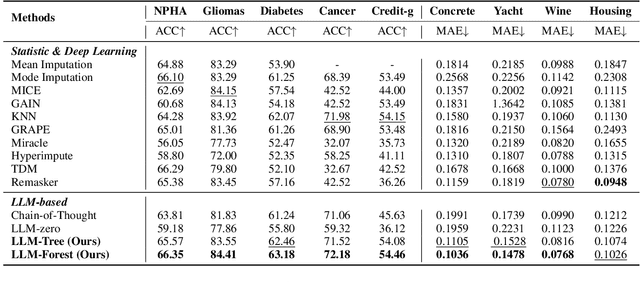
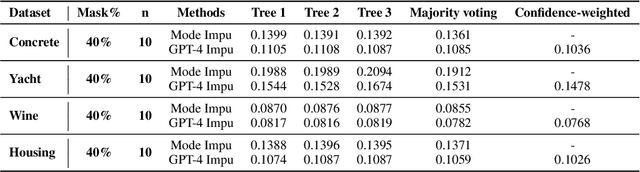
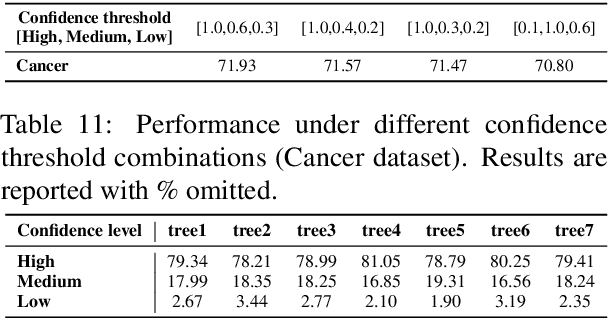
Missing data imputation is a critical challenge in tabular datasets, especially in healthcare, where data completeness is vital for accurate analysis. Large language models (LLMs), trained on vast corpora, have shown strong potential in data generation, making them a promising tool for tabular data imputation. However, challenges persist in designing effective prompts for a finetuning-free process and in mitigating the risk of LLM hallucinations. To address these issues, we propose a novel framework, LLM-Forest, which introduces a "forest" of few-shot learning LLM "trees" with confidence-based weighted voting. This framework is established on a new concept of bipartite information graphs to identify high-quality relevant neighboring entries with both feature and value granularity. Extensive experiments on four real-world healthcare datasets demonstrate the effectiveness and efficiency of LLM-Forest.
Multi-facet Contextual Bandits: A Neural Network Perspective
Jun 13, 2021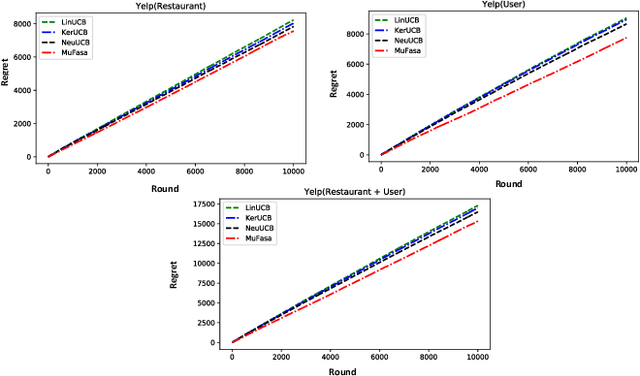
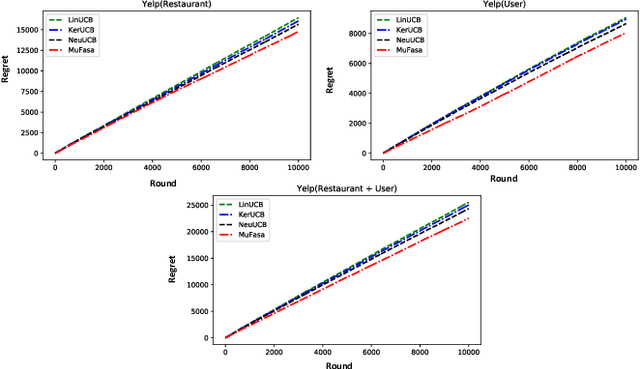
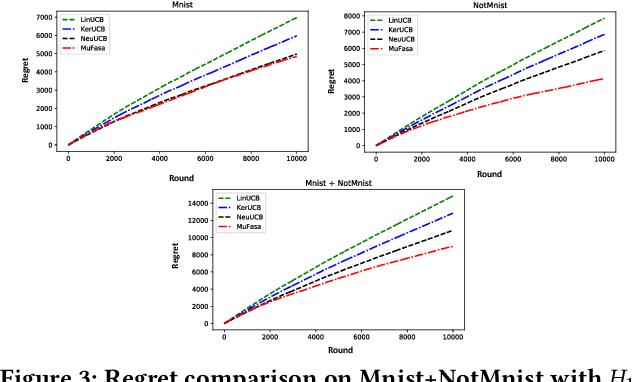
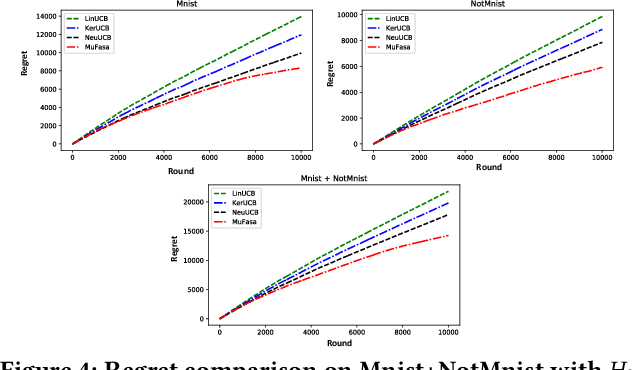
Contextual multi-armed bandit has shown to be an effective tool in recommender systems. In this paper, we study a novel problem of multi-facet bandits involving a group of bandits, each characterizing the users' needs from one unique aspect. In each round, for the given user, we need to select one arm from each bandit, such that the combination of all arms maximizes the final reward. This problem can find immediate applications in E-commerce, healthcare, etc. To address this problem, we propose a novel algorithm, named MuFasa, which utilizes an assembled neural network to jointly learn the underlying reward functions of multiple bandits. It estimates an Upper Confidence Bound (UCB) linked with the expected reward to balance between exploitation and exploration. Under mild assumptions, we provide the regret analysis of MuFasa. It can achieve the near-optimal $\widetilde{ \mathcal{O}}((K+1)\sqrt{T})$ regret bound where $K$ is the number of bandits and $T$ is the number of played rounds. Furthermore, we conduct extensive experiments to show that MuFasa outperforms strong baselines on real-world data sets.