 Add to Chrome
 Add to Firefox
 Add to Edge
APPD: Adaptive and Precise Pupil Boundary Detection using Entropy of Contour Gradients
Aug 09, 2018
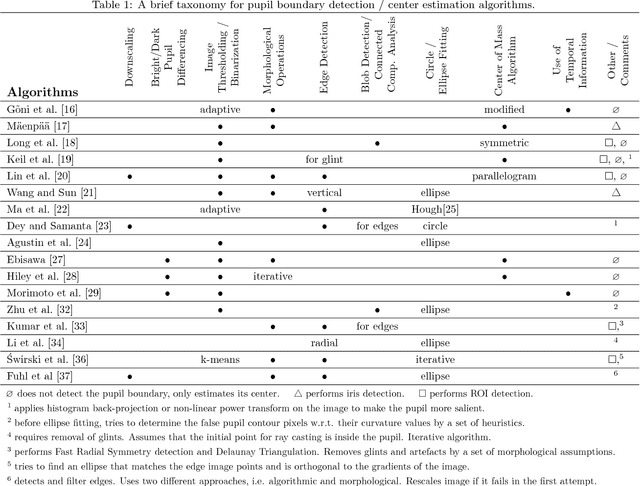
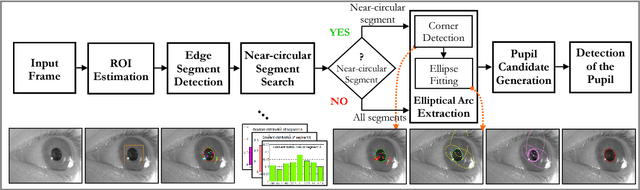
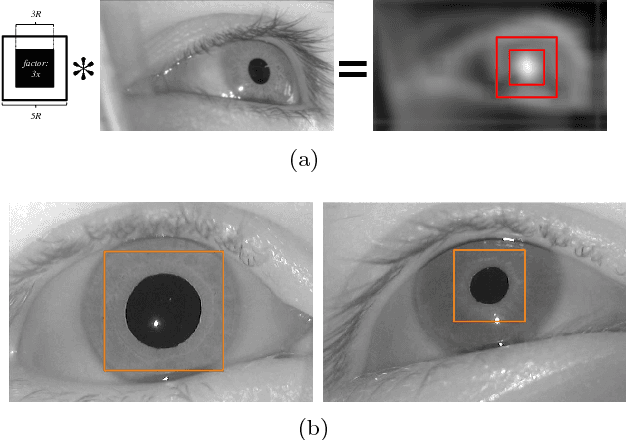
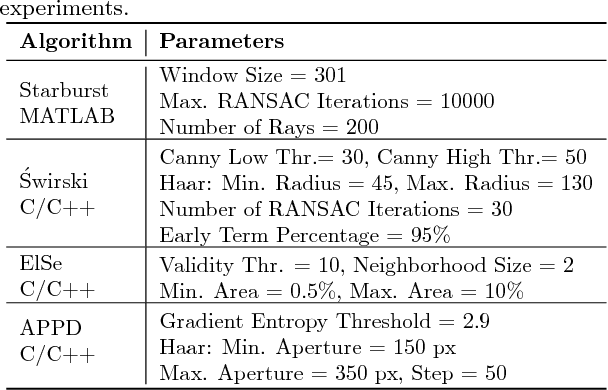
Eye tracking spreads through a vast area of applications from ophthalmology, assistive technologies to gaming and virtual reality. Precisely detecting the pupil's contour and center is the very first step in many of these tasks, hence needs to be performed accurately. Although detection of pupil is a simple problem when it is entirely visible; occlusions and oblique view angles complicate the solution. In this study, we propose APPD, an adaptive and precise pupil boundary detection method that is able to infer whether entire pupil is in clearly visible by a heuristic that estimates the shape of a contour in a computationally efficient way. Thus, a faster detection is performed with the assumption of no occlusions. If the heuristic fails, a more comprehensive search among extracted image features is executed to maintain accuracy. Furthermore, the algorithm can find out if there is no pupil as an helpful information for many applications. We provide a dataset containing 3904 high resolution eye images collected from 12 subjects and perform an extensive set of experiments to obtain quantitative results in terms of accuracy, localization and timing. The proposed method outperforms three other state of the art algorithms and has an average execution time $\sim$5 ms in single-thread on a standard laptop computer for 720p images.

STag: A Stable Fiducial Marker System
Jul 19, 2017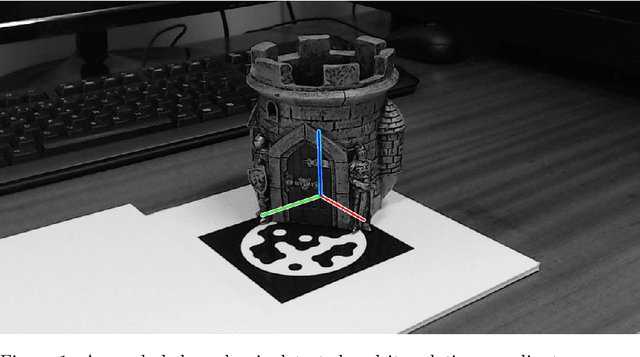

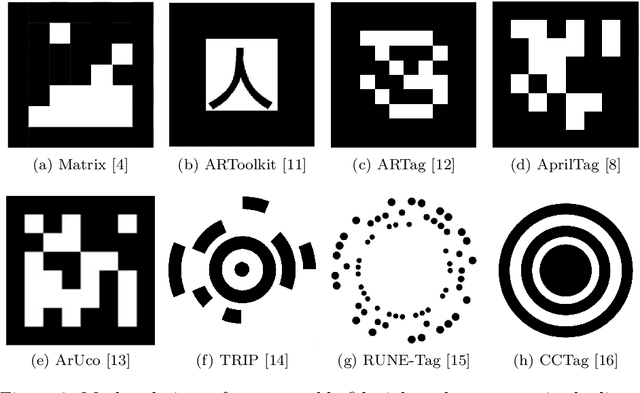
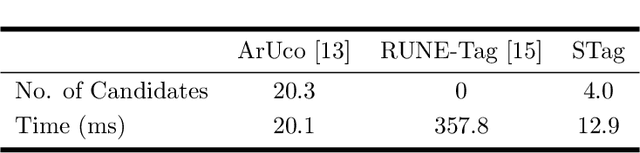
In this paper, we propose STag, a fiducial marker system that provides stable pose estimation. The outer square border of the marker is used for detection and pose estimation. This is followed by a novel pose refinement step using the inner circular border. The refined pose is more stable and robust across viewing conditions compared to the state of the art. In addition, the lexicographic generation algorithm is adapted for fiducial markers, and libraries with various sizes are created. This makes the system suitable for applications that require many unique markers, or few unique markers with high occlusion resistance. The edge segment-based detection algorithm is of low complexity, and returns few false candidates. These features are demonstrated with experiments on real images, including comparisons with the state of the art fiducial marker systems.