 Add to Chrome
 Add to Firefox
 Add to Edge
Debate to Align: Reliable Entity Alignment through Two-Stage Multi-Agent Debate
Apr 15, 2026
Entity alignment (EA) aims to identify entities referring to the same real-world object across different knowledge graphs (KGs). Recent approaches based on large language models (LLMs) typically obtain entity embeddings through knowledge representation learning and use embedding similarity to identify an alignment-uncertain entity set. For each uncertain entity, a candidate entity set (CES) is then retrieved based on embedding similarity to support subsequent alignment reasoning and decision making. However, the reliability of the CES and the reasoning capability of LLMs critically affect the effectiveness of subsequent alignment decisions. To address this issue, we propose AgentEA, a reliable EA framework based on multi-agent debate. AgentEA first improves embedding quality through entity representation preference optimization, and then introduces a two-stage multi-role debate mechanism consisting of lightweight debate verification and deep debate alignment to progressively enhance the reliability of alignment decisions while enabling more efficient debate-based reasoning. Extensive experiments on public benchmarks under cross-lingual, sparse, large-scale, and heterogeneous settings demonstrate the effectiveness of AgentEA.

Unifying Dual-Space Embedding for Entity Alignment via Contrastive Learning
Dec 06, 2024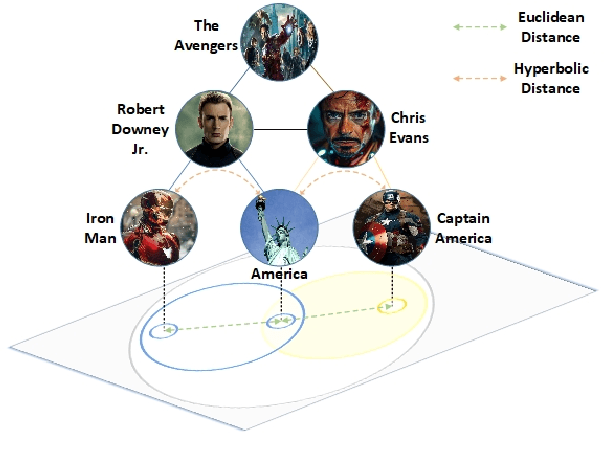
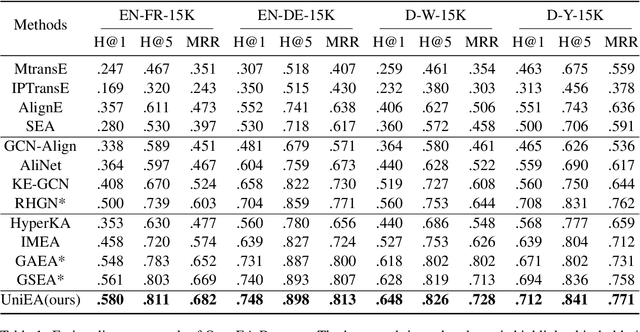
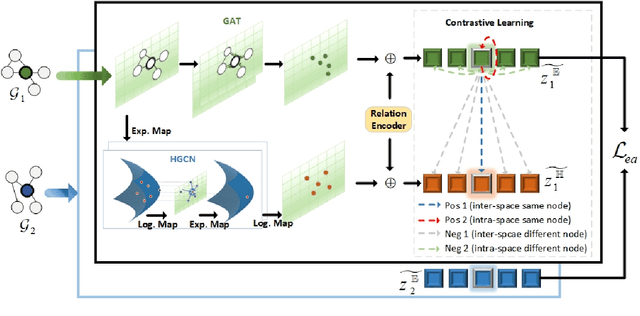
Entity alignment aims to match identical entities across different knowledge graphs (KGs). Graph neural network-based entity alignment methods have achieved promising results in Euclidean space. However, KGs often contain complex structures, including both local and hierarchical ones, which make it challenging to efficiently represent them within a single space. In this paper, we proposed a novel method UniEA, which unifies dual-space embedding to preserve the intrinsic structure of KGs. Specifically, we learn graph structure embedding in both Euclidean and hyperbolic spaces simultaneously to maximize the consistency between the embedding in both spaces. Moreover, we employ contrastive learning to mitigate the misalignment issues caused by similar entities, where embedding of similar neighboring entities within the KG become too close in distance. Extensive experiments on benchmark datasets demonstrate that our method achieves state-of-the-art performance in structure-based EA. Our code is available at https://github.com/wonderCS1213/UniEA.